222082232005


The Dreaming

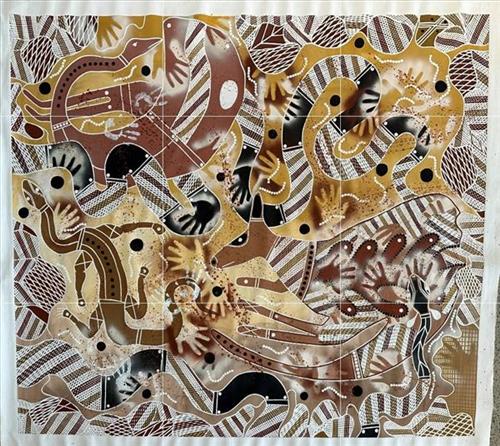
The meaning and the purpose of this painting and why it came to be, it represents me, who I am as an Aboriginal man. My bloodlines, my song lines, my ceremonies, my culture but it also represents the times of creation. The snake represents my creator spirit Biami, the rainbow serpent. The kangaroo represents Marloo the giant kangaroo. The goanna represents Barryibala the sand goanna and Bigarrumudja the emu man. The crosshatching you see or the raak patterns represents my Connection with Country and my song lines. The diamond patterns represent the Men’s business and our lore. The handprints you see are the ancestral spirits that walk the lands and guard sacred sites. The colours come from country ochre. Yellow for medicine and women also Mother Earth. Ochre red for Men’s ceremony and Men’s business and black and white for sacredness. The grubs you see are whitchety grubs and bardi grubs; the black circles are the spots you collect them from with a long stick to pull them out symbolic for our bush tucker and living off the land this is the dreaming, my country, my culture, my identity. It is me. Every single pattern and line that you see on the painting has purpose and meaning. South-East coast region, we are linear design peoples and that is the traditional way of telling story within Yorta Yorta.
115682232621


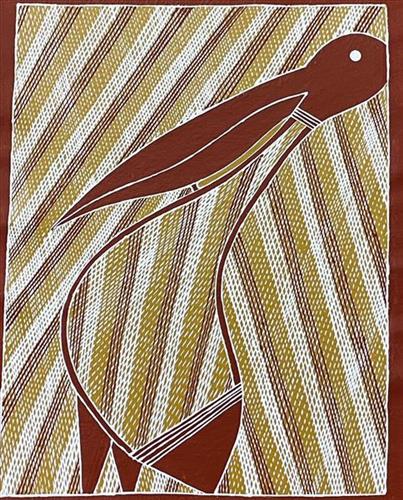
JB Fisher – Pelican (Warbalulu)

JB paints stories from his Dhuwa homeland in northeast Arnhem Land. Stories are passed on either paternally or maternally, and JB would have learnt these stories from his ancestors. The cross-hatching style is a traditional painting style of this area and can represent elements such as water, air and wind.

His paintings often feature totemic animals of the fresh waters of north east Arnhem Land.

115682232619


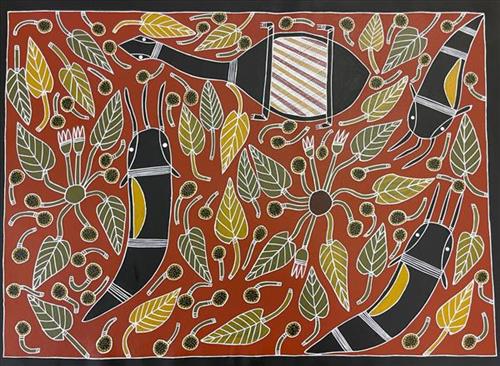
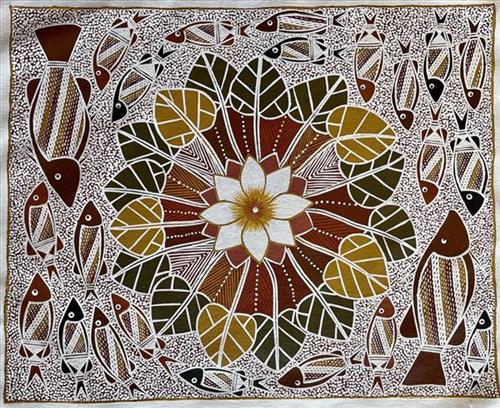
Raypiny Dhawu (Fresh Water Story)

All Aboriginal people originate from a spiritual source, fixed in a particular place in their land or the sea. These ‘spiritual reservoirs’ are often in the form of special waterholes made by Wangarr (creative spirits) that were created long ago close to the beginning of time. These creator beings moved across the countryside, shaping the land and implanting in each tract of country, the spiritual life force for the people who were to own it. These creative spirits took many forms and when they gave the land to each group, they also gave songs, dances, ceremony, the associated laws and language.


The creation story for Ganalbingu people took place near the middle section of the Glyde River where it becomes the Goyder River. Their land, Ngaliyindi, sits astride the Arafura Swamp in Central Arnhem Land. Many Ganalbingu artists paint totemic species significant to their clan. These can include baru (crocodile), banda (long necked turtle), buliya (catfish), yalman (waterlilies), gumang (magpie geese), dakawa (fresh water yabby), ratjuk (barramundi), warrnyu (flying fox) and more.


115682232618


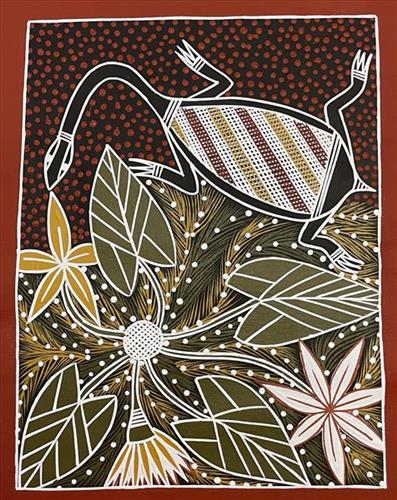
Raypiny Dhawu (Fresh Water Story)

All Aboriginal people originate from a spiritual source, fixed in a particular place in their land or the sea. These ‘spiritual reservoirs’ are often in the form of special waterholes made by Wangarr (creative spirits) that were created long ago close to the beginning of time. These creator beings moved across the countryside, shaping the land and implanting in each tract of country, the spiritual life force for the people who were to own it. These creative spirits took many forms and when they gave the land to each group, they also gave songs, dances, ceremony, the associated laws and language.


The creation story for Ganalbingu people took place near the middle section of the Glyde River where it becomes the Goyder River. Their land, Ngaliyindi, sits astride the Arafura Swamp in Central Arnhem Land. Many Ganalbingu artists paint totemic species significant to their clan. These can include baru (crocodile), banda (long necked turtle), buliya (catfish), yalman (waterlilies), gumang (magpie geese), dakawa (fresh water yabby), ratjuk (barramundi), warrnyu (flying fox) and more.


1882233405


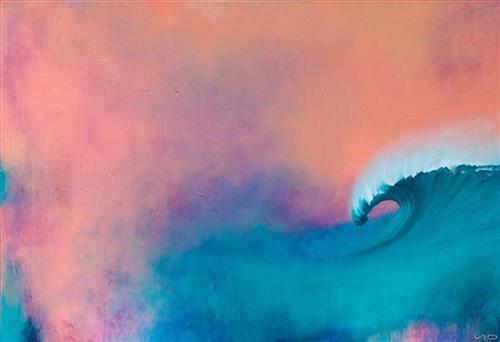
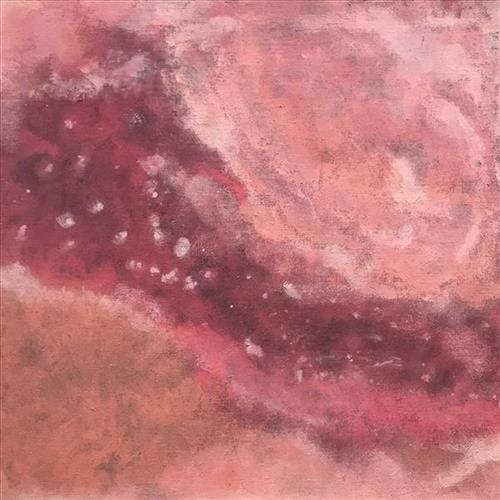
Ocean Dreaming

In the beginning, the Great Spirit of the Sea created the vast and endless ocean, a place of beauty and mystery. She painted the waters with her brush of foam and painted the sky with her brush of clouds. The waves became her canvas, and she used them to tell the stories of the Dreamtime.

The Dreamtime stories tell of the creation of the world and the adventures of the spirit beings. They are stories of magic and wonder, of love and loss, of joy and sorrow. And in my emotive abstract ocean painting, I have tried to capture the essence of these stories.

The swirling forms and vibrant colors are the spirits of the sea, dancing and singing on the waves. The brushstrokes are the trails they leave behind as they journey through the Dreamtime. And the emotions that the painting evokes are the feelings that the Great Spirit of the Sea wants to share with us, to remind us of the magic and mystery of the ocean, and of the Dreamtime stories that are told upon its waves. 

222082233314


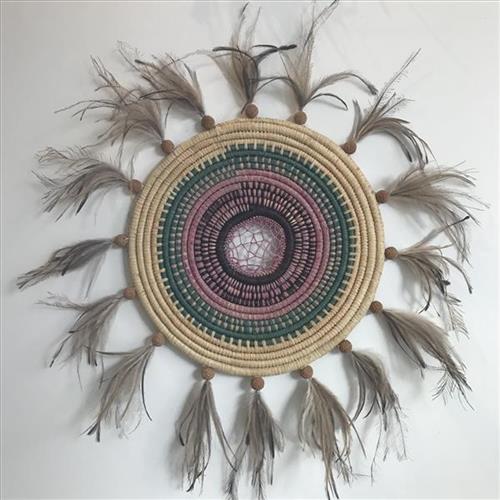
Dancing around the campfire

This weaving of natural and hand dyed raffia and ornaments of quandong seeds and emu feathers reminds me of graceful dancers moving around a campfire, providing enteratinment at your ‘fingertips’, how nature provides.

115682233403


Raypiny Dhawu (Fresh Water Story)

All Aboriginal people originate from a spiritual source, fixed in a particular place in their land or the sea. These ‘spiritual reservoirs’ are often in the form of special waterholes made by Wangarr (creative spirits) that were created long ago close to the beginning of time. These creator beings moved across the countryside, shaping the land and implanting in each tract of country, the spiritual life force for the people who were to own it. These creative spirits took many forms and when they gave the land to each group, they also gave songs, dances, ceremony, the associated laws and language.


The creation story for Ganalbingu people took place near the middle section of the Glyde River where it becomes the Goyder River. Their land, Ngaliyindi, sits astride the Arafura Swamp in Central Arnhem Land. Many Ganalbingu artists paint totemic species significant to their clan. These can include baru (crocodile), banda (long necked turtle), buliya (catfish), yalman (waterlilies), gumang (magpie geese), dakawa (fresh water yabby), ratjuk (barramundi), warrnyu (flying fox) and more.


115682233340


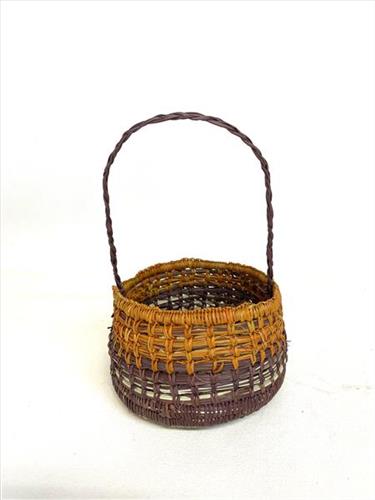
Bathi (Pandanus Basket)

Bathi are woven from the split leaves of the Screw Palm (Pandanus Spiralis). Coil weaving was introduced to Arnhem Land in the 1930s. It was adapted from techniques used by Indigenous women throughout South East Australia.

115682233336


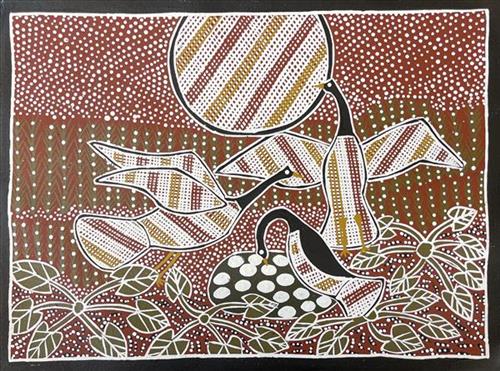
Gumang (Magpie Geese)

The Yolngu people of Arnhem Land originate from a spiritual source, fixed in a particular place in their land or the sea. These ‘Spiritual Reservoirs’ are often in the form of special waterholes made by Wangarr (Creative Beings) long ago close to the beginning of time.

The creator beings moved across the country side, shaping the land and implanting in each tract of country, the spiritual life force for the people who were to own it. These Creative Spirits took many forms. When they gave the land to each group they also gave songs, dances, ceremony, the associated laws and language. The Creation story for Ganalbingu people took place near the middle section of the Glyde River where it becomes the Goyder River. Their land, Ngaliyindi, sits astride the Arafura Swamp in Central Arnhem Land.

In this painting, the artist has depicted Gumang (magpie geese), which are sacred to the Ganalbingu people. To the east of the Arafura Swamp is a freshwater billabong which is said to have been made by the Goose Spirit and is in the shape of a goose nest. As a result, geese, their eggs and their nests are sacred.