115682236742


Banumbirr- Morning Star Ceremony (Dhuwa Moiety)

Banumbirr – Morning Star Ceremony (Dhuwa moiety)

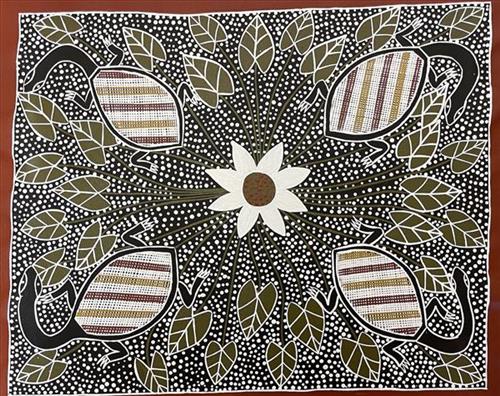
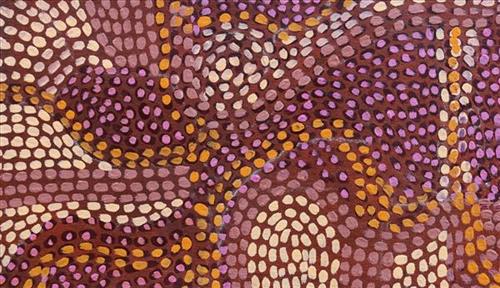
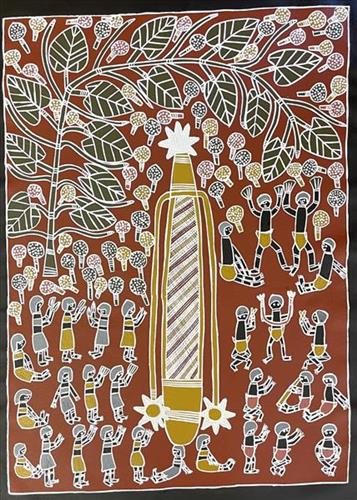
The Morning Star Ceremony is from the Dhuwa moiety. I have painted the ceremony here. It’s got leaves from the banyan tree (ficus virnens) that makes figs for people to eat – they are part of our bush tucker.


The Morning Star is from my great grandfather, my grandfather and my father. I paint it for my family to show my sisters and brothers. My grandfather and my father have both passed away, so I teach the bunggul (dancing) to my children.

We make a little Morning Star (you can see a man holding that on the right side of the painting), so the big Morning Star can came out. It is a long ceremonial pole that we dance around. You can also see the little Morning Star in this painting. There are men with yidaki (didjeridoo) and bilma (clap sticks) singing the Morning Star song cycle part for my people. The women have banyan tree leaves that they are dancing with.

We make a big Morning Star pole as part of the ceremony. You can see that in the middle of this painting.

Banumbirr – Morning Star – is an exchange ceremony with other clans in the Bapurru (clan group).

The Morning Star is the first star you see in the sky in the mornings.
115682236712


Baru Dhawu (Crocodile Story)

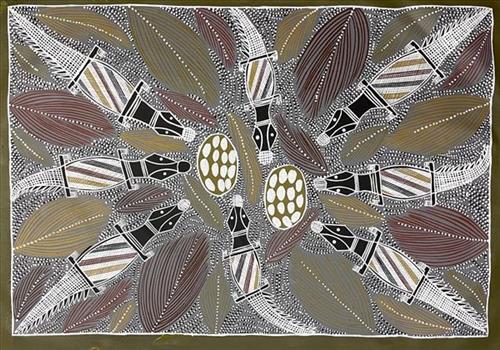
Baru (the crocodile man), was from the Gumatj clan. People usually call him Gurdu Gurdu or Baru which means crocodile. He lived his life at a place called Yirrkala. Living near him were other people, and when Baru didn’t have enough to eat he began to kill and eat these other people. After a while others noticed that some people were missing. When Baru went to the toilet, the people could smell this strong smell, so they knew that he ate the other people. Some men went to get help and they took message sticks to the other tribes. Some were sending smoke signals. When they came to Baru’s camp they started to spear him in the left side of his ribs. He dropped into the fire and burnt his left hand and maybe his right hand. He then ran into the bush and yelled to his countrymen – the animals, birds and fish that live on the land and in the sea. He stopped and he named the tribes and clans and also the places until he came to a place called Gamarru/Guyurru. There he took a rest and said to himself “This is where I stop and call this place Gamarru/Guyurru”. Baru, still in pain from the fire, then jumped into the water and turned himself into a crocodile. The fire left scars on his back. Baru paintings belong to Gumatj and Warrawarra and also the Marpi clan. This painting is used at death ceremonies or initiations and it normally is painted on the belly, which means the person the design is painted on is part of Gurdu Gurdu (the crocodile people).

115682236711


Gumang (Magpie Geese)

The Yolngu people of Arnhem Land originate from a spiritual source, fixed in a particular place in their land or the sea. These ‘Spiritual Reservoirs’ are often in the form of special waterholes made by Wangarr (Creative Beings) long ago close to the beginning of time.

The creator beings moved across the country side, shaping the land and implanting in each tract of country, the spiritual life force for the people who were to own it. These Creative Spirits took many forms. When they gave the land to each group they also gave songs, dances, ceremony, the associated laws and language. The Creation story for Ganalbingu people took place near the middle section of the Glyde River where it becomes the Goyder River. Their land, Ngaliyindi, sits astride the Arafura Swamp in Central Arnhem Land.

In this painting, the artist has depicted Gumang (magpie geese), which are sacred to the Ganalbingu people. To the east of the Arafura Swamp is a freshwater billabong which is said to have been made by the Goose Spirit and is in the shape of a goose nest. As a result, geese, their eggs and their nests are sacred.

115682236710


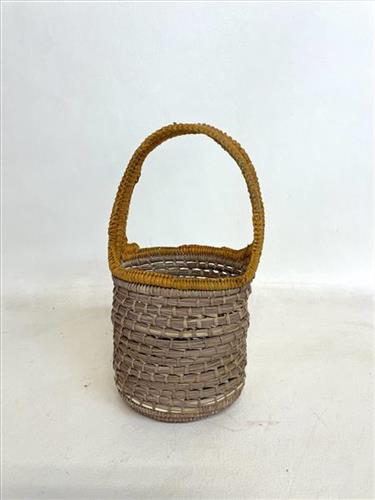
Bathi (Pandanus Basket)

Bathi are woven from the split leaves of the Screw Palm (Pandanus Spiralis). Coil weaving was introduced to Arnhem Land in the 1930s. It was adapted from techniques used by Indigenous women throughout South East Australia.

115682236709


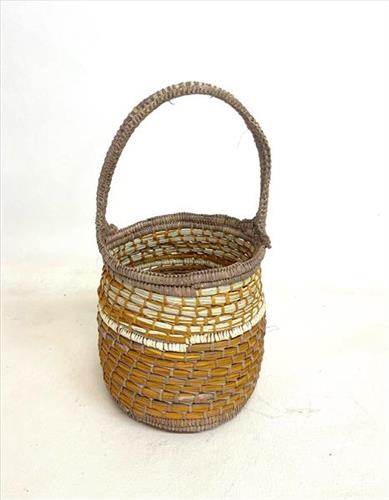
Bathi (Pandanus Basket)

Bathi are woven from the split leaves of the Screw Palm (Pandanus Spiralis). Coil weaving was introduced to Arnhem Land in the 1930s. It was adapted from techniques used by Indigenous women throughout South East Australia.

111582236807


Papuly

“I was told this story by my two aunties, Nora Wompi (dec) and Nora Nungabar (dec) and my father Friday Finaly (dec) when we were driving from Punmu to Kunawarritji. They told me this later when I was a nurse in Punmu.”

– Kennedy Finlay

Papuly is a soak located just north of Kunawarritji Aboriginal community. This site lies within Wompi’s ngurra (home Country, camp), the area which she knew intimately and travelled extensively with her family in her youth. 

In her account of Papuly, Wompi describes an incident from the Jukurrpa (Dreaming), when the ancestral eagle ate kangaroo at the site. The term Jukurrpa is often translated in English as the ‘Dreaming’, or ‘Dreamtime’. It refers generally to the period in which the world was created by ancestral beings, who assumed both human and nonhuman forms. These beings shaped what had been a formless landscape; creating waters, plants, animals, and people. At the same time they provided cultural protocols for the people they created, as well as rules for interacting with the natural environment. At their journey’s end, the ancestral beings transformed themselves into important waters, hills, rocks, and even constellations. 

During the pujiman (traditional, desert dwelling) period, Martu would traverse very large distances annually in small family groups, moving seasonally from water source to water source, and hunting and gathering bush tucker as they went. At this time knowledge of water sources was critical for survival, and today Martu Country is still defined in terms of the location and type of water. Each of the hundreds of claypans, rockholes, waterholes, soaks and springs found in the Martu desert homelands is known by name, location, quality and seasonal availability through real life experience and the recounting of Jukurrpa narratives.

116482236873


The Ochre Colours

In our land, when you come to our country, you will see lots of colours in the rocks, especially in the morning or towards evening.This painting shows these colours – ochres, reds, yellows and black.

116482236866


Colours of the Pilbara Rocks

The Rock formation is made of many different colours. When the big flood comes, all the rocks and pebbles take shape and the beauty of colours in the country take their place. The colours that we use for Trible Ceremony are white, yellow, red and black and most of these colours are used from the rocks. The different size and shape rocks are made into bricks.

116482236849


Running River (Ngurin)

This Painting is of the Ngurin (Harding River) when it is running in the wet season. The running water fills up several pools created for swimming. The three main pools are Jubilee Pool, Government Pool and Round pool.

116482236842


Salt Flats

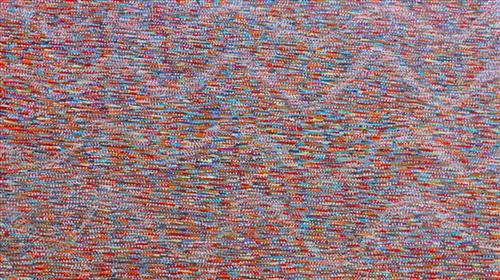
There are many Salt flats in the Pilbara.This painting depicts the water flowing underneath with the salt forming on top in ripples to show the movement of the ocean.