377810582237299


Kunwardde dja Kunronj (Rocks and Billabong)

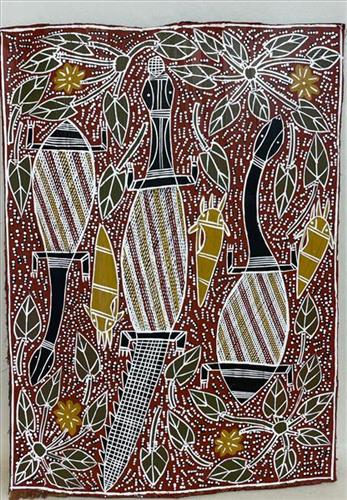
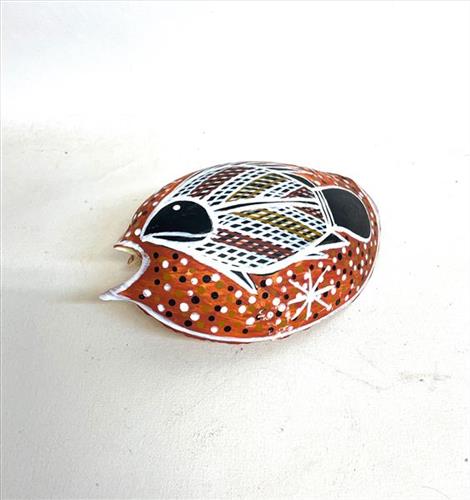
Abigail has depicted the waterholes or Kunwardde dja Kunronj (Sacred Rocks and Billabong) that lie on the plains near Mankorlod, the country for which she is a traditional owner.

The waterholes remain wet throughout the year, even during dry season. This site is connected to the artist’s djang (dreaming), the ngalng (freshwater yabbie) and stone country. Mankorlod homeland is a three-hour drive from Maningrida in the kunwardde (stone country).

115682237252


Raypiny Dhawu (Fresh Water Story)

All Aboriginal people originate from a spiritual source, fixed in a particular place in their land or the sea. These ‘spiritual reservoirs’ are often in the form of special waterholes made by Wangarr (creative spirits) that were created long ago close to the beginning of time. These creator beings moved across the countryside, shaping the land and implanting in each tract of country, the spiritual life force for the people who were to own it. These creative spirits took many forms and when they gave the land to each group, they also gave songs, dances, ceremony, the associated laws and language.


The creation story for Ganalbingu people took place near the middle section of the Glyde River where it becomes the Goyder River. Their land, Ngaliyindi, sits astride the Arafura Swamp in Central Arnhem Land. Many Ganalbingu artists paint totemic species significant to their clan. These can include baru (crocodile), banda (long necked turtle), buliya (catfish), yalman (waterlilies), gumang (magpie geese), dakawa (fresh water yabby), ratjuk (barramundi), warrnyu (flying fox) and more.

 

377810582237142


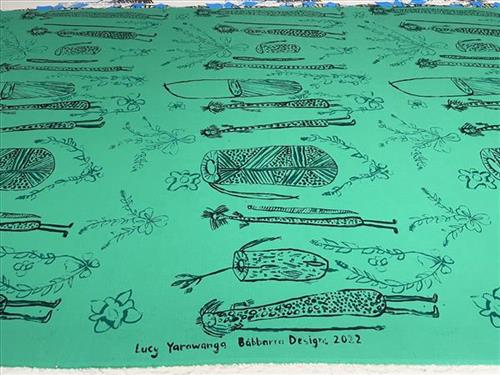
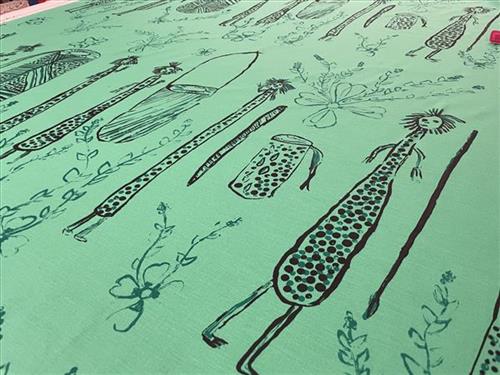
Bawaliba & Bush Flower

‘Starting back in the caves, before humans, in that place, my country Djinkarr, spirits lived. When Bawaliba (stone country spirit) were hungry, they picked up their dilly bags and went walking to collect food. They found fresh bush flowers and dug them up to plant back home and ate the fruit growing beneath them. On their way home, the Bawaliba came across a big rainbow serpent. Some Bawaliba ran back to the cave, the rest of them tried to fight the serpent with spears and distract it with their loud clap sticks and singing, but the rainbow serpent won and ate them.

When we go there to my country, we see the Bawaliba peeping at us every time. They are so cheeky and trick us. Sometimes I tell them ‘Hey leave us alone! We’re busy working on our country!’. They are good spirits they don’t make trouble.’ – Lucy Yarawanga 2023

115682237081


Raypiny Dhawu (Fresh Water Story)

All Aboriginal people originate from a spiritual source, fixed in a particular place in their land or the sea. These ‘spiritual reservoirs’ are often in the form of special waterholes made by Wangarr (creative spirits) that were created long ago close to the beginning of time. These creator beings moved across the countryside, shaping the land and implanting in each tract of country, the spiritual life force for the people who were to own it. These creative spirits took many forms and when they gave the land to each group, they also gave songs, dances, ceremony, the associated laws and language.


The creation story for Ganalbingu people took place near the middle section of the Glyde River where it becomes the Goyder River. Their land, Ngaliyindi, sits astride the Arafura Swamp in Central Arnhem Land. Many Ganalbingu artists paint totemic species significant to their clan. These can include baru (crocodile), banda (long necked turtle), buliya (catfish), yalman (waterlilies), gumang (magpie geese), dakawa (fresh water yabby), ratjuk (barramundi), warrnyu (flying fox) and more.
 

115682237059


Nawarlah (Brown River Stingray)

Aboriginal art in Ramingining, Central Arnhem Land is commonly illustrated through designs and images of animals, plants, and landscape. These motifs commonly reflect the artists ancestral inheritance and their dreamings and are referred to as totems.

For this, Serena has woven a stingray.

115682237038


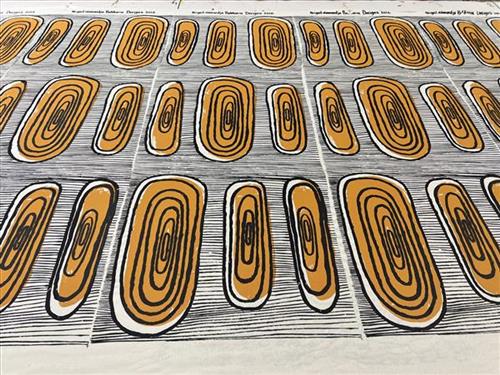
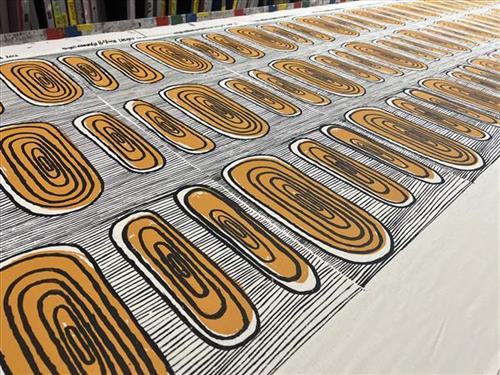
Dupun (Hollow log)

Dupuns (hollow log coffins) were traditionally used by Yolngu people as a type of coffin. They are made from tree trunks which have been hollowed out by termites and painted by clan members of the deceased depicting totemic motifs and clan patterns relevant to the person. Many years ago, Yolngu people would move about the land seasonally, travelling to where the food was available. When a member of the clan passed, their body was ritually painted with relevant clan totemic designs and placed in a tree to decompose. When the clan travelled back through the same area the following year, the bones of the deceased would be placed in the dupun and taken to the deceased persons country where a hollow log ceremony would commence. It is Yolngu’s belief that in practising this hollow log ceremony it allows the spirit of the deceased to embark on the final journey of their existence and on to the dreamtime.

115682237030


Woven Mat

Traditionally, Nganiyal (conical mats) were used as an insect screen when erected, and as a sitting mat when folded. They are used in Ceremony as well as a functional item. 

Nowadays, artists weave many different shapes including flat, round and oblong. 

377810582237305


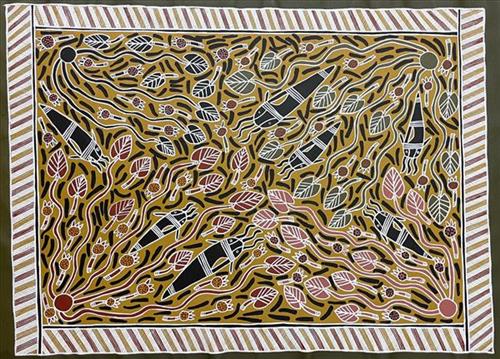
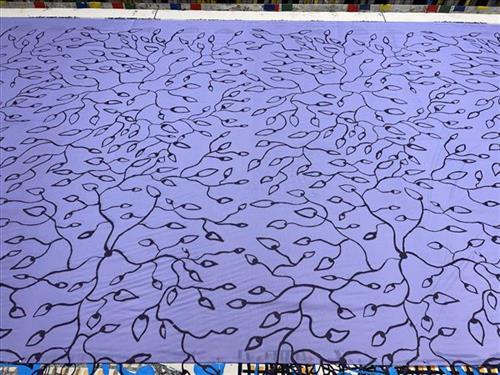
Mankotbe (Bush Onion)

Mankotbe (bush onion) grows under the ground, we follow the vine to dig it up. It is brown on the outside and white inside and we cook it on the fire, just like a potato. All the old people used to eat Mankotbe on my homeland. My grandmother showed me how to find that plant and the first time I ate so much my mouth got sore! You can’t be too greedy.

This design brings back good memories for me. I used to eat Mankotbe when I was young and living at my homeland Buluhkaduru. In those old times, my house was made of paper bark and sticks. If we wanted to come into town we had to walk, and it’s a long walk, so we would fill our dilly bags with sugar bag honey, Mankotbe and long yams to eat on the way. They were good times for me.

You can find Mankotbe any time of the year- the plant has big black leaves. When you find one onion, you know there is big mob around- they are always connected by a big long vine underground