114782235068
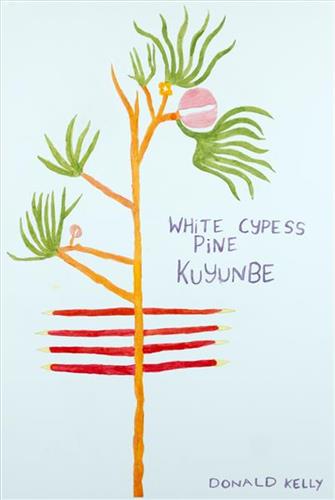
White Cypress Pine (Kuyunbe)
Kuyunbe, Kuyunba refers to the site South of Alice Springs, for young initiated men.
The image refers to the pine tree found in this location.
114782242232
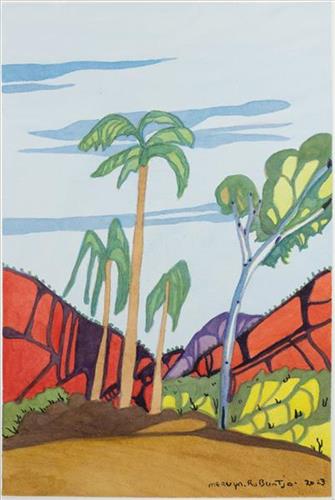
Alyape (Palm Valley), NT

377810582257560
Dakarra (cockle)
Dakarra is the Burrara Gun-nartpa word for a type of cockle shell with prominant scaled ribs and an orange colour. This is part of a diet of shellfish which has been enjoyed by people whose country lies on the saltwater estuaries at the opening of rivers throughout Arnhem Land.
Elizabeth Wullunmingu’s mother country is Djunawunya, near Gupunga on the Bligh river. This is saltwater country. Her design Dakarra represents a songline for this particular type of edible shellfish and the fishing lifestyle that is enjoyed by her people.
Elizabeth’s grandfather Frank Gurrmanamana was seen in the documentary ‘Waiting For harry’ 1978 by Ronin films which is filmed on Elizabeth’s mother country, Djunawunya. In this documentary, the late Frank Gurrmanamana is preparing the final mortuary ceremonies for his brother who died six years before. Central to the ceremonies is Harry Diama, the senior blood-relative of the deceased man, but Harry lives in Maningrida and is pre-occupied with a pending court-case there involving his son.
https://www.sbs.com.au/topics/video/1068702275809/Waiting-For-Harry

377810582257491
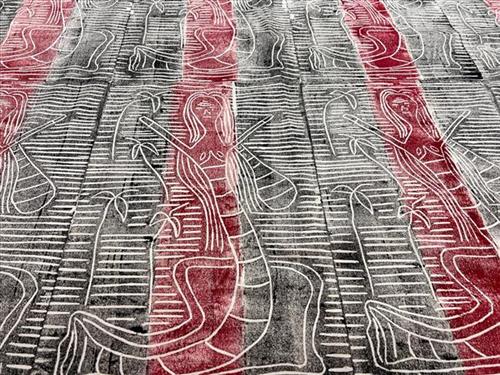
Djomi (Fresh Water Spirit)
This design depicts the story of the artist’s ancestral dreaming, the Djomi fresh water spirit mermaid.
The Djomi figure is a mermaid like spirit with fish tail that lives in the fresh water stream that flows out to the sea cliff near Maningrida. Djomi is a known to be a very powerful fertility symbol.
‘If you go there you can get pregnant easily. Djomi has babies, and they can give others babies too. The Djomi spirit is so powerful, that women can end up with multiple babies at once, twins or sometimes even more. The Djomi spirits lay eggs near the sacred freshwater stream in Maningrida. Inside the eggs are human babies as well as young Djomi.
Men do not go near that swamp, because Djomi is so powerful that men might get pregnant there too. So men, they are too scared of that Djomi. When we visit the Djomi freshwater spring, we can hear young Djomi crying. They sound like normal babies crying, those Djomi spirits. They are looking for a mother.
This Djomi is my dreaming, I got permission from my djunguys to paint this Djomi design. For me I always ask my djunguy permission to paint, because that is our cultural way.
This design also depicts the fresh water lily leaves, and seaweed from the base of the sea floor.

377810582257489
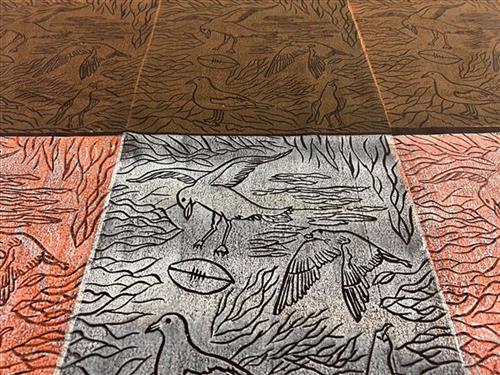
Team Seagulls

377810582257485
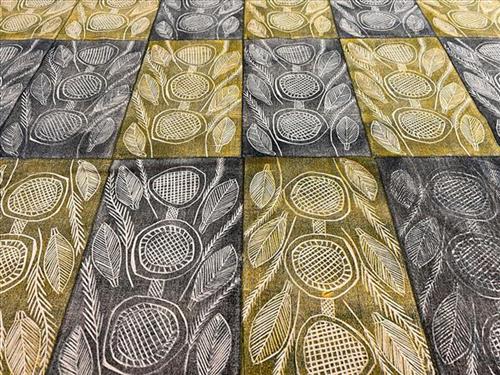
Feathers
A block print design by Janet Marawarrn

377810582257482
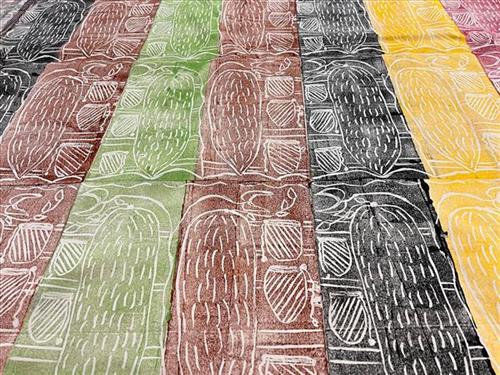
Karrbarda (Long Yam)
“This design is about collecting karrbarda (yams). The old people use these kungarrndutj (digging sticks) to dig the yams from under the ground. They carry the kunmatj (dilly bags) on their heads for collecting bush food. These yams are purple on the saltwater side of country and inland they are white.” – Deborah Wurrkidj
Deborah Wurrkidj is a Kuninjku artist from the Kurulk clan whose country lies around the outstation of Mumeka in central Arnhem Land. In this design, she has depicted Kun-madj (dilly bag) and karrbarda (long yam). Women dig up long yams with kungarrndutj (digging sticks) and they are then cooked in the ashes of the fire to be eaten.
Kun-madj, or dilly bag, is a large woven collecting basket. These large bags are often made from the vine ‘Malasia scandens’, a strong pliable plant that grows along the floor and into the canopy of monsoon vine thickets. The bags are used to collect heavy foods, such as fish caught in conical fish traps or large collections of yams. They can also be made from Pandanus spiralis, a plant that grows in many areas of Arnhem Land.

377810582257479
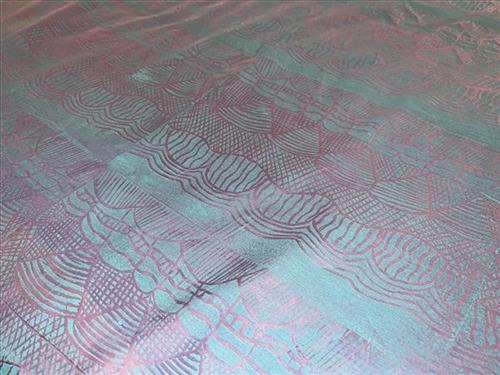
Welebme (flat)
This is a Kune word that refers to the flattening out of items stones, flat leaves and kunbad (money).
This design shows different items that have flattened out. Carol designed this for her grandkids to show them the tradition of Welebme.