377810582254613


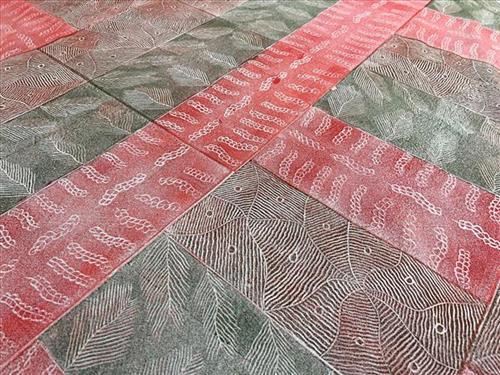
Kunkurra (Spiral Wind)

‘My designs, they are all alive living up in my head’- Janet Marawarr

Janet Marawarr has depicted kunkurra, the spiralling wind associated with several sites in the Kardbam clan. On one level, this design can be interpreted as a depiction of the kinds of mini-cyclones common during the wet season in Arnhem Land, where the artist lives. Kunkurra also relates specifically to a site called Bilwoyinj, near Mankorlod, on the artist’s clan estate.

At this site, two of the most important Kuninjku creation beings, a father and son known as na-korrkko, are believed to have hunted and eaten a goanna. They left some of the goanna fat behind at the site, which turned into the rock that still stands there today.

Bilwoyinj site is also a ceremonial ground for a ceremony called Yabbaduruwa, a major ceremony owned by the Yirridja patrimoiety. The Yabbaduruwa ceremony is primarily concerned with initiation, land ownership and promoting the cyclical regeneration of the human and natural worlds.

377810582254612


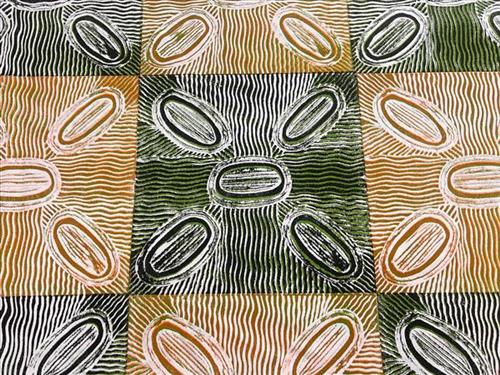
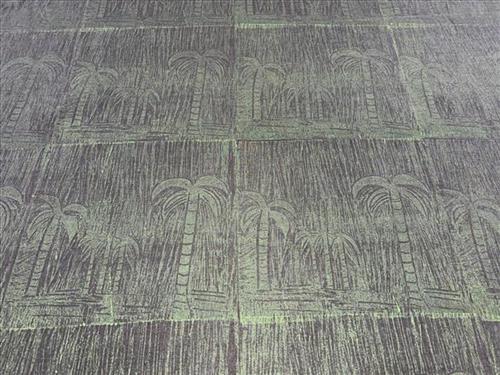
Palm tree on my country

This fabric was created using the linocut printing technique. The lino tile has been carved by the artist in Maningrida, and has been printed by hand using a variety of colours and layers. The linocut technique ensures each textile piece is a one-off, limited edition piece.

377810582254607


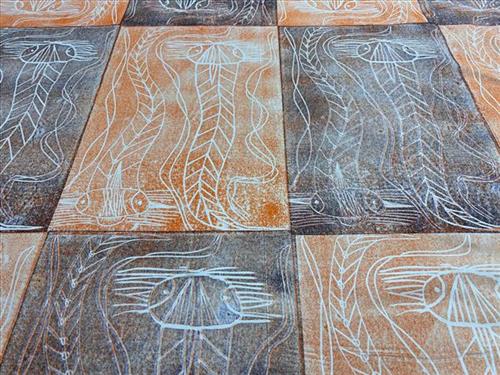
Comb Fish

A beautiful, one off, lino cut, hand printed design by Ndjebanna woman, Joy Garlbin depicting the story of Comb Fish. 

225682254594


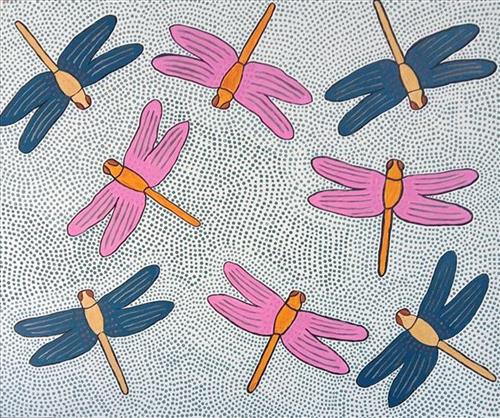
Bulbuji

I’m Kuku-Yalanji woman. My mum is from Wujal Wujal and my dad is from Laura, Chillagoe and Cooktown. For us Bama (Kuku-Yalanji people), we can’t touch bulbuji or wurarr-wurarr. They are sacred. Bulbuji start flying around once the rains come, they are also maja (boss) for bana (water) and the walkurr (water goanna).

After the rains come everything comes to life.  It’s the time when special plants flower and tell us to go hunting for different animals.  Everything is connected for us.  The plants and animals.  Everything.

225682254999


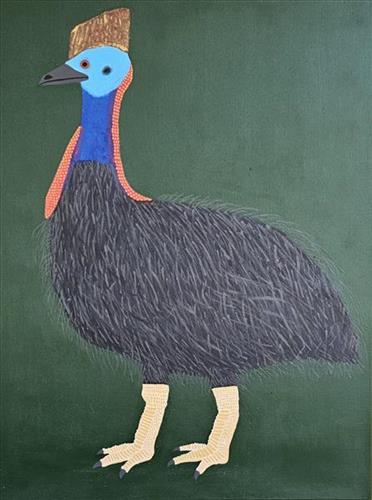
Kurranji

I was born in Katherine in the Northern Territory.  I grew up in Darwin and spent time in Milingimbi. I decided to move to Wujal Wujal in 2022 to spend time with my father’s family.

I’ve been mostly a weaver but now I am giving painting a go. I have painted this Kurranji, which is the language name from my father who is Kuku Yalanji.

Where I grew up we did not have any Kurranji so I am enjoying learning all about the new birds from my fathers country.

359709482254855


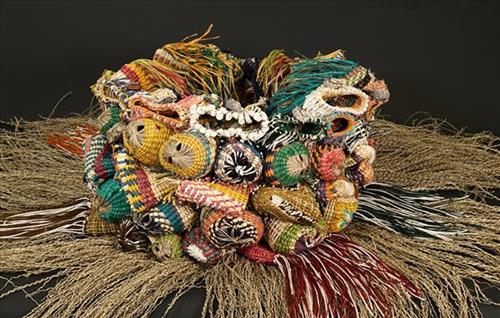
Reef Series 4

There are three reefs off the coast of Lag Mua. The first, and closest, is Dollar Reef. It is the deeper one and most of the food comes from this one. Crayfish, fish, dugong, turtle and clams. The second and third reefs are further out and sit up higher. In the old times we went fishing and collecting in canoes, and carried seafood in baskets. Now we got dinghys and outboards and eskies. These baskets are more about sea life; the coral and sponges under the water.


Art Centre notes: The basket is made of natural raffia / cotton / jute / sea chord / matchbox (kulap) seeds / shells. It is made using a traditional ‘one twist’ method. The dyes are commercial and colour fast. 

115682255129


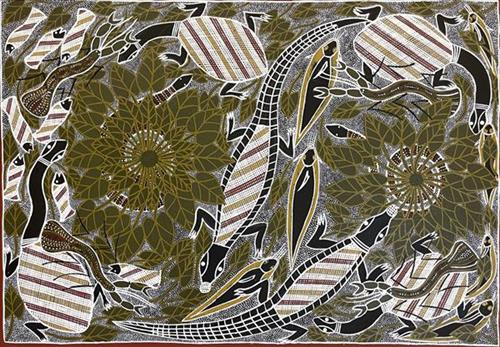
Raypiny Dhawu (Fresh Water Story)

All Aboriginal people originate from a spiritual source, fixed in a particular place in their land or the sea. These ‘spiritual reservoirs’ are often in the form of special waterholes made by Wangarr (creative spirits) that were created long ago close to the beginning of time. These creator beings moved across the countryside, shaping the land and implanting in each tract of country, the spiritual life force for the people who were to own it. These creative spirits took many forms and when they gave the land to each group, they also gave songs, dances, ceremony, the associated laws and language.


The creation story for Ganalbingu people took place near the middle section of the Glyde River where it becomes the Goyder River. Their land, Ngaliyindi, sits astride the Arafura Swamp in Central Arnhem Land. Many Ganalbingu artists paint totemic species significant to their clan. These can include baru (crocodile), banda (long necked turtle), buliya (catfish), yalman (waterlilies), gumang (magpie geese), dakawa (fresh water yabby), ratjuk (barramundi), warrnyu (flying fox) and more.


115682255128


Woven Mat

Traditionally, Nganiyal (conical mats) were used as an insect screen when erected, and as a sitting mat when folded. They are used in Ceremony as well as a functional item. 

Nowadays, artists weave many different shapes including flat, round and oblong. 

115682255127


Woven Mat

Traditionally, Nganiyal (conical mats) were used as an insect screen when erected, and as a sitting mat when folded. They are used in Ceremony as well as a functional item. 

Nowadays, artists weave many different shapes including flat, round and oblong.