111982260443


Lorrkon (Hollow Log)

The Lorrkon or bone pole coffin ceremony was the final ceremony in a sequence of mortuary rituals celebrated by the people of Arnhem Land. This ceremony involves the placing of the deceased’s bones into a hollow log which was decorated with painted clan designs and ceremonially placed into the ground where it remained until it slowly decayed over many years.

The log is made from a termite hollowed Stringybark tree (Eucalyptus tetradonta) and is decorated with totemic emblems. The western Arnhem Land version of the Lorrkon ceremony involves the singing of sacred songs to the accompaniment of karlikarli, a pair of sacred boomerangs used as rhythm instruments. During the final evening of the ceremony, dancers decorate themselves with kapok down, or today, cotton wool and conduct much of the final segments of the ceremony in the secrecy of a restricted mens’ camp. The complete ceremony may stretch over a period of two weeks, but on the last night the bones of the deceased, which have been kept in a bark container or today wrapped in cloth and kept in a suitcase are taken out, are painted with red ochre and placed inside the hollow log. This ceremony may take place many years after the person has died.

At first light on the final morning of the Lorrkon ceremony, the men appear, coming out of their secret bush camp carrying the pole towards the women’s camp. The two groups call to each other using distinct ceremonial calls. The women have prepared a hole for the pole to be placed into and when it is stood upright, women in particular kinship relationships to the deceased dance around the pole in a jumping/shuffling motion. The Lorrkon is then often covered with a tarpaulin and left to slowly decay.

111982260442


Wak Wak

This painting depicts a sacred site at ‘Kurrurldul’, an outstation south of Maningrida.

The ‘rarrk’, or abstract crosshatching, on this work represents the design for the crow totem ancestor called ‘Djimarr’. Today this being exists in the form of a rock, which is permanently submerged at the bottom of Kurrurldul Creek. The ‘Djimarr’ rock in the stream at Kurrurldul is said to move around and call out in a soft hooting tone at night. Both the stone itself and the area around it are considered sacred.

The imagery represents the rock mentioned above at the bottom of Kurrurldul creek, which is the final transmutation of the dreaming ancestor ‘Djimarr’. Finally, the pattern used here is also the crow design used in the sacred ‘Mardayin’ ceremony, which is a large regional patri-moiety ceremony now rarely conducted in central and eastern Arnhem Land.

111982260441


An-gujechiya (Fish Trap)

To make fish traps and fish net fences artists firstly get vine (mirlarl) from the jungle and they put it in water for one night to make it soft. Next they start weaving it; they make rings for the inside to keep the fish trap’s shape. Artists work for three or four weeks on the fish trap. They also make string from kurrajong (burdaga) to attach the hibiscus (bardainy) rings and to tie the conical end of the fish trap. This fish trap is used in saltwater and freshwater. People also use fish net fences called mun-dirra. A long time ago they would put the mun-dirra across rivers and creeks. In the middle they would place the an-gujechiya. They also used small things like sticks, rocks, mud and grass to block the fish from going through. People would then catch fish like saltwater barramundi rajarra, freshwater barramundi (janambal), small black freshwater catfish (buliya), bonefish (an-guwirrpiya), and sand bass (dalakan) in these fish traps.

111982260440


Mat

Mats can vary greatly. Artists commonly use a mix of naturally dyed and undyed fibre to create a striking variation of coloured bands. Some artists also incorporate different types of looping to produce different patterns and textured finishes. Each type of mat, fibre bag, basket and dilly bag has its own name in the various languages spoken in the Maningrida region.

111982227948


Maringgal (Spear Thrower)

The Maringgal (Spear Thrower) is used to help propel a spear. These items are used for hunting and highly decorative pieces are used in ceremony.

Also known as woomera; a flat type of spear thrower.

The Burarra word for scorpion maringgul ji-jurlpa literally translates as ‘Spearthrower on-her-bottom-end’. 

Excerpt from the Burarra – Gun-nartpa dictionary: with English finder list. Published by the Summer Institute of Linguistics 1994.

111982227947


Warrakuy (Baracuda)

Aboriginal bark paintings have a long cultural tradition, believed to extend back many thousands of years.
In northern Australia, paintings on bark shelters in the Kimberley and Arnhem Land were stylistically similar to rock shelter paintings. The Aboriginal bark paintings were used to convey and illustrate stories which were told to the clan when holed up in the shelter for long periods in the wet season. In Kimberly, the Aboriginal bark paintings by Lily karadada resemble ancient rock art Wandjina paintings which are themselves many, many thousands of years old.

Bark paintings with deep cultural and ritual significance still feature in the Aboriginal sacred ceremonies of northern Australia and they, along with some coastal inhabitants are the only indigenous Aborigines still making traditional bark paintings.

The process of making a bark painting begins with choosing a suitable stringybark eucalyptus tree, preferably in the wet season when the sap is rising and the bark is fairly supple and easy to grip. After finding a section of bark that is devoid of knots and termite damage, cuts are made top and bottom and after some encouragement by tugging and prying, a hollow open cylinder of bark is removed. The bark sheet is trimmed and a fire made ready, over which the bark will be cured to drive out any moisture. The bark is then flattened to the ground with feet and then held down with heavy weights to ensure that it doesn’t curl or warp.

The Aboriginal bark painters of Arnhem Land adhere to four basic pigments – red, black, white and yellow. The reds and yellows come from ochres, crushed and powdered rocks. White comes from pipeclay and black generally comes from charcoal. Sometimes natural fixatives are mixed in to bind the pigments and which includes wax, yolk of eggs, resins and the sap of orchid plants. The paint can then be applied to the bark with perhaps a rarrk design by using a wood comb, or with brushes made from human hair or even feathers.

111982227946


Marrchila (Saltwater Crocodile)

Aboriginal bark paintings have a long cultural tradition, believed to extend back many thousands of years.
In northern Australia, paintings on bark shelters in the Kimberley and Arnhem Land were stylistically similar to rock shelter paintings. The Aboriginal bark paintings were used to convey and illustrate stories which were told to the clan when holed up in the shelter for long periods in the wet season. In Kimberly, the Aboriginal bark paintings by Lily karadada resemble ancient rock art Wandjina paintings which are themselves many, many thousands of years old.

Bark paintings with deep cultural and ritual significance still feature in the Aboriginal sacred ceremonies of northern Australia and they, along with some coastal inhabitants are the only indigenous Aborigines still making traditional bark paintings.

The process of making a bark painting begins with choosing a suitable stringybark eucalyptus tree, preferably in the wet season when the sap is rising and the bark is fairly supple and easy to grip. After finding a section of bark that is devoid of knots and termite damage, cuts are made top and bottom and after some encouragement by tugging and prying, a hollow open cylinder of bark is removed. The bark sheet is trimmed and a fire made ready, over which the bark will be cured to drive out any moisture. The bark is then flattened to the ground with feet and then held down with heavy weights to ensure that it doesn’t curl or warp.

The Aboriginal bark painters of Arnhem Land adhere to four basic pigments – red, black, white and yellow. The reds and yellows come from ochres, crushed and powdered rocks. White comes from pipeclay and black generally comes from charcoal. Sometimes natural fixatives are mixed in to bind the pigments and which includes wax, yolk of eggs, resins and the sap of orchid plants. The paint can then be applied to the bark with perhaps a rarrk design by using a wood comb, or with brushes made from human hair or even feathers.

111582258930


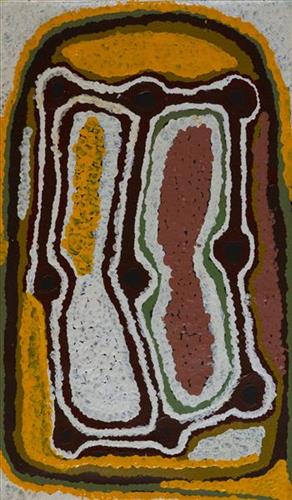
Kinyu (Canning Stock Route Well 35), Kunawarritji Jarntu (Dog)

“In pujiman (traditional, desert dwelling) time there were giant jarntu (dogs) walking around Kunawarritji (Canning Stock Route Well 33). Like I can see you, you can see me, real life those jarntu showed themselves. Those jarntu would go under ground. Under the parna (ground, earth). There was a male and female dog. The wanti (woman, girl) jarntu was juri (beautiful, good) one. The male jarntu wanted to be nyupa- nyupa (partners). The wanti jarntu say, no, paki (nothing). The male jarntu was young and claimed that female jarntu.”

– Kumpaya Girgirba as translated by Ignatius Taylor

Kinyu (Canning Stock Route Well 35) is a small yinta (permanent spring) that was a popular camping site during the pujiman (traditional, desert dwelling) era. Kinyu forms part of Kumpaya’s ngurra (home Country, camp), the area which she knew intimately and travelled extensively with her family in her youth.

As alluded to in Kumpaya’s account, the site is home to the ancestral mother dingo, a generous provider and fierce protector of her Martu countrymen. Kinyu is so revered that the site and its associated ancestral being are often deferentially called jarntu (dog) in place of uttering the actual name. The site is believed to possess healing and magical powers, and children born here are said to inherit these same powers. 

During the Jukurrpa (Dreaming), Kinyu was the home for a family of dingoes; a mother, father, and their litter of pups. Originally the family had travelled to Wirlarra, following the call of the moon. At Wirlarra the moon cared for them and created a windbreak for the family to shelter. The dingoes stayed for a time at Wirlarra, scratching into the earth to create several distinctive small salt water pools which are still visited by the Martu for their healing properties. After a time, the dingoes continued travelling eastward toward the rising moon until they reached Kinyu, where they remained until all of the dingo pups had grown up. From Kinyu the family travelled further east. 

The intersection of the Canning Stock Route with Kinyu also made this a site of early contact with Europeans for many Martu then living a pujiman life in the desert. Following the route’s construction, Martu encountered Europeans and other Martu working as cattle drovers as they would travel up and down the Stock Route from water source to water source. Increasingly, pujimanpa (desert dwellers) followed the route to newly established ration depots, mission and pastoral stations. They were drawn to the route in search of food, by a sense of curiosity, or by loneliness. By the late 1950s and early 1960s, most of the desert family groups had left the desert. Eventually, these factors combined with an extreme and prolonged drought in the 1960s to prompt the few remaining pujimanpa to move in from the desert.