115682259664


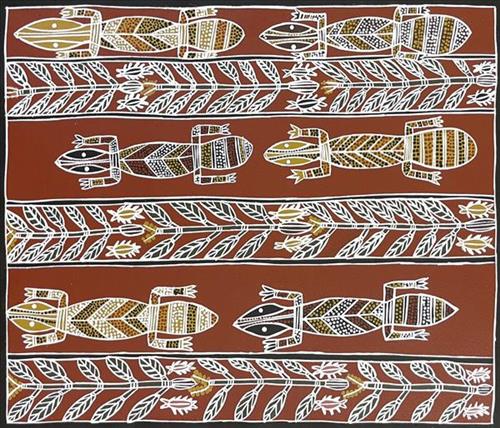
Northern Marbled Velvet Gecko (Oedura marmorata)

Aboriginal art in Ramingining, Central Arnhem Land is commonly illustrated through designs and images of animals, plants, and landscape. These motifs commonly reflect the artists ancestral inheritance and their dreamings and are referred to as totems.

For this painting, the artist has painted Northern Marbled Velvet Gecko (Oedura marmorata)

111582259745


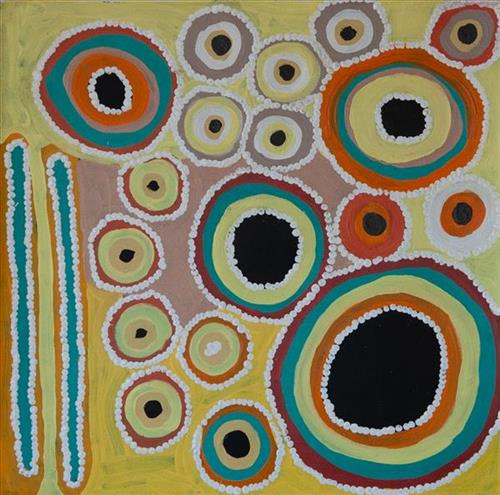
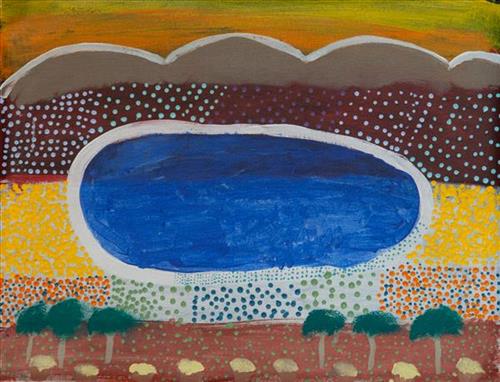
Kunawarritji, Nyipily and Kinyu

“Kunawarritji, Nyipily, Kinyu…. And that women’s area.”

-Pauline Williams

Kunawarritji is an important site in the Great Sandy Desert where multiple stories and histories intersect. The area forms part of Pauline’s ngurra (home Country, camp) through her family. Originally a spring water and major Martu pujiman (traditional, desert dwelling) camping site, at the turn of the 20th century Kunawarritji was converted into a well along the Canning Stock Route. Each year throughout the 1930-50s, the well became a site of contact between the drovers, their cattle, and desert families.

Long before colonial history entered this Country, however, other stories dominated the site. Primarily, Kunawarritji features in the Minyipuru (Jakulyukulyu, Seven Sisters) Jukurrpa (Dreaming). Minyipuru is a central Jukurrpa narrative for Martu, Ngaanyatjarra, Pitjantjatjara and Yankunytjatjara people that is associated with the seasonal Pleiades star constellation. Today, Kunawarritji is a site of return, a place where people came back to continue their life in the desert with the formation of Kunawarritji Aboriginal community in the early 1980s. The community’s cultural significance endures, with the population swelling up to 1000 during cultural business. 

As Pauline states in her account, this work also depicts Kinyu. Kinyu (Canning Stock Route Well 35) is a small yinta (permanent spring) that was a popular camping ground during the pujiman (traditional, desert dwelling) era. The site is home to the ancestral mother dingo, who is both a generous provider and fierce protector of her Martu countrymen. Kinyu is so revered that the site and its associated ancestral being are often deferentially referred to as jarntu (dog) in place of uttering the actual name. The site is believed to possess healing and magical powers, and children born here are said to inherit these same powers.

Nyipily (Nyipil, Nibil, Canning Stock Route Well 34) is also depicted in this work. It is a soak located north east of Kunawarritji. Soaks, or soakwaters, derive their name from the manner in which their waters generally seep into the sand from below stores, sometimes as part of an ephemeral river or creek. Soaks were an especially important source of water during the pujiman (traditional, desert dwelling) era, being the most dependable water source in times of drought. Water was obtained from soaks by scooping away the sand with a piti (timber bowls used for carrying food and the desert.water) until clear water gathered at the base of the hole, sometimes at a depth of several metres. 

During the pujiman period, knowledge of water sources was critical for survival, and today Martu Country is still defined in terms of the location and type of water. Each of the hundreds of claypans, rockholes, waterholes, soaks and springs found in the Martu desert homelands is known through real life experience and the recounting of Jukurrpa narratives by name, location, quality and seasonal availability.

Transfer of cultural knowledge through visual arts is an important way for Martu artists to keep their culture strong. Younger Martu artists like Pauline typically begin painting with their parents, grandparents and extended family, thus fostering an organic process of learning, not only about painting techniques, but also specific locations, family histories, traditional ways of life, bush tucker and  Jukurrpa. 


111582259744


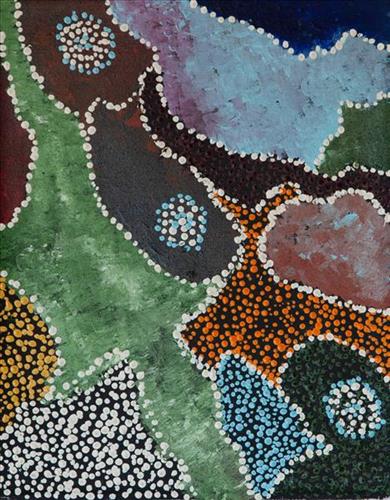
Near Jigalong

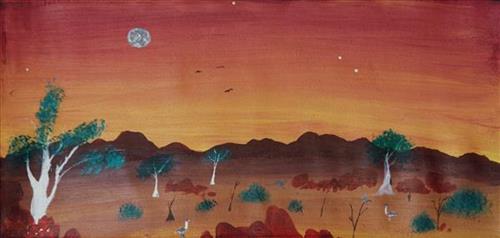
“Near Jigalong this place. There is two turkey and one kangaroo. Kipara and marlu and full moon.”

-Troy Polly

This work portrays an area known to the artist, painted here from memory. During the pujiman (traditional, desert dwelling) era one’s survival depended on their intimate knowledge of the location of resources; thus physical elements of Country, such as sources of kapi (water), tali (sandhills), and different varieties of warta (trees, vegetation) were carefully observed and remembered. Today, this relationship with Country remains equally strong, despite the movement of Martu out of the desert and into remote Aboriginal communities, towns and cities.

Troy has painted country near Jigalong, an Aboriginal Community, the largest of the Martu communities, is located on the western edge of the Little Sandy Desert, not far from the town of Newman. Jigalong was established in 1907 as the site for a maintenance and rations store for workmen constructing the Rabbit Proof Fence, and was converted into a camel breeding site in the 1930’s before finally becoming a Christian mission under the Apostolic Church in 1947. Old Jigalong is where the camp on Jigalong Station was situated before the present Community was built. Jigalong and its surrounding land was returned to the Martu in 1974. 

For many Martu, Jigalong Mission was the site where their pujiman (traditional, desert dwelling) lifestyle came to an end from the late 1940s. From this time, they mostly transitioned to a life as stockmen and women working in cattle stations in the Pilbara region and beyond. In the wake of the extreme and prolonged drought of the 1960s, the last of the remaining pujimanpa (desert dwellers) were forced to move to missions like Jigalong, where a supply of food and water was assured. There, many were reunited with family members that had already moved in from the desert.


111582259741


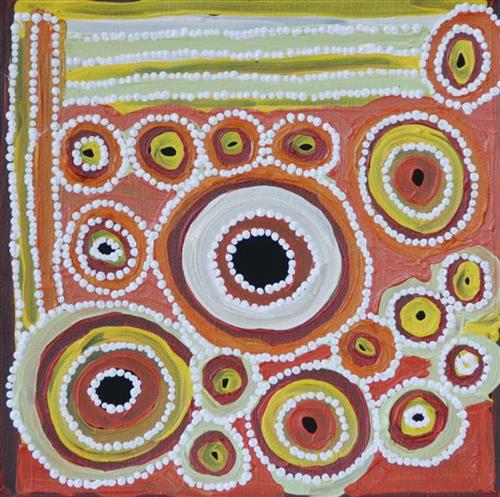
Partjanta

“Katjarra’s  [Katjarra Butler] ngurra (home Country, camp). Birthplace. [It is] sandhill country. Rockhole, little bit of rocks. And in the sandhill, there is a jurnu (soakwater). They take that water, come out [of the soakwater]. Partjanta the name of that jurnu. Main one. She [Katjarra Butler] been go jina [foot, walking]. Early days. Walking [to] Kintore, Papunya.”

“I’m painting my grandmother’s country, her way. Katjarra style.”

-Sharon Porter

This site forms part of Sharon’s ngurra (home Country, camp) through her grandmother, Katjarra Butler. Located east of Kiwirrkurra and on Pintupi country.

The Western Desert term ‘ngurra’ is hugely versatile in application. Broadly denoting birthplace and belonging, ngurra can refer to a body of water, a camp site, a large area of Country, or even a modern house. People identify with their ngurra in terms of specific rights and responsibilities, and the possession of intimate knowledge of the physical and cultural properties of one’s Country. This knowledge is traditionally passed intergenerationally through family connections. Country for Martu is full of memory; not just the memory of their own movement through it, but also of their family. As summarised by Ngalangka Nola Taylor, “painting the ngurra, they do it to remember their connections.”

Painting ngurra, and in so doing sharing the Jukurrpa (Dreaming) stories and physical characteristics of that place, has today become an important means of cultural maintenance. Physical maintenance of one’s ngurra, like cultural maintenance, ensures a site’s wellbeing, and is a responsibility of the people belonging to that area. 

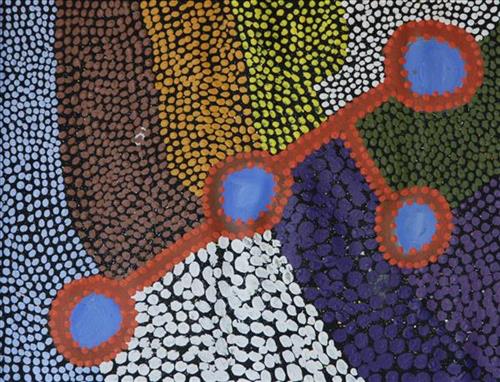
This work depicts a yinta (permanent spring) within the artists’ ngurra (home Country, camp), typically depicted with circular forms. Yinta provided a reliable source of water and were traditionally used as camping sites throughout the year.

During the pujiman (traditional, desert dwelling) period, knowledge of water sources was critical for survival, and today Martu Country is still defined in terms of the location and type of water. Each of the hundreds of claypans, rockholes, waterholes, soaks and springs found in the Martu desert homelands is known through real life experience and the recounting of Jukurrpa (Dreaming) narratives by name, location, quality and seasonal availability. This encyclopedic knowledge extends even to the nature and movement of arterial waterways, and sustained Martu as they travelled across their Country, hunting and gathering, visiting family, and fulfilling ceremonial obligations. They would traverse very large distances annually, visiting specific areas in the dry and wet season depending on the availability of water and the corresponding cycles of plant and animal life on which hunting and gathering bush tucker was reliant.

111582259739


Punmu, Kunawarritji and Parrngurr

Troy has painted the three Martu communities of Punmu, Kunawarritji and Parrngurr. 


Punmu refers to a region and an Aboriginal community within its vicinity, located 670km North-East of Newman. Created during the return to Country movement of the 1980s, with the recognition of Martu land rights and native title, the community was named after a nearby Jukurrpa (Dreaming) story.

Punmu Aboriginal community sits on the edge of a large salt lake known as Nyayartakujarra, or Lake Dora. The lake runs south into Karlamilyi River (Rudall River). Surrounding Punmu are numerous fresh water soaks and the red tali (sandhills) typical of the area. The most frequently visited yinta (permanent springs) around Punmu include Wirlarra, Rawa, Yilyara, Jila-jila and Tuu-tuu.

The Country around Punmu features in several Jukurrpa stories. Of particular importance is the story of the Jila Kujarra (Two Snakes), one of the key Jukurrpa narratives for the Martu. Though the story belongs to Warnman people, it is shared across the Western Desert with several other language groups. The narrative centres on the travels of two snakes as they are pursued by the Niminjarra, spiritual ancestors of the Warnman people. 

Before transforming themselves into snakes, the Jila Kujarra were young brothers. As snakes, they began travelling home to their mother, but were intercepted by the Niminjarra, who tracked the Jila Kujarra to Paji, east of Nyayartakujarra (Lake Dora). Though the Jila Kujarra eluded their pursuers here by escaping under the lake at Paji, they were soon after speared and injured by two Pukurti (initiates with bundled hair) at Nyayartakujarra, who returned with the Niminjarra to cook the snakes at the site of Kumpupirntily (Kumpupintily, Lake Disappointment). As the Niminjarra cut down the length of the Jila Kujarra, the snake’s bladders were pierced, causing an explosion of scalding hot urine in which the Niminjarra all perished and became black rocks at the site. The spirits of the Jila Kujarra returned to their mother at Nyayartakujarra, where the mother and her sons entered the ground below Nyayartakujarra and remain to this day.

Kunawarritji is an important site in the Great Sandy Desert where multiple stories and histories intersect. Originally a spring water and major Martu pujiman (traditional, desert dwelling) camping site, at the turn of the 20th century Kunawarritji was converted into a well along the Canning Stock Route. Each year throughout the 1930-50s, the well became a site of contact between the drovers, their cattle, and desert families. 

Long before colonial history entered this Country, however, other stories dominated the site. Primarily, Kunawarritji features in the Minyipuru (Jakulyukulyu, Seven Sisters) Jukurrpa (Dreaming). Minyipuru is a central Jukurrpa narrative for Martu, Ngaanyatjarra, Pitjantjatjara and Yankunytjatjara people that is associated with the seasonal Pleiades star constellation. Beginning in Roebourne on the west coast of Western Australia, the story morphs in its movement eastward across the land, following a group of women as they walk, dance, and even fly from waterhole to waterhole. As they travelled the women left markers in the landscape and create landforms that remain to this day. During the entirety of their journey the women are pursued by a lustful old man, Yurla, although interactions with other animals, groups of men, and spirit beings are also chronicled in the narrative.
The Minyipuru travelled to Kunawarritji from Nyipily (Nyipil, Nibil, Canning Stock Route Well 34), and transformed themselves into a distinctive group of trees that remain in the area between these two sites. From Kunawarritji Yurla followed the sisters to Pangkapirni, where he finally caught one of the women. 

Today, Kunawarritji is a site of return, a place where people came back to continue their life in the desert with the formation of Kunawarritji Aboriginal community in the early 1980s. The community’s cultural significance endures, with the population swelling up to 1000 during cultural business.

Parnngurr is an Aboriginal community located 370km east of Newman, at the Southern end of the Karlamilyi (Rudall River) area, and in the Pilbara region of Western Australia. Created during the return to Country movement of the 1980s, with the recognition of Aboriginal land rights and native title, the community was named after its’ original primary water source, a nearby rockhole and yinta (permanent spring). Until recently the community was widely known as Cotton Creek, after the European name for the ephemeral creek running alongside the community. Parnngurr and its surrounds are physically dominated by distinctively red tali (sandhills), covered sparingly with spinifex and low lying shrub.

Historically Parnngurr Rockhole was an important site for Aboriginal people during the pujiman (traditional, desert born) era. During this nomadic period families stopped and camped here depending on the seasonal availability of water and the corresponding cycles of plant and animal life on which hunting and gathering bush tucker was reliant. At Parnngurr and other similarly important camp sites, families would meet for a time before moving to their next destination. 

Parnngurr is also a site chronicled in the epic Jukurrpa (Dreaming) story of the Minyipuru (Jakulyukulyu, Seven Sisters), as they flee from the lustful old man, Yurla. The sisters stopped to rest on Parnngurr Hill before continuing on their long journey east. Minyipuru is a central Jukurrpa narrative for Martu, Ngaanyatjarra, Pitjantjatjara and Yankunytjatjara people that is associated with the seasonal Pleiades star constellation. Relayed in song, dance, stories and paintings, Minyipuru serves as a creation narrative, a source of information relating to the physical properties of the land, and an embodiment of Aboriginal cultural laws. Beginning in Roebourne on the west coast of Western Australia, the story morphs in its movement eastward across the land, following the women as they walk, dance, and even fly from waterhole to waterhole. As they travel the women camp, sing, wash, dance and gather food, leaving markers in the landscape and creating landforms that remain to this day, such as groupings of rocks and trees, grinding stones and seeds. During the entirety of their journey the women are pursued by a lustful old man, Yurla, although interactions with other animals, groups of men, and spirit beings are also chronicled in the narrative.


111582259738


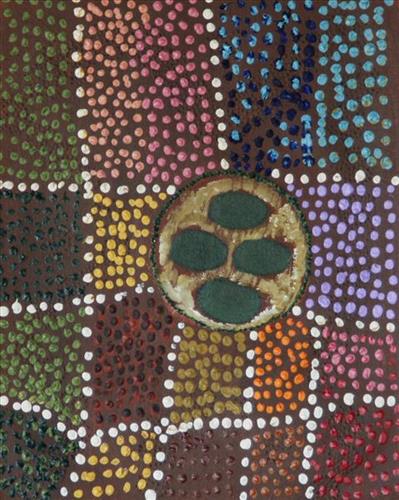
Emu Eggs

“These [are] emu eggs. In the spinifex. Wiluna. My mother’s side. They just look for those emu tracks, forwards and then going back. They follow them back to the nest. They know how to find them, emu eggs. And then eat them.”

-Shoshanna Jeffries

Depicted in this work are karlaya (emu) eggs; these are large, flightless birds endemic to Australia, and found across the whole country. Emus have been hunted by Martu people as a source of bush tucker from the pujiman (traditional, desert dwelling) era through to today. Typically, emus were tracked using their distinctive jina (tracks, footprints). Acute skill in track observation and identification traditionally possessed by Aboriginal people developed directly in relation to their past hunter-gatherer existence, when survival depended in large part on the successful tracking of hunted animals. In the absence of an actual animal sighting, tracks act as an identifier that an animal was present, which were then followed to the animal’s location.

111582259737


Untitled

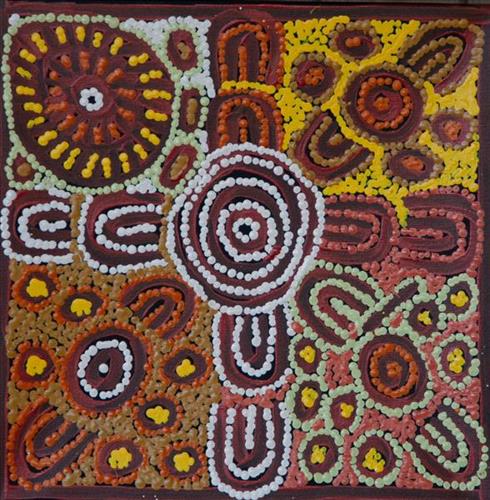
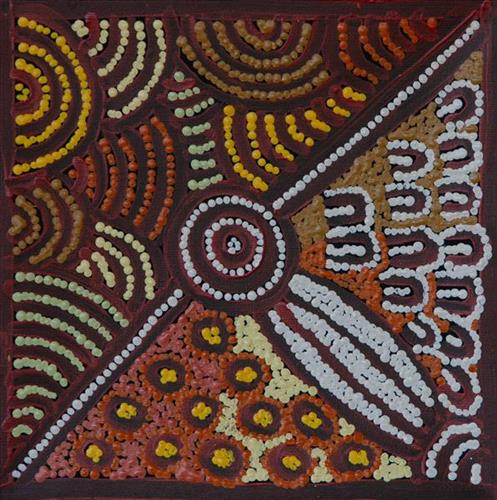
This work portrays an area known to the artist, painted here from memory. During the pujiman (traditional, desert dwelling) era one’s survival depended on their intimate knowledge of the location of resources; thus physical elements of Country, such as sources of kapi (water), tali (sandhills), and different varieties of warta (trees, vegetation) were carefully observed and remembered. Today, this relationship with Country remains equally strong, despite the movement of Martu out of the desert and into remote Aboriginal communities, towns and cities.

Also visible may be traces of life cycles based around kalyu (rain, water) and waru (fire). A thousands of year old practice, fire burning continues to be carried out as both an aid for hunting and a means of land management today. As the Martu travelled and hunted they would burn tracts of land, ensuring plant and animal biodiversity and reducing the risk of unmanageable, spontaneous bush fires. The patchwork nature of regrowth is visible in many landscape works, with each of the five distinctive phases of fire burning visually described with respect to the cycle of burning and regrowth.  

Finally, metaphysical information relating to a location may also be recorded; Jukurrpa (Dreaming) narratives chronicle the creation of physical landmarks, and can be referenced through depictions of ceremonial sites, songlines, and markers left in the land. 

111582259736


All the mima (women)

The site depicted in this work, situated to the east of Kiwirrkurra and on Pintupi Country, forms part of Sharon’s ngurra (home Country, camp) through her grandmother, Katjarra Butler. Katjarra shared with Sharon the jukurrpa (dreaming) story for this area. This narrative describes how a distinctive group of rocks located here came to be formed by “all the mima (women) sitting down next to two rocks and one rockhole. They was eating bush tucker, yellow berries, and they was drinking water from one rockhole. They was in one place, and they was eating a big round one, that yellow berry. They was looking round and round for more. They never went, they stayed sitting in one place. They still there, they turned into rocks there.” (Sharon Porter)

The term Jukurrpa is often translated in English as the ‘dreaming’, or ‘dreamtime’. It refers generally to the period in which the world was created by ancestral beings, who assumed both human and nonhuman forms. These beings shaped what had been a formless landscape; creating waters, plants, animals, and people. At the same time they provided cultural protocols for the people they created, as well as rules for interacting with the natural environment. At their journey’s end, the ancestral beings transformed themselves into important waters, hills, rocks, and even constellations.

111582259735


All the mima (women)

The site depicted in this work, situated to the east of Kiwirrkurra and on Pintupi Country, forms part of Sharon’s ngurra (home Country, camp) through her grandmother, Katjarra Butler. Katjarra shared with Sharon the jukurrpa (dreaming) story for this area. This narrative describes how a distinctive group of rocks located here came to be formed by “all the mima (women) sitting down next to two rocks and one rockhole. They was eating bush tucker, yellow berries, and they was drinking water from one rockhole. They was in one place, and they was eating a big round one, that yellow berry. They was looking round and round for more. They never went, they stayed sitting in one place. They still there, they turned into rocks there.” (Sharon Porter)

The term Jukurrpa is often translated in English as the ‘dreaming’, or ‘dreamtime’. It refers generally to the period in which the world was created by ancestral beings, who assumed both human and nonhuman forms. These beings shaped what had been a formless landscape; creating waters, plants, animals, and people. At the same time they provided cultural protocols for the people they created, as well as rules for interacting with the natural environment. At their journey’s end, the ancestral beings transformed themselves into important waters, hills, rocks, and even constellations.

111582259734


Partjanta

“Katjarra’s  [Katjarra Butler] ngurra (home Country, camp). Birthplace. [It is] sandhill country. Rockhole, little bit of rocks. And in the sandhill, there is a jurnu (soakwater). They take that water, come out [of the soakwater]. Partjanta the name of that jurnu. Main one. She [Katjarra Butler] been go jina [foot, walking]. Early days. Walking [to] Kintore, Papunya.”

“I’m painting my grandmother’s country, her way. Katjarra style.”

-Sharon Porter

This site forms part of Sharon’s ngurra (home Country, camp) through her grandmother, Katjarra Butler. Located east of Kiwirrkurra and on Pintupi country.

The Western Desert term ‘ngurra’ is hugely versatile in application. Broadly denoting birthplace and belonging, ngurra can refer to a body of water, a camp site, a large area of Country, or even a modern house. People identify with their ngurra in terms of specific rights and responsibilities, and the possession of intimate knowledge of the physical and cultural properties of one’s Country. This knowledge is traditionally passed intergenerationally through family connections. Country for Martu is full of memory; not just the memory of their own movement through it, but also of their family. As summarised by Ngalangka Nola Taylor, “painting the ngurra, they do it to remember their connections.”

Painting ngurra, and in so doing sharing the Jukurrpa (Dreaming) stories and physical characteristics of that place, has today become an important means of cultural maintenance. Physical maintenance of one’s ngurra, like cultural maintenance, ensures a site’s wellbeing, and is a responsibility of the people belonging to that area. 

This work depicts a yinta (permanent spring) within the artists’ ngurra (home Country, camp), typically depicted with circular forms. Yinta provided a reliable source of water and were traditionally used as camping sites throughout the year.

During the pujiman (traditional, desert dwelling) period, knowledge of water sources was critical for survival, and today Martu Country is still defined in terms of the location and type of water. Each of the hundreds of claypans, rockholes, waterholes, soaks and springs found in the Martu desert homelands is known through real life experience and the recounting of Jukurrpa (Dreaming) narratives by name, location, quality and seasonal availability. This encyclopedic knowledge extends even to the nature and movement of arterial waterways, and sustained Martu as they travelled across their Country, hunting and gathering, visiting family, and fulfilling ceremonial obligations. They would traverse very large distances annually, visiting specific areas in the dry and wet season depending on the availability of water and the corresponding cycles of plant and animal life on which hunting and gathering bush tucker was reliant.