377810582275269


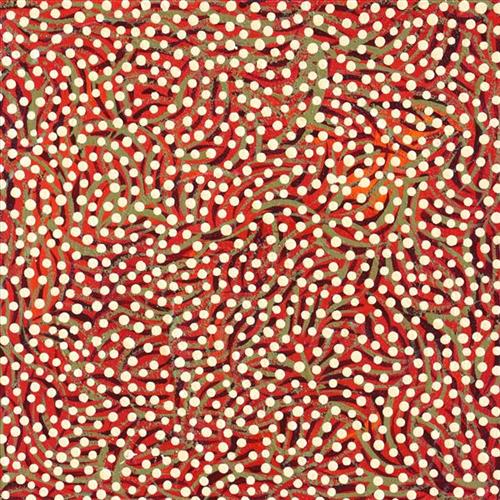
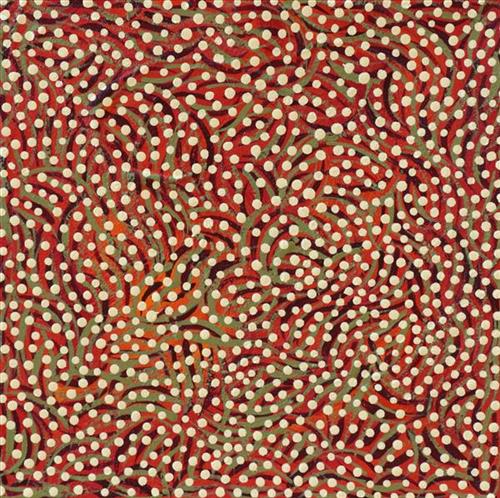
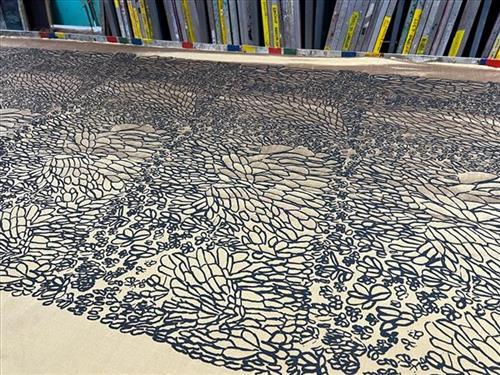
Kunkih (Mud Ripples)

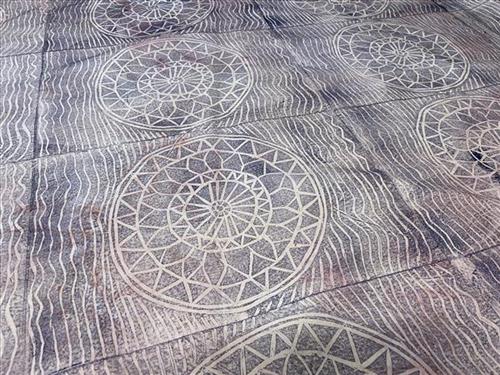
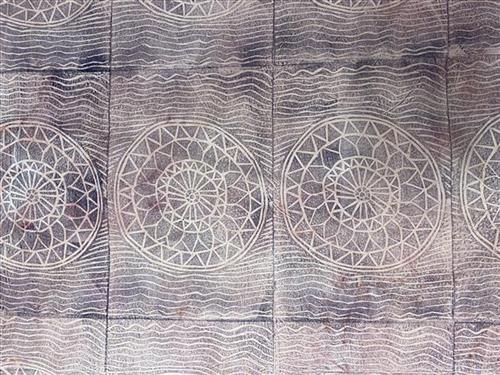
This design depicts the patterns of the freshwater mud ripples, which emerge after strong monsoonal wet seasons on the Djinkarr and Nangak flood plains.

These ripples form on the earth’s surface in delicate repetitive and shifting patterns. The mud ripples move, crack, disappear and re-emerge in response to the changing wind, rains and new sun.

The mud ripples depicted in this design are on Elizabeth’s homeland, the Djinkarr and Nangak floodplains south of Maningrida in Arnhem Land.

116482275186


Our Country (The Pilbara)

Pilbara is the country where we the Yindjibarndi people live and share many of our Cultural stories and history that have been passed onto us by our ancestors, of how they used to walk through the flat country we call the (Table Lands) visiting family members at nearby stations. Our country has so much to offer. Bush foods and medicine as well as animals such as kangaroo, emu, goanna, and turkey. When the rains come our rivers are full and we all love to go out and spend the day fishing. We are also close to the ocean, so we often go fishing there as well. During the holidays many of our families go bush to enjoy the beauty of our country. We see wildflowers blooming as nature takes its course. Our country is still full of riches it always gives me joy to be a part of it. We are connected to our land it is a part of who we are.

116482275122


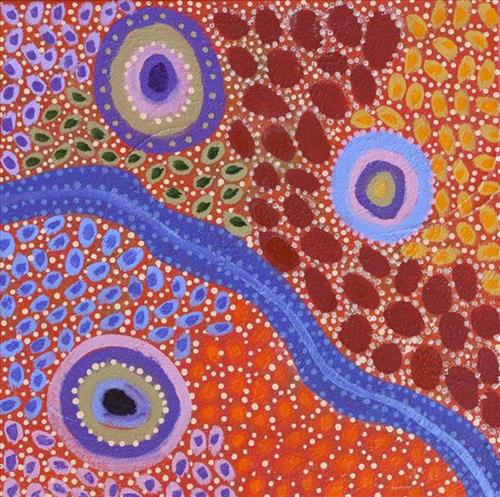
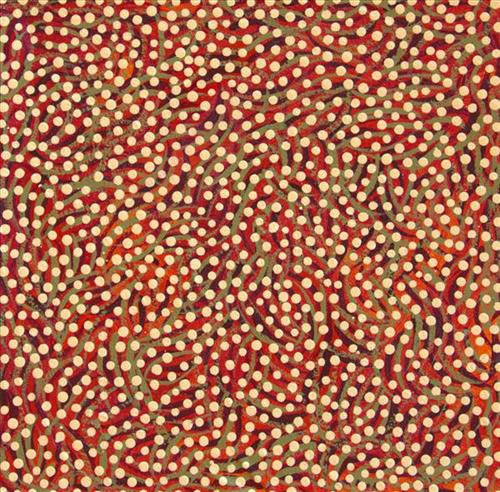
Burst of Spring

Springtime is a beautiful blending of colours in our country. After the rain all the wild flowers come up in a pattern like a puzzle. The artist often sponges her background using colours which include red, pink, yellow’s and orange. She painted over this background with her own unique style and bright colours. As in much aborigional art, the artist has represented her country from an aerial perspective.

116482275116


Burst of Spring

‘Springtime is a beautiful blending of colours in our country . When it’s been raining, all the flowers come up in a pattern like a puzzle.’ The artist started this painting with a sponge laden with colours. She painted over this background with shapes made up of coloured dots. She then further defined this coloured pattern by working over it again with white dots, to bring the colours into relief. As in much aboriginal art, the artist has represented her country from an aerial perspective.

116482275115


Burst of Spring

‘Springtime is a beautiful blending of colours in our country . When it’s been raining, all the flowers come up in a pattern like a puzzle.’ The artist started this painting with a sponge laden with colours. She painted over this background with shapes made up of coloured dots. She then further defined this coloured pattern by working over it again with white dots, to bring the colours into relief. As in much aboriginal art, the artist has represented her country from an aerial perspective.

377810582275079


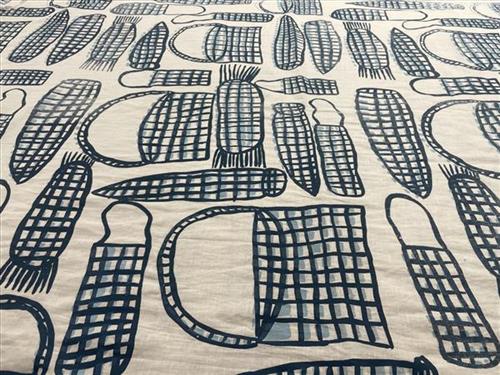
Gunga (Pandanus)

Gunga refers to the weaving and production of goods from pandanus leaves and natural fibres. This design depicts fibre art from her homeland Galiwinku, Elcho Island.

The fish trap, basket, string bag and pandanus mats are objects as well as ancestral spirits and are significant to the artists as together they relate to her djang (Aboriginal religious belief).

Fish traps are woven by hand using the milirl (Burney vine, Trophis scandens) from the jungle, which is soaked overnight to make it soft. Fish traps are used by both saltwater and freshwater hunters. Baskets and pandanus mats are made from pandanus leaves, which are collected using long hooks, stripped, dried, boiled in natural dye, then woven.

377810582275498


Kundayarr and Billabong


Works in fibre from the Maningrida region are widely recognised as some of the finest in Australia. Artists confidently push the boundaries of fibre craft and cultural expression, adapting traditional techniques and forms to produce strikingly inventive and aesthetically exquisite artworks.

Artists usually use kundayarr, pandanus spiralis, to weave decorative round or oblong mats, as well as the less common triangular and conical shapes. Weaving is physically hard work, now done only by women. They colour the pandanus using natural dyes made from the roots, leaves or flowers of plants within the weaver’s clan estate.

This artwork also includes a billabong scene with local birdlife like the brolga and jabiru.

Jocelyn has used the root of Man-Kurdudjumuk (coelospermun reticulatum) to dye the fabric a beautiful yellow. This fabric has been dyed on country in the outstation of Kakodbubuldi and later printed in our Maningrida studio. Feathers, basket weaves and pandanus plants are pictured.

377810582275497


Kundayarr and Billabong

Works in fibre from the Maningrida region are widely recognised as some of the finest in Australia. Artists confidently push the boundaries of fibre craft and cultural expression, adapting traditional techniques and forms to produce strikingly inventive and aesthetically exquisite artworks.

Artists usually use kundayarr, pandanus spiralis, to weave decorative round or oblong mats, as well as the less common triangular and conical shapes. Weaving is physically hard work, now done only by women. They colour the pandanus using natural dyes made from the roots, leaves or flowers of plants within the weaver’s clan estate.

This artwork also includes a billabong scene with local birdlife like the brolga and jabiru.

Jocelyn has used the root of Man-Kurdudjumuk (coelospermun reticulatum) to dye the fabric a beautiful yellow. This fabric has been dyed on country in the outstation of Kakodbubuldi and later printed in our Maningrida studio. Feathers, basket weaves and pandanus plants are pictured.

377810582275495


Marebu and Bush Dye

Deborah Wurrkidj is a Kuninjku artist from the Kurulk clan whose country lies around the outstation of Mumeka in central Arnhem Land. She is an accomplished artist working across mediums including painting, sculpture, weaving and textile design. 

Deborah currently lives on Kakodbebuldi Outstaion where she is working from her home studio. Deborah has dyed silk using locally harvested plants cooked over an open fire.

The print design is Marebu (woven pandanus mats).

Artists usually use kundayarr, pandanus spiralis, to weave decorative round or oblong mats, as well as the less common triangular and conical shapes. Weaving is physically hard work, now done only by women. They colour the pandanus using natural dyes made from the roots, leaves or flowers of plants within the weaver’s clan estate.

The radial woven patterns of the finest round mats appear to vibrate with colour, sometimes regarded as an aesthetic manifestation of deep cultural meaning, as there is a significant spiritual dimension to pandanus mats.
377810582275487


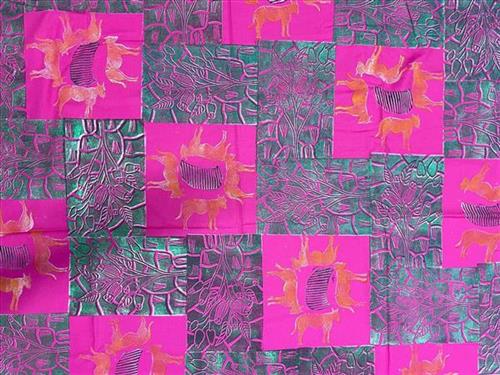
Manbamo and Duruk (dog)

Seed pod of a tree or shrub, especially eucalypts (‘gumnuts’), acacias and the cup-shaped woody capsules of Melaleuca fruit. Also referred to as Bamomo in Kuninjku and Kune.

Janet has also incorporated her duruk (camp dog) lino tile.

This artwork was purchased by the art centre as part of an ANKA Safe Cultures Strong Future Grant in 2020. Not to be sold.