111982274344


Coil Basket

Coil basketry is a well-established fibre art form in the Maningrida region, especially for women from the Kuninjku, Rembarrnga, Ndjebbana and Nakkara language groups. 

Artists make coiled baskets of many shapes and sizes, ranging from small round baskets to large oval baby baskets, and made mostly from pandanus fibre that is dyed with natural pigments. Bundles of fibre are formed into coils which are covered and stitched together with strands of fibre threaded onto a needle. Artists combine colours and patterns to obtain intricate new graphic patterns.

These techniques are believed to have been introduced to Arnhem Land by Greta Matthews, a missionary on Goulburn Island in the 1920s. She had probably learnt coil basketry from Aboriginal people in the south-east of Australia, possibly the Murray River people such as the Yorta Yorta or the coastal Ngarrindjeri. 

The coiling technique spread quickly from Goulburn Island to people on mainland Arnhem Land. 


111982274343


Komrdawh (Long neck turtle)

Works in fibre from the Maningrida region are widely recognised as some of the finest in Australia. Artists confidently push the boundaries of fibre craft and cultural expression, adapting traditional techniques and forms to produce strikingly inventive and aesthetically exquisite artworks.

In 2003, Kuninjku artist Marina Murdilnga brought a revolutionary new form of pandanus weaving to Maningrida Arts & Culture: a flat yawkyawk made from knotted pandanus on a jungle-vine frame, painted with natural pigments. She next explored using dyed pandanus and feathers in this way. Murdilnga’s innovation inspired many other weavers, who are producing an array of beautifully resolved flat figurative works (stingray, butterflies, spiderwebs) and spiritual figures and Ancestral beings. Alongside Murdilnga, leading artists of this form of fibre art are Anniebell Marnngamarnnga, Frewa Bardaluna and Rembarrnga artists Vera Cameron and Maisie Cameron. Lulu Larandjbi has woven interpretations of the rock pools at Kobumi where Ngalyod (the Rainbow Serpent) entered and died.

Commonly used fibres include the leaves of pandanus (Pandanus spiralis), and palms (Livistonus), mírlírl (burney or jungle vine, Malaisia scandens), and the inner bark of kurrajong and stringybark eucalyptus trees. Weaving is physically hard work, now done only by women. They colour the pandanus using natural dyes made from the roots, leaves or flowers of plants within the weaver’s clan estate. The same dye bath is often used to dye a number of batches of fibre, with variations in the colours depending on the time spent in the dye bath and the potency of the bath. The women skilfully use salt and wood ash as mordants and colour enhancers.


111982274342


Komrdawh (Long neck turtle)

Works in fibre from the Maningrida region are widely recognised as some of the finest in Australia. Artists confidently push the boundaries of fibre craft and cultural expression, adapting traditional techniques and forms to produce strikingly inventive and aesthetically exquisite artworks.

In 2003, Kuninjku artist Marina Murdilnga brought a revolutionary new form of pandanus weaving to Maningrida Arts & Culture: a flat yawkyawk made from knotted pandanus on a jungle-vine frame, painted with natural pigments. She next explored using dyed pandanus and feathers in this way. Murdilnga’s innovation inspired many other weavers, who are producing an array of beautifully resolved flat figurative works (stingray, butterflies, spiderwebs) and spiritual figures and Ancestral beings. Alongside Murdilnga, leading artists of this form of fibre art are Anniebell Marnngamarnnga, Frewa Bardaluna and Rembarrnga artists Vera Cameron and Maisie Cameron. Lulu Larandjbi has woven interpretations of the rock pools at Kobumi where Ngalyod (the Rainbow Serpent) entered and died.

Commonly used fibres include the leaves of pandanus (Pandanus spiralis), and palms (Livistonus), mírlírl (burney or jungle vine, Malaisia scandens), and the inner bark of kurrajong and stringybark eucalyptus trees. Weaving is physically hard work, now done only by women. They colour the pandanus using natural dyes made from the roots, leaves or flowers of plants within the weaver’s clan estate. The same dye bath is often used to dye a number of batches of fibre, with variations in the colours depending on the time spent in the dye bath and the potency of the bath. The women skilfully use salt and wood ash as mordants and colour enhancers.


111982274341


Bekka (File Snake)

Works in fibre from the Maningrida region are widely recognised as some of the finest in Australia. Artists confidently push the boundaries of fibre craft and cultural expression, adapting traditional techniques and forms to produce strikingly inventive and aesthetically exquisite artworks.

In 2003, Kuninjku artist Marina Murdilnga brought a revolutionary new form of pandanus weaving to Maningrida Arts & Culture: a flat yawkyawk made from knotted pandanus on a jungle-vine frame, painted with natural pigments. She next explored using dyed pandanus and feathers in this way. Murdilnga’s innovation inspired many other weavers, who are producing an array of beautifully resolved flat figurative works (stingray, butterflies, spiderwebs) and spiritual figures and Ancestral beings. Alongside Murdilnga, leading artists of this form of fibre art are Anniebell Marnngamarnnga, Frewa Bardaluna and Rembarrnga artists Vera Cameron and Maisie Cameron. Lulu Larandjbi has woven interpretations of the rock pools at Kobumi where Ngalyod (the Rainbow Serpent) entered and died.

Commonly used fibres include the leaves of pandanus (Pandanus spiralis), and palms (Livistonus), mírlírl (burney or jungle vine, Malaisia scandens), and the inner bark of kurrajong and stringybark eucalyptus trees. Weaving is physically hard work, now done only by women. They colour the pandanus using natural dyes made from the roots, leaves or flowers of plants within the weaver’s clan estate. The same dye bath is often used to dye a number of batches of fibre, with variations in the colours depending on the time spent in the dye bath and the potency of the bath. The women skilfully use salt and wood ash as mordants and colour enhancers.


111982274340


Bekka (File Snake)

Works in fibre from the Maningrida region are widely recognised as some of the finest in Australia. Artists confidently push the boundaries of fibre craft and cultural expression, adapting traditional techniques and forms to produce strikingly inventive and aesthetically exquisite artworks.

In 2003, Kuninjku artist Marina Murdilnga brought a revolutionary new form of pandanus weaving to Maningrida Arts & Culture: a flat yawkyawk made from knotted pandanus on a jungle-vine frame, painted with natural pigments. She next explored using dyed pandanus and feathers in this way. Murdilnga’s innovation inspired many other weavers, who are producing an array of beautifully resolved flat figurative works (stingray, butterflies, spiderwebs) and spiritual figures and Ancestral beings. Alongside Murdilnga, leading artists of this form of fibre art are Anniebell Marnngamarnnga, Frewa Bardaluna and Rembarrnga artists Vera Cameron and Maisie Cameron. Lulu Larandjbi has woven interpretations of the rock pools at Kobumi where Ngalyod (the Rainbow Serpent) entered and died.

Commonly used fibres include the leaves of pandanus (Pandanus spiralis), and palms (Livistonus), mírlírl (burney or jungle vine, Malaisia scandens), and the inner bark of kurrajong and stringybark eucalyptus trees. Weaving is physically hard work, now done only by women. They colour the pandanus using natural dyes made from the roots, leaves or flowers of plants within the weaver’s clan estate. The same dye bath is often used to dye a number of batches of fibre, with variations in the colours depending on the time spent in the dye bath and the potency of the bath. The women skilfully use salt and wood ash as mordants and colour enhancers.


111982274339


Burlupurr – large dillybag

Burlupurr, or dilly bag, is a large woven collecting basket. These large bags are often made from the vine ‘Malasia scandens’, a strong pliable plant which grows along the floor and into the canopy of monsoon vine thickets. The bags are used to collect any kind of large numbers of heavy foods such as fish caught in conical fish traps or large collections of yams.

They can also be made from Pandanus spiralis, a plant which grows in many areas of Arnhem Land. These dilly bags are a tightly woven collecting basket, very finely made. These dilly bags are often used to collect sugarbag, the native honey 

As well as being of practical use, dilly bags are also of religious significance to Arnhem Land people. Dilly bags are said to be totemic objects and associated with particular sites in the landscape.

111982274337


Burlupurr – large dillybag

Burlupurr, or dilly bag, is a large woven collecting basket. These large bags are often made from the vine ‘Malasia scandens’, a strong pliable plant which grows along the floor and into the canopy of monsoon vine thickets. The bags are used to collect any kind of large numbers of heavy foods such as fish caught in conical fish traps or large collections of yams.

They can also be made from Pandanus spiralis, a plant which grows in many areas of Arnhem Land. These dilly bags are a tightly woven collecting basket, very finely made. These dilly bags are often used to collect sugarbag, the native honey 

As well as being of practical use, dilly bags are also of religious significance to Arnhem Land people. Dilly bags are said to be totemic objects and associated with particular sites in the landscape.

11152117910


Kunawarritji (Canning Stock Route Well 33)

Kunawarritji is an important site in the Great Sandy Desert where multiple stories and histories intersect. Originally a spring water and major Martu pujiman (traditional, desert dwelling) camping site, at the turn of the 20th century Kunawarritji was converted into a well along the Canning Stock Route. Each year throughout the 1930-50s, the well became a site of contact between the drovers, their cattle, and desert families like Nungabar’s (dec.). Nungabar was born near Lipuru (Libral Well, Canning Stock Route Well 37), north east of Kunawarritji. She grew up in the Country between these sites, and from an early age she and her family had encounters with drovers along the Canning Stock Route.

Long before colonial history entered this Country, however, other stories dominated this site. Primarily, Kunawarritji features in the Minyipuru (Jakulyukulyu, Seven Sisters) Jukurrpa (Dreaming). Minyipuru is a central Jukurrpa narrative for Martu, Ngaanyatjarra, Pitjantjatjara and Yankunytjatjara people that is associated with the seasonal Pleiades star constellation. Beginning in Roebourne on the west coast of Western Australia, the story morphs in its movement eastward across the land, following a group of women as they walk, dance, and even fly from waterhole to waterhole. As they travelled the women left markers in the landscape and create landforms that remain to this day. During the entirety of their journey the women are pursued by a lustful old man, Yurla, although interactions with other animals, groups of men, and spirit beings are also chronicled in the narrative.

The Minyipuru travelled to Kunawarritji from Nyipily (Nyipil, Nibil, Canning Stock Route Well 34), and transformed themselves into a distinctive group of trees that remain in the area between these two sites. From Kunawarritji Yurla followed the sisters to Pangkapirni, where he finally caught one of the women. 

Today, Kunawarritji is a site of return, a place where people came back to continue their life in the desert with the formation of Kunawarritji Aboriginal community in the early 1980s. The community’s cultural significance endures, with the population swelling up to 1000 during cultural business. In her late years Nungabar relocated to her homelands at Kunawarritji, though she continued to travel regularly between Kunawarritji, Balgo and Mulan. Nungabar was a custodian of a great deal of cultural knowledge about the Kunawarritji area, much of which is referred to in her extensive body of work.
111576341595


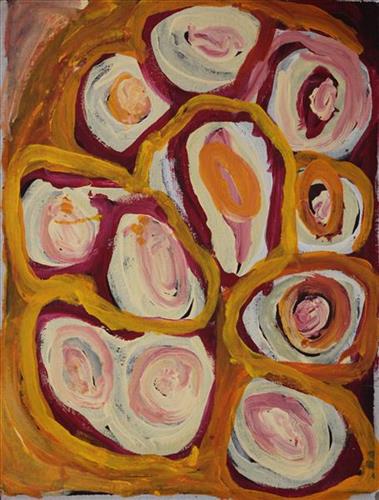
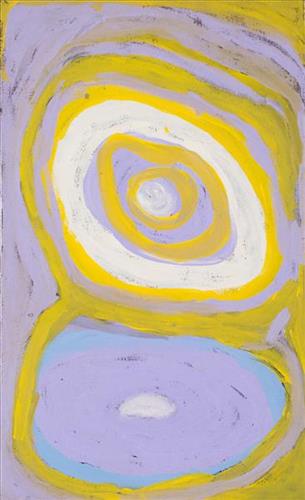
Untitled

“This is a rock hole that was made in the Jukurrpa (Dreamtime). These kanaputa (ancestral beings) are the stars in the sky, the Seven Sisters. They are standing up as a group of trees between Nyipily (Nyipil, Nibil, Canning Stock Route Well 34) and Kunawarritji. I was a little baby here at the rock holes of Kunawarritji and Nyarruri (Canning Stock Route Well 32). I painted all the little hills around that area. In the Jukurrpa, they were all squeezed out of the soft earth. People made them.”

 – Nora Wompi (dec.)

Kunawarritji is an important site in the Great Sandy Desert where multiple stories and histories intersect. Originally a spring water and major Martu pujiman (traditional, desert dwelling) camping site, at the turn of the 20th century Kunawarritji was converted into a well along the Canning Stock Route. Each year throughout the 1930-50s, the well became a site of contact between the drovers, their cattle, and desert families like Wompi’s. Wompi was born near Lipuru (Libral Well, Canning Stock Route Well 37), north east of Kunawarritji. She grew up in the Country between these sites, and from an early age she and her family had encounters with drovers along the Canning Stock Route. As a young woman, Wompi followed the drovers north to Balgo Mission, where she stayed for many years. She learned to paint there with her close friend, Artist Eubena Nampitjin, and returned to Kunawarritji when it became a community in its own right.

As Wompi describes in her account, Kunawarritji features as an important site in the Minyipuru (Jakulyukulyu, Seven Sisters) Jukurrpa (Dreaming). Minyipuru is a central Jukurrpa narrative for Martu, Ngaanyatjarra, Pitjantjatjara and Yankunytjatjara people that is associated with the seasonal Pleiades star constellation. Beginning in Roebourne on the west coast of Western Australia, the story morphs in its movement eastward across the land, following a group of women as they walk, dance, and even fly from waterhole to waterhole. As they travelled the women left markers in the landscape and create landforms that remain to this day. During the entirety of their journey the women are pursued by a lustful old man, Yurla, although interactions with other animals, groups of men, and spirit beings are also chronicled in the narrative. The Minyipuru travelled to Kunawarritji from Nyipily (Nyipil, Nibil, Canning Stock Route Well 34), and transformed themselves into a distinctive group of trees that remain in the area between these two sites. From Kunawarritji Yurla followed the sisters to Pangkapirni, where he finally caught one of the women. 

The Wati Kujarra (Two Goanna Men) is another important Jukurrpa narrative that passes through Kunawarritji. This story also features frequently in Wompi’s paintings for this area. The Wati Kujarra existed as half men, half goanna. They were responsible for the creation of many land features in Martu Country and beyond as they travelled, hunted and burned Country together. 

Today, Kunawarritji is a site of return, a place where people came back to continue their life in the desert with the formation of Kunawarritji Aboriginal community in the early 1980s. The community’s cultural significance endures, with the population swelling up to 1000 during cultural business. In her late years Wompi relocated to her homelands at Kunawarritji, though she continued to travel regularly between Kunawarritji and Balgo. Wompi was a custodian of a great deal of cultural knowledge about the Kunawarritji area, much of which is referred to in her extensive body of work. 
111576676129


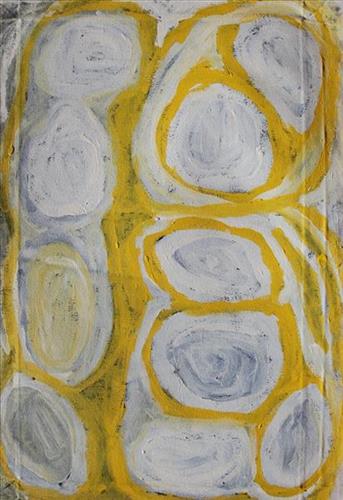
Untitled

This is Nungabar’s Country- her ‘ngurra’ (home Country, camp). People identify with their ngurra in terms of specific rights and responsibilities, and the possession of intimate knowledge of the physical and cultural properties of one’s Country. Painting ngurra, and in so doing sharing the Jukurrpa (Dreaming) stories and physical characteristics of that place, has today become an important means of cultural maintenance. Nungabar’s ngurra encompasses her birthplace, near Lipuru well (Libral Well, Canning Stock Route Well 37) and the Country that became Wells 33 through to 38 along the Canning Stock Route, where her family walked in the pujiman (traditional, desert-dwelling) era. From an early age Nungabar and her family had encounters with the white men who drove cattle along the route. As a young woman, together with her close friend Nora Wompi, Nungabar followed the drovers north to Balgo Mission, where she settled and raised a family.

Portrayed in this work are features of Nungabar’s family’s ngurra, such as the striking salt lakes, permanent red tali (sandhills), warta (trees, vegetation), and the individually named water sources they camped at. Rock holes, waterholes, soaks and springs were all extremely important sites for Martu people during the pujiman period, and are generally depicted with circular forms. 

The encyclopaedic knowledge of the location, quality and seasonal availability of the hundreds of water bodies found in one’s Country sustained Martu as they travelled across their Country, hunting and gathering, visiting family, and fulfilling ceremonial obligations. They would traverse very large distances annually, visiting specific areas in the dry and wet season depending on the availability of water and the corresponding cycles of plant and animal life on which hunting and gathering bush tucker was reliant. As they travelled and hunted they would also burn areas of Country, generating a greater diversity of plant and animal life.