111982284054


Ngalkordow (Brolga)

Throughout the 1990s, artists Lena Yarinkura and her mother Lena Djammarrayku (now deceased) diverged from the more conventional fibre work of their contemporaries, extending traditional weaving techniques and materials to make new ambitious and innovative sculptural forms. Yarinkura applied the dilly bag, fish trap and coil basket weaving techniques to make the body of new forms, such as djamo (dog), yok (bandiboot) and yawkyawk (female water spirit), which she then filled with paperbark and painted with ochre. Yarinkura and her husband Bob Burruwal have also become renowned for their distinctive spirit figures, including wurum and wyarra, which are often displayed as part of large installations. In using her weaving skills to make three-dimensional representations, Yarinkura has adapted a traditional weaving technique to explore new narrative possibilities for expressing important cosmological themes or illustrating stories from her homeland. Yarinkura and Burruwal’s children, grandchildren and extended family, including Yolanda Rostron, Philimena Kelly, Vera Cameron and Gloreen Campion, continue this legacy.

111982284052


Lorrkon (Hollow Log)

The Lorrkon or bone pole coffin ceremony was the final ceremony in a sequence of mortuary rituals celebrated by the people of Arnhem Land. This ceremony involves the placing of the deceased’s bones into a hollow log which was decorated with painted clan designs and ceremonially placed into the ground where it remained until it slowly decayed over many years.

The log is made from a termite hollowed Stringybark tree (Eucalyptus tetradonta) and is decorated with totemic emblems. The western Arnhem Land version of the Lorrkon ceremony involves the singing of sacred songs to the accompaniment of karlikarli, a pair of sacred boomerangs used as rhythm instruments. During the final evening of the ceremony, dancers decorate themselves with kapok down, or today, cotton wool and conduct much of the final segments of the ceremony in the secrecy of a restricted mens’ camp. The complete ceremony may stretch over a period of two weeks, but on the last night the bones of the deceased, which have been kept in a bark container or today wrapped in cloth and kept in a suitcase are taken out, are painted with red ochre and placed inside the hollow log. This ceremony may take place many years after the person has died.

At first light on the final morning of the Lorrkon ceremony, the men appear, coming out of their secret bush camp carrying the pole towards the women’s camp. The two groups call to each other using distinct ceremonial calls. The women have prepared a hole for the pole to be placed into and when it is stood upright, women in particular kinship relationships to the deceased dance around the pole in a jumping/shuffling motion. The Lorrkon is then often covered with a tarpaulin and left to slowly decay.

111982284051


Nguykal (Golden Trevally)

This is a depiction of Nguykal, the Golden Trevally [Gnathanodon speciosus]. In the early times of creation, Nguykal, the Trevally ancestor, travelled as two fish from the east along the coast. As he travelled along the coast he named clans or bapurru. These clans include Gamarl, Mardarrpa, Ritjarrngu, Gumatj, Dhalwangu, Wan.gurri and Warramiri. When Nguykal reached Gu-mugumuk on the east coast of Cape Stewart he leaped from the sea and landed inland at Gamurra Gu-yurra on Warrawarra clan lands. This created the sacred dreaming called Baltha, which is represented in design as a forked shape, reminiscent of the tail of a fish. Baltha stands as a tree at Gamurra Gu-yurra, and the forked shape that the main branches make with the trunk betray its sacred associations.
The Trevally ancestor then returned to the sea and kept travelling around Yinangarnduwa (Cape Stewart). Upon reaching Burnbuwa, a site midway between Yinangarnduwa and Yilan outstation, he became frightened by the appearance of lunggurrma, the clouds and rain associated with the northwest monsoon, which originated from beneath the sea. At this point the two fish separated. One of the Nguykal ancestors went inside at Burnbuwa and remains there as a dreaming, while the other returned back to the east and kept travelling until he reached the Yirrkala area. There he named a site Burnbuwa, which marks the link between these places.
Trevally spend much time swimming in and around the rocky reefs that lie close to shore along the north-central Arnhem Land coast. The formation swimming of the trevally has a religious dimension, and when the Gamarl and their close clansmen dance the Trevally ancestor, they also dance in formation like a school of fish and at one stage two groups of men will dance towards each other.
In painted depictions, cross-hatched stripes of infill surrounding Nguykal may represent rrawa or country at Burnbuwa and other places along the north-eastern Arnhem Land coast where Nguykal swam. Different clan groups each hold tenure over separate sections of country, but together they form a ‘company’ of related clans. These clans form a network linked by a system of reciprocal kinship and ceremonial ties. The Golden Trevally Ancestor is the explanation for the links between the different clan groups, and today the celebration of Nguykal’s creation journey in song, dance and design by the members of these groups continues to strengthen the kinship and ceremonial links between the members of these clans. 

377810582284014


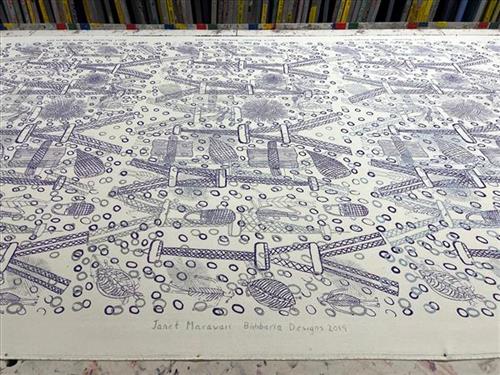
Eiffel tower and the Maladj spirit

“I want to tell you about my design, that Eiffel tower one.

This year it was my first time going to Paris. I didn’t know that place, nothing. We travelled around the world to get there, we flew underneath the world in an aeroplane.

Paris was a big, crowded city. They speak a different language there, just like here in Maningrida with all our different languages.

The Bábbarra artists and Ingrid, we were all walking around, like tourists. We went on the boat in the Paris river. There was a film crew taking videos of us. We saw so many beautiful buildings covered with black string (iron balconies) and big statues. We’d never seen things like that before.

I remember when we got off that boat and I looked up and saw that tower. When I first looked up at that tower, it made me happy- it’s so long up into the sky. We walked towards it. I was standing there watching that tower and thinking, ‘wow, first time for me seeing a tower like that’.

Then I was thinking, and I said to myself, when I go back to my own country, I’m going to paint that tower.

We came to Maningrida, I started to draw. I drew that tower from France, but also I drew maladj (stone country orphan spirit), women’s sacred woven mat, fish traps and rolk (insects). I also put round kunngol (clouds) in the design, those circles. That maladj spirit, it’s standing there next to the Eiffel tower, looking at the dancing lights at night. The tower is from Paris, but everything else in my design I took from my mother’s country and my father’s country.

Maybe one day I’ll travel back to France, and take my design with me to show them, all the French mob.” Janet Marawarr

377810582283994


Bawáliba and Ngalyod (Rainbow Serpent)

‘My Kikka (mother), when she was alive, she would tell me these stories. I was just a  little girl and she would tell us the stories in her language Gurrgoni.

In the camps there were boy and girl Bawaliba, and old Bawaliba too. They loved to  dance by the firelight, keeping rhythm with a stick. They had lots of hair, they were  really tall and skinny, with spots on their bodies. The Bawaliba lived a long time in  peace. They were the only spirits on their country and so they were never disturbed.

One day, a long time ago, the Bawaliba were out hunting and they saw a large  snake- they didn’t know then but she was the Rainbow Serpent. They were really  scared, they had never seen that. creature before. She was really beautiful- like a  normal king brown snake but with a rainbow from the sky on her back. The rainbow  serpent was really hungry, and she could smell the Bawaliba from a long way away.  She was out looking for food.  The Bawaliba tried to stop Ngalyod coming for them but she was just too quick. She  snuck up behind the Bawaliba and before they could get away she ate them up.  When she was really full and couldn’t eat anymore Bawaliba she changed the rest of  them into stone. Still til this day, the Bawaliba stay on that same country as stones.’ Lucy Yarawanga

359709482006124


ISLAND TOP (BACK) – 3 OF 4

Island Top is worn everyday by Ama’s and Aka’s. island top range from different colours and beautiful patterning. 

Art Centre notes:

The artwork is an unframed collagraph,  printed on BFK Rives paper (100% cotton rag with strong archival properties). Signed on front.

Printer: Paula Savage

Print Assistant: Dian Darmansjah


359709482084893


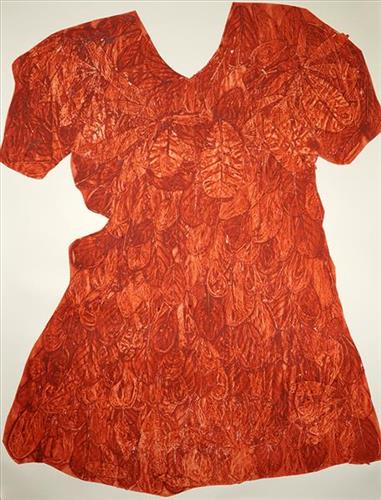
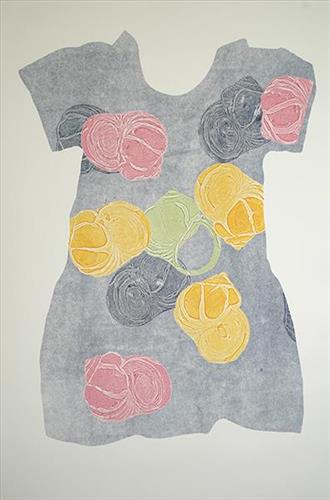
Wongai Dress 1 of 4

This dress is a continuation of my small wongai print I did on my bigger dress. I used cassava and dried wongai leaves to make my garden island design.

Art Centre notes:

The artwork is an unframed collagraph, printed on BFK Rives paper (100% cotton rag with strong archival properties). Signed on reverse.

The print is embossed with the design elements.

Printer: Paula Savage

Print Assistant: Dian Darmansjah

359709482086083


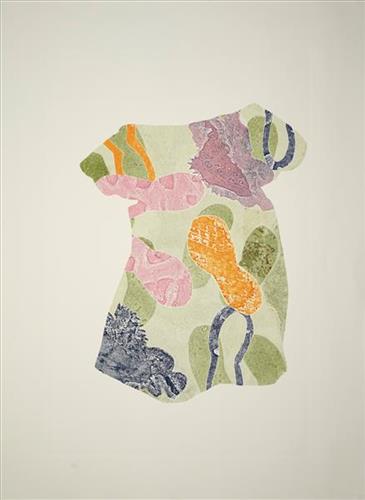
Mepah Leaf Dress 4 of 4

My Mepah design dress I used cassava and cashew and mepah leaves to make a floral and garden design. Cassava are on the bottom of the dress and cashew and mepah leaves go in the middle.

Art Centre notes:

The artwork is a framed monoprint, printed on BFK Rives paper (100% cotton rag with strong archival properties). Signed on reverse.

The print  is embossed with the design elements.

359709482262036


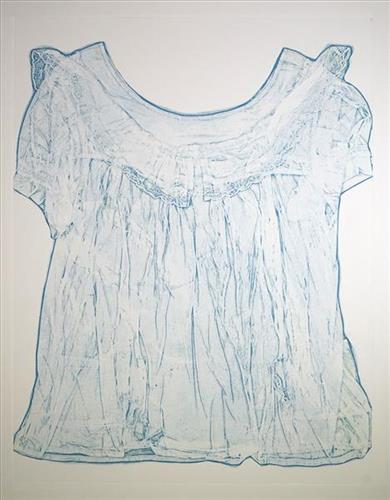
Blue Peri Dress

My favourite shell (peri winkle shell) design on my island dress. The blue represents the saltwater that we are surrounded and see everyday. 

Art Centre notes:

The artwork is a framed ‘pochoir’ print, or monotype, printed on BFK Rives paper (100% cotton rag with strong archival property). Signed on the front. 

Printer: Paula Savage

Print Assistant: Dian Darmansjah

359709482262809


What is It?

Going down to the reef on low tide looking for small clam shells, Dad would always remind me to be cautious of ston fish (stonefish). 

Art Centre notes: The artwork is a framed ‘pochoir’ print, or monotype, printed on BFK Rives paper (100% cotton rag with strong archival properties). Signed by the artist on the reverse.

Printer: Paula Savage

Print Assistant: Dian Darmansjah