111982282814


Warraburnburn

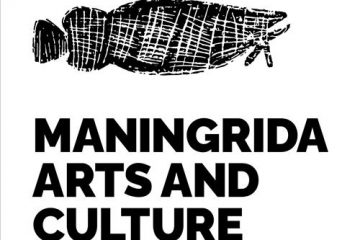
In Burarra and Gun-nartpa languages the figure represented in this artwork is generally known as a wangarra ‘ghost spirit’. For the Warrawarra clan ghost spirits have their own particular characteristics and their own name – Warraburnburn.

The Warraburnburn and the closely related Galabarrbarr spirit (owned by the Balkarranga clan) are also manikay song topics.  The spirits are related to each other as maternal grandparent and grandchild, just as the people of Warrawarra and Balkarranga are. The dancing of the two ghost spirit figures forms the finale performance for funerals, and is the final goodbye to a deceased family member.

In many ways the Warraburnburn and Galabarrbarr ghost spirits are like people. They emerge from the patches of jungle on Warrawarra and Balkarranga country in the late afternoon and go hunting in family groups of men, women and children. They stay in contact with each other by calling out as the men hunt for fish and the women walk with their dillybags looking for vegetable food. 

The ghost spirits are associated closely with white ochre and artists commonly paint the bodies of carved figures in white. Different types of ghost spirit wear different patterns. Warraburnburn is decorated with uniform white dots while others are painted white all over. Some ghost spirits are shown with a design painted on their chest infilled with rarrk ‘cross-hatching’, the same designs that are painted onto japi an-guyinda ‘male initiations’. 

They also have supernatural characteristics including superhuman size (jarra anbaykarda ‘super tall’). They know the country intimately – some are malevolent towards humans and will lead people astray, taking them to unfamiliar and dangerous places. These malevolent spirits are likened to an-muburda ‘sorcerers’ and can conduct dangerous rituals that cause harm to people. Others are benign and will lead humans back to familiar paths and their own camps.
 

111982282813


Warraburnburn

In Burarra and Gun-nartpa languages the figure represented in this artwork is generally known as a wangarra ‘ghost spirit’. For the Warrawarra clan ghost spirits have their own particular characteristics and their own name – Warraburnburn.

The Warraburnburn and the closely related Galabarrbarr spirit (owned by the Balkarranga clan) are also manikay song topics.  The spirits are related to each other as maternal grandparent and grandchild, just as the people of Warrawarra and Balkarranga are. The dancing of the two ghost spirit figures forms the finale performance for funerals, and is the final goodbye to a deceased family member.

In many ways the Warraburnburn and Galabarrbarr ghost spirits are like people. They emerge from the patches of jungle on Warrawarra and Balkarranga country in the late afternoon and go hunting in family groups of men, women and children. They stay in contact with each other by calling out as the men hunt for fish and the women walk with their dillybags looking for vegetable food. 

The ghost spirits are associated closely with white ochre and artists commonly paint the bodies of carved figures in white. Different types of ghost spirit wear different patterns. Warraburnburn is decorated with uniform white dots while others are painted white all over. Some ghost spirits are shown with a design painted on their chest infilled with rarrk ‘cross-hatching’, the same designs that are painted onto japi an-guyinda ‘male initiations’. 

They also have supernatural characteristics including superhuman size (jarra anbaykarda ‘super tall’). They know the country intimately – some are malevolent towards humans and will lead people astray, taking them to unfamiliar and dangerous places. These malevolent spirits are likened to an-muburda ‘sorcerers’ and can conduct dangerous rituals that cause harm to people. Others are benign and will lead humans back to familiar paths and their own camps.
 

111982282812


Warraburnburn

In Burarra and Gun-nartpa languages the figure represented in this artwork is generally known as a wangarra ‘ghost spirit’. For the Warrawarra clan ghost spirits have their own particular characteristics and their own name – Warraburnburn.

The Warraburnburn and the closely related Galabarrbarr spirit (owned by the Balkarranga clan) are also manikay song topics.  The spirits are related to each other as maternal grandparent and grandchild, just as the people of Warrawarra and Balkarranga are. The dancing of the two ghost spirit figures forms the finale performance for funerals, and is the final goodbye to a deceased family member.

In many ways the Warraburnburn and Galabarrbarr ghost spirits are like people. They emerge from the patches of jungle on Warrawarra and Balkarranga country in the late afternoon and go hunting in family groups of men, women and children. They stay in contact with each other by calling out as the men hunt for fish and the women walk with their dillybags looking for vegetable food. 

The ghost spirits are associated closely with white ochre and artists commonly paint the bodies of carved figures in white. Different types of ghost spirit wear different patterns. Warraburnburn is decorated with uniform white dots while others are painted white all over. Some ghost spirits are shown with a design painted on their chest infilled with rarrk ‘cross-hatching’, the same designs that are painted onto japi an-guyinda ‘male initiations’. 

They also have supernatural characteristics including superhuman size (jarra anbaykarda ‘super tall’). They know the country intimately – some are malevolent towards humans and will lead people astray, taking them to unfamiliar and dangerous places. These malevolent spirits are likened to an-muburda ‘sorcerers’ and can conduct dangerous rituals that cause harm to people. Others are benign and will lead humans back to familiar paths and their own camps.
 

377810582283238


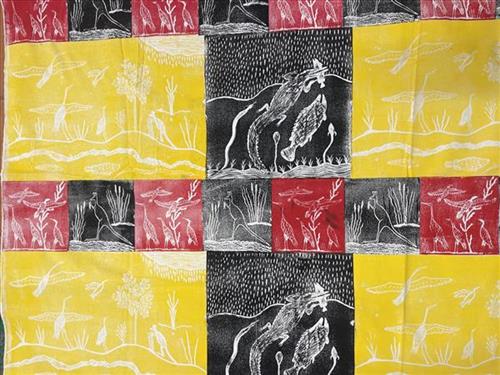
Wayuk

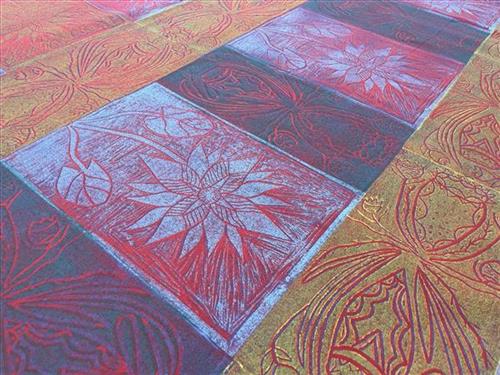
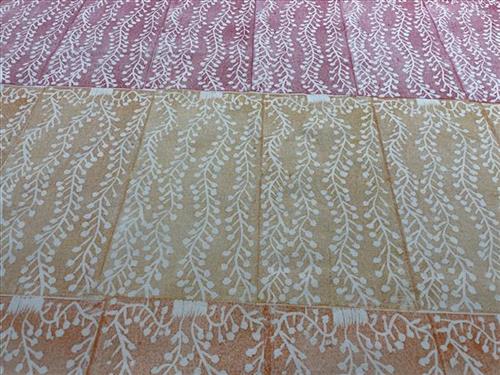
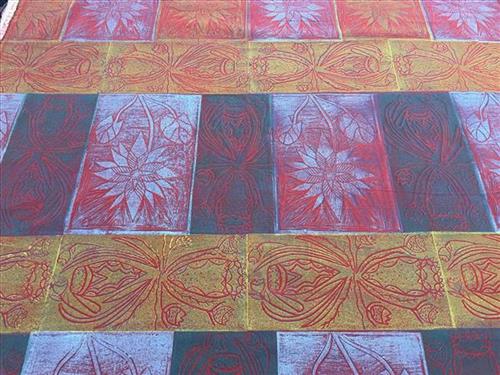
Wayuk (Waterlily) Nymphaea violacea. 

The stem of wayuk is a popular bushfood and the beautiful flower is enjoyed across Arnhem Land. 

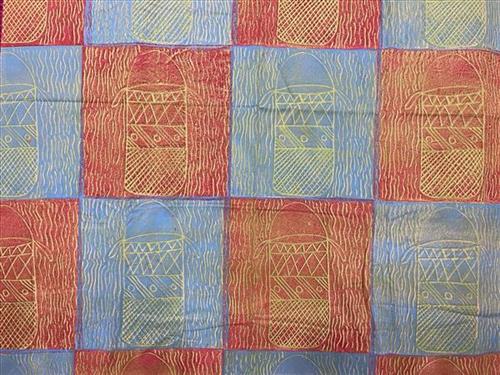
This fabric was created using the linocut printing technique. The lino tile has been carved by the artist in Maningrida, and has been printed by hand using a variety of colours and layers. The linocut technique ensures each textile piece is a one-off, limited edition piece. Bábbarra Women’s Centre supports the economic independence of Indigenous women in the Arnhem Land community of Maningrida, Northern Territory, Australia. Designs created by the women at Bábbarra reflect strong cultural knowledge, which is passed down to younger generations through their textile design practice.

377810582283157


Dedded Wongkorr (ceremonial dilly bag with feathers) – ARCHIVE

This design depicts a ‘wongkorr’ sacred dilly bag woven with brightly coloured orange parrot feathers called ‘dedded’. It is depicted alongside a digging stick. Wongkorr are used in a number of public ceremonial contexts, and are sacred objects for the Bininj Kunwok speaking people of Western Arnhem Land.

‘This is a really special kind of dillybag for us, not like a normal dillybag.

This story was from a long time ago, when my great great grandfather was alive. He’s the one that was a medicine man for our people.
We are not supposed to see that sacred spirit dillybag that lives below the saltwater. If we ever see that site, it might drag us under and drown us. When the tide goes out he floats and when the tide comes in he goes under to hide.

This story is about fresh water and salt water mixing and our ancient law. There are strings of the Wongkorr hold it under the water. The Wongkorr is made with lorikeet parrot feathers and Kurrajong bark string.

I remember having a ceremony at that outstation Bolkjam when I was only 16 years old, near Ji Bal-bal homeland, and my father would tell me the story of the Wongkorr sacred site. My two sisters taught me to paint, and my Dad was a famous painter. Some balanda (non-Indigneous) know my father’s painting, it is about digging sticks, sharks and wongkorr.

This story links to mixed water, plant life and animals living at the artist’s country, and following the lessons and knowledge of the ancestors.’ Elizabeth Kala Kala

This was printed in August 2018

377810582283231


Ngalkunburriyaymi (Mermaid) – Archive

Ngalkunburriyaymi 

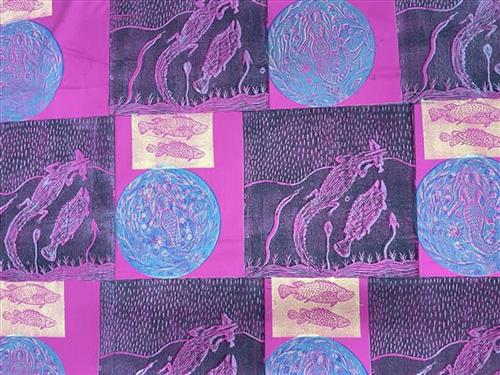
Kuninjku people call mermaids yawkyawk, but in my language, Kune, we call them Ngalkunburriyaymi (pronounced Ngaal gun borro yay mee).

The Ngalkunburriyaymi depicted in my artworks is from a place called Marra-yii (sp?).  There are too many Ngalkunburriyaymi living at this place.  They are always there and have been there forever. We can go camping and fishing at this place.  Marar-yii is a place in the river. They are freshwater. They are Duwa moiety. Same as the freshwater crocodile. 

My mum told me her story.  Ngalkunburriyaymi gave her a baby.  Ngalkunburriyaymi came to her in a dream.  They gave her my brother. In my mother’s dream, she went fishing Marra-yii and Ngalkunburriyaymi came to her to tell her she was having a baby.  She said to her I will give you a baby.  In a couple of months, you will be pregnant.

Ngalkunburriyaymi eats fish and waterlilies.

Owen Yalandja is my cousin from my father’s side and Lulu is my grandmother also from my father’s side. They are from different outstations, but we are family.  My Ngalkunburriyaymi story is connected to them but different.

I love my mother’s story and it is why I made a lino plate. I print it on different colour fabrics – silk, linen and cotton. I like using lots of different colours.  I come from a family who have made artwork on bark and hollow logs using ochre—black, yellow, red and white. But at Babbarra Designs, we can use bright colours in our fabric designs.

111982283230


Lorrkon (Hollow Log)

The Lorrkon or bone pole coffin ceremony was the final ceremony in a sequence of mortuary rituals celebrated by the people of Arnhem Land. This ceremony involves the placing of the deceased’s bones into a hollow log which was decorated with painted clan designs and ceremonially placed into the ground where it remained until it slowly decayed over many years.

The log is made from a termite hollowed Stringybark tree (Eucalyptus tetradonta) and is decorated with totemic emblems. The western Arnhem Land version of the Lorrkon ceremony involves the singing of sacred songs to the accompaniment of karlikarli, a pair of sacred boomerangs used as rhythm instruments. During the final evening of the ceremony, dancers decorate themselves with kapok down, or today, cotton wool and conduct much of the final segments of the ceremony in the secrecy of a restricted mens’ camp. The complete ceremony may stretch over a period of two weeks, but on the last night the bones of the deceased, which have been kept in a bark container or today wrapped in cloth and kept in a suitcase are taken out, are painted with red ochre and placed inside the hollow log. This ceremony may take place many years after the person has died.

At first light on the final morning of the Lorrkon ceremony, the men appear, coming out of their secret bush camp carrying the pole towards the women’s camp. The two groups call to each other using distinct ceremonial calls. The women have prepared a hole for the pole to be placed into and when it is stood upright, women in particular kinship relationships to the deceased dance around the pole in a jumping/shuffling motion. The Lorrkon is then often covered with a tarpaulin and left to slowly decay.

111982283228


Lorrkon (Hollow Log)

The Lorrkon or bone pole coffin ceremony was the final ceremony in a sequence of mortuary rituals celebrated by the people of Arnhem Land. This ceremony involves the placing of the deceased’s bones into a hollow log which was decorated with painted clan designs and ceremonially placed into the ground where it remained until it slowly decayed over many years.

The log is made from a termite hollowed Stringybark tree (Eucalyptus tetradonta) and is decorated with totemic emblems. The western Arnhem Land version of the Lorrkon ceremony involves the singing of sacred songs to the accompaniment of karlikarli, a pair of sacred boomerangs used as rhythm instruments. During the final evening of the ceremony, dancers decorate themselves with kapok down, or today, cotton wool and conduct much of the final segments of the ceremony in the secrecy of a restricted mens’ camp. The complete ceremony may stretch over a period of two weeks, but on the last night the bones of the deceased, which have been kept in a bark container or today wrapped in cloth and kept in a suitcase are taken out, are painted with red ochre and placed inside the hollow log. This ceremony may take place many years after the person has died.

At first light on the final morning of the Lorrkon ceremony, the men appear, coming out of their secret bush camp carrying the pole towards the women’s camp. The two groups call to each other using distinct ceremonial calls. The women have prepared a hole for the pole to be placed into and when it is stood upright, women in particular kinship relationships to the deceased dance around the pole in a jumping/shuffling motion. The Lorrkon is then often covered with a tarpaulin and left to slowly decay.

377810582283227


Modjarrkki (Freshwater Crocodile Story) – Archive

Modjarrkki (Freshwater Crocodile) 

Kune language

‘This is a true story. My great great grandfather and my father told this story and I tell it to my children. It’s about a freshwater crocodile called Modjarrkki. One day an unmarried man who was camping with his brother and his brothers wife went walking by himself. He came to a creek where he found a crocodile. He went back to camp and said to his brother ‘hey I found a croc, lets go kill it!’. He tried to kill the crocodile but the crocodile bit his brother. He bit his guts, his hand, his legs and he died. Modjarrkki was an angry crocodile but today Modjarkki doesn’t bite people, he’s only a little crocodile and he eats barramundi. He is still alive and he lives in rock country, Karrabarda, which is in Gorlobidahdah.’ Jay Rostron Jurrupula