Ngokngok (Owl)
Ngokngok or mun-ngokngok is the Southern Boobook owl. Their clan is Warrawarra and the are connected to witch doctors and traditional healers.
Ngokngok or mun-ngokngok is the Southern Boobook owl. Their clan is Warrawarra and the are connected to witch doctors and traditional healers.
Mats can vary greatly. Artists commonly use a mix of naturally dyed and undyed fibre to create a striking variation of coloured bands. Some artists also incorporate different types of looping to produce different patterns and textured finishes. Each type of mat, fibre bag, basket and dilly bag has its own name in the various languages spoken in the Maningrida region.
Mats can vary greatly. Artists commonly use a mix of naturally dyed and undyed fibre to create a striking variation of coloured bands. Some artists also incorporate different types of looping to produce different patterns and textured finishes. Each type of mat, fibre bag, basket and dilly bag has its own name in the various languages spoken in the Maningrida region.
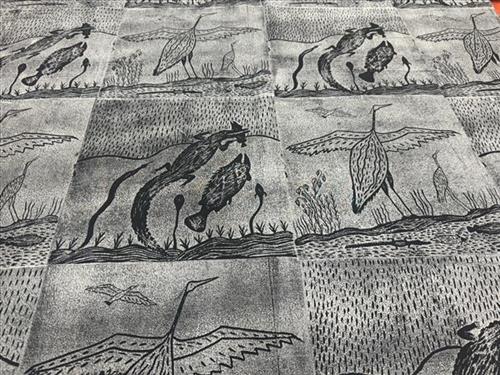
The artist has carved the ‘Gomarla’, which in the Burarra word for Egret. This bird is native to the country of Yilan, which is the coastal region North West of Maningrida Community.
People use feathers from gomarla to make ceremonial regalia for Yirrichinga. Many Yirrichinga groups own manikay ‘song’ for gomarla.
Gomarla mun-baparrurr Gopungorra. Jin-gubatbatcha jin-banga jiny-yorkiya. Gomarla waykin makukuya mu-guyinda.
The egret belongs to the Gopungorra clan. It always eats grasshoppers. The egret is high in a nest (builds its nest in the tree).
The artist has carved the ‘Gomarla’, which in the Burarra word for Egret. This bird is native to the country of Yilan, which is the coastal region North West of Maningrida Community.
People use feathers from gomarla to make ceremonial regalia for Yirrichinga. Many Yirrichinga groups own manikay ‘song’ for gomarla.
Gomarla mun-baparrurr Gopungorra. Jin-gubatbatcha jin-banga jiny-yorkiya. Gomarla waykin makukuya mu-guyinda.
The egret belongs to the Gopungorra clan. It always eats grasshoppers. The egret is high in a nest (builds its nest in the tree).
This is a depiction of Ngalkunburriyaymi or Yawkyawk, the fish-women spirit. Sometimes compared to the European notion of mermaids, they exist as spiritual beings living in freshwater streams, particularly those in the stone country. These water spirits are perhaps the most enigmatic, and are usually described and depicted with the tails of fish. Thus the Kuninjku people sometime call them ngalberddjenj which literally means ‘the woman who has a tail like a fish’. They have long hair which is associated with trailing blooms of green algae (man-bak in Kuninjku) found in freshwater streams and rock pools. At times they leave their aquatic homes to walk about on dry land, particularly at night.
Aboriginal people believe that at one time all animals were humans. During the time of the creation of landscapes and plants and animals, these ancestor heroes in human form changed into their animal forms via a series of various significant events now recorded as oral mythologies. Today the Kuninjku believe that ngalkunburriyaymi are alive and well and living in freshwater sites in a number of sacred locations. The Kuninjku also believe that ‘clever’ man (magicians with mystical powers called na-kordang) may take these spirits as wives. The father of Mandarrk, a well known artist who resided in the Central Arnhem area, is said to have had such a spirit as a wife. Unfortunately, it is said, she failed one day to return from being sent to fetch water from the river, and returned to her kin. The ngalkunburriyaymi also have husbands and children of their own kind. Their sites are usually shared with the rainbow serpent ngalyod. Some have ritual importance, for example in some depictions, the yawkyawk spirit holds ceremonial string, just like the lengths of string women hold between both hands today during certain public ceremonies.
There are at least three major ngalkunburriyaymi sacred sites that are well known in the area south and south-west of Maningrida. One site Bolerrhlerr is on the Mann River at a place near Yikarrakkal Outstation where there are rugged rocky banks and clefts beneath stone overhangs in the water. Another very similar site further west in the Kumadderr River district is surrounded by a number of small but very old rock art sites and has become known in English as ‘Dreaming Lady’. A third site is a major yawkyawk dreaming place which is so significant that the traditional Dangkorlo clan custodians have set up an outstation near the site. The identity of this group is very much related to their yawkyawk dreaming for which they have spiritual and practical responsibility.
Yawkyawk is a word in the Kunwinjku/Kunwok language of Western Arnhem Land meaning ‘young woman’ and ‘young woman spirit being’. The different groups of Kunwinjku people (one of the Eastern dialect groups call themselves Kuninjku) each have Yawkyawk mythologies, which relate to specific locations in clan estates. These mythologies are represented in bark paintings and sculptures of Yawkyawk beings. There are also a few examples of rock art images of these beings.
The female water spirits Yawkyawk or Ngalkunburriyaymi are perhaps the most enigmatic of mythological themes. Sometimes compared to the European notion of mermaids, they exist as spiritual beings living in freshwater streams and rock pools, particularly those in the stone country. The spirit Yawkyawk is usually described and depicted with the tail of a fish. Thus the Kuninjku people sometimes call them ngalberddjenj which literally means ‘the young woman who has a tail like a fish’. They have long hair, which is associated with trailing blooms of green algae (called man-bak in Kuninjku). At times they leave their aquatic homes to walk about on dry land, particularly at night.
Aboriginal people believe that in the beginning most animals were humans. During the time of the creation of landscapes and plants and animals, these ancestral heroes in human form transmutated into their animal forms via a series of various significant events now recorded as oral mythologies. The creation ancestor Yawkyawk travelled the country in human form and changed into the form of Ngalkunburriyaymi as a result of various ancestral adventures. Today the Kuninjku believe that Ngalkunburriyaymi are alive and well and living in freshwater sites in a number of sacred locations.
Some features of a respective country are equated with body parts of Yawkyawk. For example a bend in a river or creek may be said to be ‘the tail of the Yawkyawk, a billabong may be ‘the head of the Yawkyawk and so on. Thus different groups can be linked together by means of a shared mythology featured in the landscape, which crosscuts clan and language group boundaries.
This is a depiction of Ngalkunburriyaymi or Yawkyawk, the fish-women spirit. Sometimes compared to the European notion of mermaids, they exist as spiritual beings living in freshwater streams, particularly those in the stone country. These water spirits are perhaps the most enigmatic, and are usually described and depicted with the tails of fish. Thus the Kuninjku people sometime call them ngalberddjenj which literally means ‘the woman who has a tail like a fish’. They have long hair which is associated with trailing blooms of green algae (man-bak in Kuninjku) found in freshwater streams and rock pools. At times they leave their aquatic homes to walk about on dry land, particularly at night.
Aboriginal people believe that at one time all animals were humans. During the time of the creation of landscapes and plants and animals, these ancestor heroes in human form changed into their animal forms via a series of various significant events now recorded as oral mythologies. Today the Kuninjku believe that ngalkunburriyaymi are alive and well and living in freshwater sites in a number of sacred locations. The Kuninjku also believe that ‘clever’ man (magicians with mystical powers called na-kordang) may take these spirits as wives. The father of Mandarrk, a well known artist who resided in the Central Arnhem area, is said to have had such a spirit as a wife. Unfortunately, it is said, she failed one day to return from being sent to fetch water from the river, and returned to her kin. The ngalkunburriyaymi also have husbands and children of their own kind. Their sites are usually shared with the rainbow serpent ngalyod. Some have ritual importance, for example in some depictions, the yawkyawk spirit holds ceremonial string, just like the lengths of string women hold between both hands today during certain public ceremonies.
There are at least three major ngalkunburriyaymi sacred sites that are well known in the area south and south-west of Maningrida. One site Bolerrhlerr is on the Mann River at a place near Yikarrakkal Outstation where there are rugged rocky banks and clefts beneath stone overhangs in the water. Another very similar site further west in the Kumadderr River district is surrounded by a number of small but very old rock art sites and has become known in English as ‘Dreaming Lady’. A third site is a major yawkyawk dreaming place which is so significant that the traditional Dangkorlo clan custodians have set up an outstation near the site. The identity of this group is very much related to their yawkyawk dreaming for which they have spiritual and practical responsibility.
This is a depiction of Ngalkunburriyaymi or Yawkyawk, the fish-women spirit. Sometimes compared to the European notion of mermaids, they exist as spiritual beings living in freshwater streams, particularly those in the stone country. These water spirits are perhaps the most enigmatic, and are usually described and depicted with the tails of fish. Thus the Kuninjku people sometime call them ngalberddjenj which literally means ‘the woman who has a tail like a fish’. They have long hair which is associated with trailing blooms of green algae (man-bak in Kuninjku) found in freshwater streams and rock pools. At times they leave their aquatic homes to walk about on dry land, particularly at night.
Aboriginal people believe that at one time all animals were humans. During the time of the creation of landscapes and plants and animals, these ancestor heroes in human form changed into their animal forms via a series of various significant events now recorded as oral mythologies. Today the Kuninjku believe that ngalkunburriyaymi are alive and well and living in freshwater sites in a number of sacred locations. The Kuninjku also believe that ‘clever’ man (magicians with mystical powers called na-kordang) may take these spirits as wives. The father of Mandarrk, a well known artist who resided in the Central Arnhem area, is said to have had such a spirit as a wife. Unfortunately, it is said, she failed one day to return from being sent to fetch water from the river, and returned to her kin. The ngalkunburriyaymi also have husbands and children of their own kind. Their sites are usually shared with the rainbow serpent ngalyod. Some have ritual importance, for example in some depictions, the yawkyawk spirit holds ceremonial string, just like the lengths of string women hold between both hands today during certain public ceremonies.
There are at least three major ngalkunburriyaymi sacred sites that are well known in the area south and south-west of Maningrida. One site Bolerrhlerr is on the Mann River at a place near Yikarrakkal Outstation where there are rugged rocky banks and clefts beneath stone overhangs in the water. Another very similar site further west in the Kumadderr River district is surrounded by a number of small but very old rock art sites and has become known in English as ‘Dreaming Lady’. A third site is a major yawkyawk dreaming place which is so significant that the traditional Dangkorlo clan custodians have set up an outstation near the site. The identity of this group is very much related to their yawkyawk dreaming for which they have spiritual and practical responsibility.
Modjarrkki (Freshwater Crocodile)
Kune language
‘This is a true story. My great great grandfather and my father told this story and I tell it to my children. It’s about a freshwater crocodile called Modjarrkki. One day an unmarried man who was camping with his brother and his brothers wife went walking by himself. He came to a creek where he found a crocodile. He went back to camp and said to his brother ‘hey I found a croc, lets go kill it!’. He tried to kill the crocodile but the crocodile bit his brother. He bit his guts, his hand, his legs and he died. Modjarrkki was an angry crocodile but today Modjarkki doesn’t bite people, he’s only a little crocodile and he eats barramundi. He is still alive and he lives in rock country, Karrabarda, which is in Gorlobidahdah.’ Jay Rostron Jurrupula