111582291786


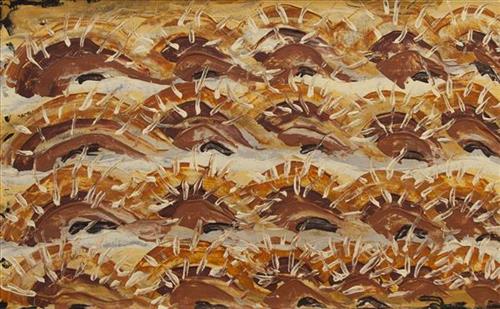
Spinifex

“When I went back to County, I thought how beautiful the spinifex was. How the sun glazed against the spinifex. The County that I speak of is Jilukurru, my grandfather’s country.”

– Kathleen Maree Sorenson

Martu Country is dominated by striking permanent tali (sandhills) covered with spinifex, gums, and other trees and shrubs. Spinifex is a pale green, spiky grass that grows in clumps throughout the Central and Western Deserts of Australia. Some varieties yield edible seeds and another contains a resin. 

111582291785


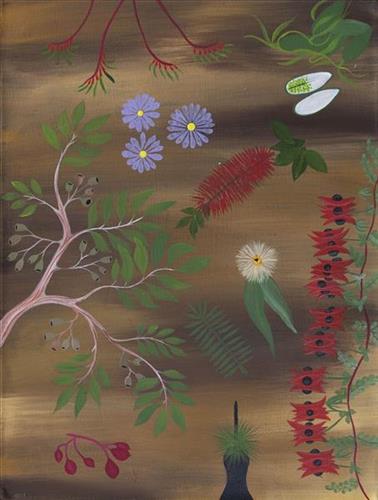
Untitled

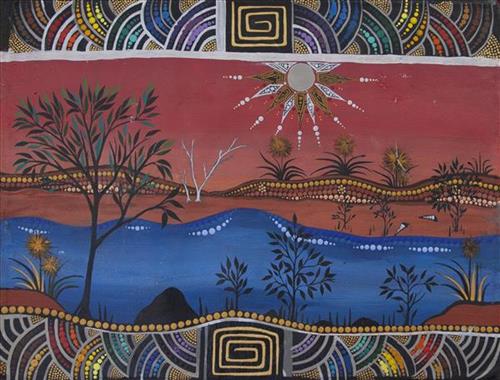
This work portrays an area known to the artist, painted here from memory. During the pujiman (traditional, desert dwelling) era one’s survival depended on their intimate knowledge of the location of resources; thus physical elements of Country, such as sources of kapi (water), tali (sandhills), and different varieties of warta (trees, vegetation) were carefully observed and remembered. Today, this relationship with Country remains equally strong, despite the movement of Martu out of the desert and into remote Aboriginal communities, towns and cities.

Also visible may be traces of life cycles based around kalyu (rain, water) and waru (fire). A thousands of year old practice, fire burning continues to be carried out as both an aid for hunting and a means of land management today. As the Martu travelled and hunted they would burn tracts of land, ensuring plant and animal biodiversity and reducing the risk of unmanageable, spontaneous bush fires. The patchwork nature of regrowth is visible in many landscape works, with each of the five distinctive phases of fire burning visually described with respect to the cycle of burning and regrowth.  

Finally, metaphysical information relating to a location may also be recorded; Jukurrpa (Dreaming) narratives chronicle the creation of physical landmarks, and can be referenced through depictions of ceremonial sites, songlines, and markers left in the land. 

111582291784


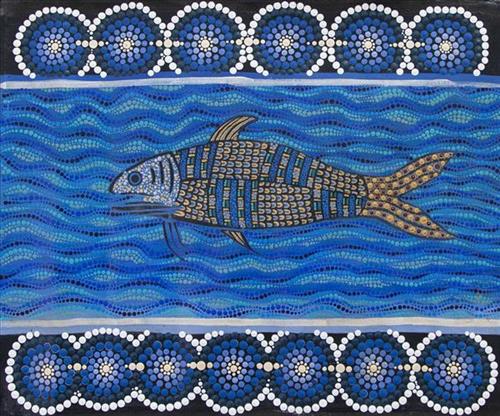
Untitled

“When Martu paint, it’s like a map. Martu draw story on the ground and on the canvas, and all the circle and line there are the hunting areas and different waters and tracks where people used to walk, and [some you] can’t cross, like boundaries. So nowadays you see a colourful painting and wonder what it is, but that’s how Martu tell story long ago. It’s not just a lovely painting, it’s a story and a songline and a history and everything that goes with it.” 

– Ngalangka Nola Taylor and Joshua Booth

This work portrays an area of Country that can be interpreted in multiple ways. Firstly, the image may be read as an aerial representation of a particular location known to the artist- either land that they or their family travelled, from the pujiman (traditional, desert dwelling) era to now. During the pujiman period, Martu would traverse very large distances annually in small family groups, moving seasonally from water source to water source, and hunting and gathering bush tucker as they went. At this time, one’s survival depended on their intimate knowledge of the location of resources; thus physical elements of Country, such as sources of kapi (water), tali (sandhills), different varieties of warta (trees, vegetation), ngarrini (camps), and jina (tracks) are typically recorded with the use of a use of a system of iconographic forms universally shared across the desert. 

An additional layer of meaning in the work relates to more intangible concepts; life cycles based around kalyu (rain, water) and waru (fire) are also often evident. A thousands of year old practice, fire burning continues to be carried out as both an aid for hunting and a means of land management today. As the Martu travelled and hunted they would burn tracts of land, ensuring plant and animal biodiversity and reducing the risk of unmanageable, spontaneous bush fires. The patchwork nature of regrowth is evident in many landscape works, with each of the five distinctive phases of fire burning visually described with respect to the cycle of burning and regrowth.  

Finally, metaphysical information relating to a location may also be recorded; Jukurrpa (Dreaming) narratives chronicle the creation of physical landmarks, and can be referenced through depictions of ceremonial sites, songlines, and markers left in the land. Very often, however, information relating to Jukurrpa is censored by omission, or alternatively painted over with dotted patterns.

111582291783


Untitled

“When Martu paint, it’s like a map. Martu draw story on the ground and on the canvas, and all the circle and line there are the hunting areas and different waters and tracks where people used to walk, and [some you] can’t cross, like boundaries. So nowadays you see a colourful painting and wonder what it is, but that’s how Martu tell story long ago. It’s not just a lovely painting, it’s a story and a songline and a history and everything that goes with it.” 

– Ngalangka Nola Taylor and Joshua Booth

This work portrays an area of Country that can be interpreted in multiple ways. Firstly, the image may be read as an aerial representation of a particular location known to the artist- either land that they or their family travelled, from the pujiman (traditional, desert dwelling) era to now. During the pujiman period, Martu would traverse very large distances annually in small family groups, moving seasonally from water source to water source, and hunting and gathering bush tucker as they went. At this time, one’s survival depended on their intimate knowledge of the location of resources; thus physical elements of Country, such as sources of kapi (water), tali (sandhills), different varieties of warta (trees, vegetation), ngarrini (camps), and jina (tracks) are typically recorded with the use of a use of a system of iconographic forms universally shared across the desert. 

An additional layer of meaning in the work relates to more intangible concepts; life cycles based around kalyu (rain, water) and waru (fire) are also often evident. A thousands of year old practice, fire burning continues to be carried out as both an aid for hunting and a means of land management today. As the Martu travelled and hunted they would burn tracts of land, ensuring plant and animal biodiversity and reducing the risk of unmanageable, spontaneous bush fires. The patchwork nature of regrowth is evident in many landscape works, with each of the five distinctive phases of fire burning visually described with respect to the cycle of burning and regrowth.  

Finally, metaphysical information relating to a location may also be recorded; Jukurrpa (Dreaming) narratives chronicle the creation of physical landmarks, and can be referenced through depictions of ceremonial sites, songlines, and markers left in the land. Very often, however, information relating to Jukurrpa is censored by omission, or alternatively painted over with dotted patterns.

111982292134


Mat

Mats can vary greatly. Artists commonly use a mix of naturally dyed and undyed fibre to create a striking variation of coloured bands. Some artists also incorporate different types of looping to produce different patterns and textured finishes. Each type of mat, fibre bag, basket and dilly bag has its own name in the various languages spoken in the Maningrida region.

377810582291944


Kundalk (Grasses) and Kunred (Country) – Woodblock

A beautiful indigo discharge dyed silk sari featuring woodblock designs created in 2023 during a special workshop with Tharangini Studio in Bangalore. This fabric features the following block designs:

Kunred (Country) by Janet Marawarr)

Kundalk (Grasses) by Deborah Wurrkidj 

Printed in India by Tharangini Studio – Bangalore. This is a limited edition cotton yardage created as a result of workshops in India in January 2023. As part of their visit to India to open their exhibition, Jarracharra (dry season wind), Janet Marawarr and Deborah Wurrkidj visited Tharangini Studio, Bangalore’s oldest heritage textile studio. Established in 1977, Tharangini is woman-owned and specialises in organic, sustainable woodblock printed textiles. Tharangini’s skilled artisans worked closely with Babbarra in 2022 to hand carve some of babbarra designs old, Lino cut designs into woodblock. This initiative was supported by Kinaway Chamber of Commerce, Victoria and Bawinanga Aboriginal Corporation.

‘I’m excited to see my Lino design made into woodblock. We are going to spend Saturday printing with Tharangini studio. We are going to learn woodblock printing. I’ve been working Bábbarra Women’s Centre for 37 years since it started. I’ve been printing Lino on fabric.’ Janet Marawarr 2023

‘Tomorrow we do printing Yawkyawk (mermaid spirit) and Ngalyod (rainbow serpent). My design is together with my sister. Together we started working at the Women’s Centre and Maningrida Arts and Culture, taught by our mother and grandmother. My sister is a sick one and she pass on her story to me – Ngalyod (rainbow serpent). I help my sister, I help carry the knowledge for her. That’s why we both have designs being made into woodblock.’ Deborah Wurrkidj 2022


377810582291942


Kundalk (Grasses) and Kunred (Country) – Woodblock

A beautiful indigo discharge dyed silk sari featuring woodblock designs created in 2023 during a special workshop with Tharangini Studio in Bangalore. This fabric features the following block designs:

Kunred (Country) by Janet Marawarr)

Kundalk (Grasses) by Deborah Wurrkidj 

Printed in India by Tharangini Studio – Bangalore. This is a limited edition cotton yardage created as a result of workshops in India in January 2023. As part of their visit to India to open their exhibition, Jarracharra (dry season wind), Janet Marawarr and Deborah Wurrkidj visited Tharangini Studio, Bangalore’s oldest heritage textile studio. Established in 1977, Tharangini is woman-owned and specialises in organic, sustainable woodblock printed textiles. Tharangini’s skilled artisans worked closely with Babbarra in 2022 to hand carve some of babbarra designs old, Lino cut designs into woodblock. This initiative was supported by Kinaway Chamber of Commerce, Victoria and Bawinanga Aboriginal Corporation.

‘I’m excited to see my Lino design made into woodblock. We are going to spend Saturday printing with Tharangini studio. We are going to learn woodblock printing. I’ve been working Bábbarra Women’s Centre for 37 years since it started. I’ve been printing Lino on fabric.’ Janet Marawarr 2023

‘Tomorrow we do printing Yawkyawk (mermaid spirit) and Ngalyod (rainbow serpent). My design is together with my sister. Together we started working at the Women’s Centre and Maningrida Arts and Culture, taught by our mother and grandmother. My sister is a sick one and she pass on her story to me – Ngalyod (rainbow serpent). I help my sister, I help carry the knowledge for her. That’s why we both have designs being made into woodblock.’ Deborah Wurrkidj 2022


377810582291856


Eiffel tower and the Maladj spirit

“I want to tell you about my design, that Eiffel tower one.

This year it was my first time going to Paris. I didn’t know that place, nothing. We travelled around the world to get there, we flew underneath the world in an aeroplane.

Paris was a big, crowded city. They speak a different language there, just like here in Maningrida with all our different languages.

The Bábbarra artists and Ingrid, we were all walking around, like tourists. We went on the boat in the Paris river. There was a film crew taking videos of us. We saw so many beautiful buildings covered with black string (iron balconies) and big statues. We’d never seen things like that before.

I remember when we got off that boat and I looked up and saw that tower. When I first looked up at that tower, it made me happy- it’s so long up into the sky. We walked towards it. I was standing there watching that tower and thinking, ‘wow, first time for me seeing a tower like that’.

Then I was thinking, and I said to myself, when I go back to my own country, I’m going to paint that tower.

We came to Maningrida, I started to draw. I drew that tower from France, but also I drew maladj (stone country orphan spirit), women’s sacred woven mat, fish traps and rolk (insects). I also put round kunngol (clouds) in the design, those circles. That maladj spirit, it’s standing there next to the Eiffel tower, looking at the dancing lights at night. The tower is from Paris, but everything else in my design I took from my mother’s country and my father’s country.

Maybe one day I’ll travel back to France, and take my design with me to show them, all the French mob.” Janet Marawarr

377810582291821


Manyawok (Cheeky Yam)

This design depicts the cheeky yam, which is found on the artist’s country, near the outstation of Mumeka in central Arnhem Land. Yams are an important bush food that are collected during the wet season.

Unlike other yams that can be eaten roasted, the cheeky yam can be poisonous if not properly prepared. The preparation process of the yam traditionally takes two days. Firstly, the yams are dug up with a digging stick and boiled over a fire. They are then peeled and sliced into thin strips, which are placed in a special dillybag woven by women from pandanus leaves. The yam-laden dillybag is then strung from an overhanging branch into a river, so the bag just touches the flowing fresh water. The cheeky yams are left like this overnight to allow the running water to remove the toxins. The next morning, people return and collect the dillybag, and leave the yam pieces in full sunlight to dry out. Finally, when the yam pieces have dried in the sun for a day, they are ready to eat.

111982292127


Ngalkodjek Spirit Pole

Transcription of text by Jack Nawilil about two ceremonial objects— Karlanj and Ngalkodjek. Transcribed by Murray Garde and Margaret Carew 2 & 5 December 2017. Notes by Margaret Carew on 5 Dec 2017


Note: The site Jack refers to as Kœnœdjangka is in the Rembarrnga language. The ‘œ’ vowel sounds like the ‘ur’ in English ‘fur’. As this vowel does not exist in neighbouring languages, it is usually converted to an ‘i’ as Kinidjangka by Kuninjku and Burarra speakers. I have used that spelling also in the English translation but retained Kœnœdjangka in the transcription of Jack’s speech. Jack’s speech involves code switching amongst Kriol, Kune, Burarra and English.


[00:00:01] This one here, like ngaye ngakurrmeng, im my draw.


This one here [ceremonial objects], I have drawn my own personal designs on them.


[00:00:09] This one Ngalkodjek.


This one (is called) Ngalkodjek. (MG- note, that this is not the subsection term Ngalkodjok, rather the stem -kodjek is formative in the verb -kodjekmang ‘to abduct’ and may refer to a secret episode in the Nakorrkko story, the father and son cultural heroes for Bininj in western Arnhem Land).


[00:00:13] Daluk, im from Elcho im bin travellng, im from Elcho, gama ngarla, jiny-bona didjan na, and didjan du.


This represents a woman, she travelled (here) from Elcho Island, she is from Elcho, she was a woman indeed, she went/travelled, this one and this one too.


[00:00:27] Didjan najawan, didjan na.


This is another one however, this one.


[00:00:30] Shemaiah: Those two are the same story?


[00:00:33] Same story this mob but I’ll bringim next week. I’ll bring another one.


[00:00:39] This one here, an-nerranga, an-guna balaji, mun-anngiya langa djolworra kantri, im from gun-anngiya, im from like im 


This one here, this is a different one and represents a food plant, what’s its name (that tucker), it is from the saltwater country, from this way, like, it’s from what’s that place


(MC comment: -anngiya is a ‘what’s its name’ word, that inflects for noun class.)


[00:01:05] In my country where that Kœnidjangka way. Didjan na.


In my country there at Kinidjangka. This one here.


[00:01:09] Yo an-guna. Yo Murray, Murray im save, marn.gi.


This one. Murray knows about this.


[00:01:19] Yo, Murray ngudda yibengkan ngayi ngarduk nani Murray. From Kœnidjangka ngamarnbom.


Murray you know this one, it’s my design Murray. I made it, the one from Kinidjangka.


[00:01:28] En nani Kœnidjangka ngamarnbom, en nani kuluban kayo kure Nakorrkko wam. Nani ngamarnbom. Ungke nane ngamarnbom that story ngarduk na. Ngakurrmeng ngaye. Ngudda yibengkan. Kanmarnebengkan Bulanj. Yoh.


This one I made it, the design from Kinidjangka, the place where flying foxes live where the Nakorrkko passed through. I made that. I’ve made that story for you, that one of mine. I have put it there. You know that. You know what I’m talking about Bulanj (to Murray Garde).


[00:01:51] Didjan, nane, dijan gama i bin travelling garra didjei, garra didjei.


This one here, she is a woman who travelled this way, coming this way (to the west from north-east Arnhem Land).


[00:02:03] Im gona garra ebrijing. From Kunidjangka i bin make it. From Kœnidjangka ngamarnbom en nani Kœnidjangka ngamarnbom. En dijan Kœnidjangka ngamarnbom. Nane now.


She has many things. I made it, the one from Kinidjangka. From Kinidjangka I made it. It is from Kinidjangka, this thing i have made. That’s it now.


[00:02:25] Ngarduk my draw nane. Like ngamarnbun, like im nomo marrek ba morning star, im different nani. ngardapa ngardapa ngarla dreaming. Mu-gurrmurra, yo a-gurrmurra a-bona. Wangarr ngarla.


This design belongs to me. Like, I made it, and it should not be confused with a morning star pole, no, it is something different. they are separate indeed, these dreamings. It (an ancestral spirit) put it there. It is my totemic emblem. It is my ancestral design of the ancestral beings, indeed.


MC note: 

mu-gurrmurra

00:02:44.460 – 00:02:45.310

it put it (object belongs to mun- vegetable noun class)

00:02:44.460 – 00:02:45.310

a-gurrmurra a-bona

00:02:45.310 – 00:02:47.928

it put it (object now belongs to an- masculine noun class). a-bona here literally means ‘it (masculine) went’ but functions as an aspectual auxilliary, showing that the action is completed. Tense suffixes construe this in the past.


Shemaiah responds: yo gun-burral

00:02:49.570 – 00:02:51.155

yes that’s true

00:02:49.570 – 00:02:51.155


[00:02:53] Dijan, dijan, im from dijei na, from Elcho. mm dijan.


This one, its origins are from this way (the east), from Elcho, mm, this one.


[00:03:00] gama


a woman


[00:03:02] Shemaiah: Ngay ngay ngay


yeah yeah yeah


[00:03:05] Dijan, im daga ia la Kœnidjangka. Balajiya. But im Mardayin. Bad ai jas putumbat eniwe yuno?


This other one is an edible plant. Food. But it is a sacred thing from the Mardayin ceremony. But I have adapted it to make it a secular version.


MC note: balajiya – note emphasis -ya final syllable.


@Shemaiah: balaji murda

00:03:09.370 – 00:03:10.530

food this one

00:03:09.370 – 00:03:10.530

murda is a contracted demonstrative (from mun-narda), ‘this one in focus’ compare arda, jirda, gurda, other noun class inflected forms. These contracted demonstrative forms are a feature of modern Burarra. 

00:03:09.370 – 00:03:10.530


[00:03:19] Dijan na. Dijan, dijan mun-anngeyo balaji gen


This one. This is also a food.


[00:03:27] Shemaiah: balaji?


Food?


[00:03:28] Yo im my country igen bad awirri-gapajinga ngarla. We digim and karrimang. We eatim na, dijan na. 


Yes, in my country, we dig it, but has a secret element to the story. We dig it and take it out. Then we eat it, this thing.


MC note:

The transitive prefix awirri- (~abirri-) reads to me as ‘you and me plus one more’, ie inclusive unit augmented. If plural/augmented we’d expect mbi-gapajinga ie third person augmented acting on singular object, where there is noun class agreement with the object. If just ‘you and me’ is intended it would be ay-gapajinga. Quite commonly unit augmented prefixes are used in generic statements such as this, where one might expect another prefix going from the speech or discourse context.

00:03:29.960 – 00:03:31.565


[00:03:42] Like ngakurrmeng namekke Murray, Bulanj, nane Ngalkodjek wam from aa kure kamdolkkang from aam, Elcho.


So, Murray, that’s what I’ve put on it (the design). This is Ngalkodjek who travelled, setting out from Elcho Island.


[00:03:58] Ngamarnbom. Nabuyika nane, ngamarnbom manme rerri. Manme ngamarnbom, mane manme kangeydi manbingkanj.


I made it. The other one, I also made that one too. I made the plant food emblem, and the name of that plant is manbingkanj.


[00:04:16] Nane, nane ngamarnbom karlanj ngamarnbom, manme rerrih. Nane na Kœnidjangka ngamarnbom. Ngaleng nani, ngaleng Elcho kamwam daluk. Dijan na.


This thing here, I made it, this object is called karlanj and it represents a plant food. This one I have made is from Kinidjangka. She is a woman who came from Elcho Island. This one now.


[00:04:34] Im from long way dijan i bin travelling, from Elcho, (kala xxx ) like yu nomo save… yuno that, daluk, blanga im business, garra dijan i bin travelling. Yo. Dijan ia im mine dijan. Nane ngarduk rowk Bulanj, namekke draw namekke recordim ngayeman ngangeykurrmehkurrmeng nane.


She was travelling a long way, from Elcho Island (…..) like, you don’t know that story (it’s secret)… you know it related to a woman, it was her ceremonial story, and she was travelling. This thing here is my (clan) design. These are all mine Bulanj (to Garde) and what I have drawn, it’s being recorded now and I’m explaining all the names relating to it.


[00:05:03] Nane Ngalkodjek daluk, nane manme karlanj en nane mak, njamed, um. Karlanj manih manbu. Mak mane manbuyika, djal manbuyika yerri.


This woman, her name is Ngalkodjek, and this is the food, the karlanj, and this whatsit, um. Karlanj, that’s it. And there is another one but it is different again.


[00:05:24] Manbu rerri kayime wanjh mani nawu.


It is similar again, this one here.


[00:05:26] Ngamarnbom.


I made them.


[00:05:28] Ungke Murray. Kaluk yibekkan yingan kumekke mankarre yimarnbun. Yo namekke. Ma, thank you.


This (recording) is for you Murray (to transcribe for the art and cultural centre). You can listen to it and document the cultural story. That’s it. Okay, thank you.