Girriwa (Goanna)
This is a collaboration with my wife, Suzanne. The Girriwa (Goanna) is reflective of the responsibility it has in the Ecosystem.
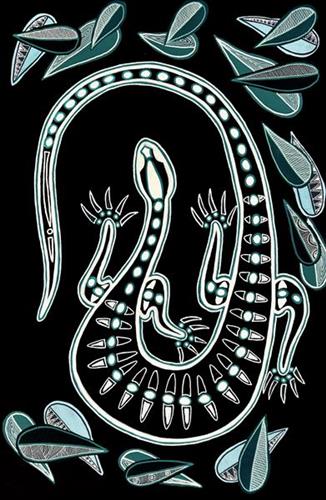
This is a collaboration with my wife, Suzanne. The Girriwa (Goanna) is reflective of the responsibility it has in the Ecosystem.
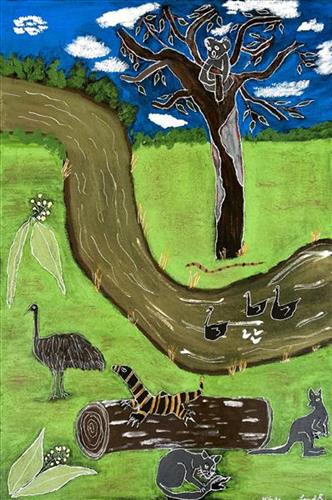
When I look at the Dungala (Murray River) I feel sad at the thought of how it used to be, and how it is now. A few comments have been made over the years, especially regarding the Barmah Forest, where some visitors to the area disrespect it. As a small child, my elders taught me right from wrong when it comes to the land, birds and animals. ‘Always have respect and protect them’, this is not happening today.
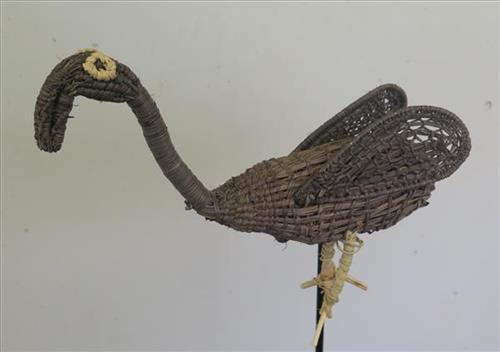
Fibre Art is an ancient Aboriginal women’s craft that is still made today using the same techniques as their ancestors. Making fibre art is labour intensive and much care and fine needlework is required to ensure the finished object is both functional and beautiful. Fibre art from the Ghunmarn Culture Centre includes dilly bags, floor mats, bush fans, woven creatures found in the landscape, plants such as yams (bush potato), baskets, place mats, and spirit figures such as mermaids and Mukuy’s. Natural pandanus fibre (Mukarra), is used to make much of the fibre art produced by the artists of Djilpin Arts. Women collect the pandaus by pulling from the top of the pandanus tree, then stripping and drying the leaves before they are dyed with natural bush colour collected from the Beswick surrounds.
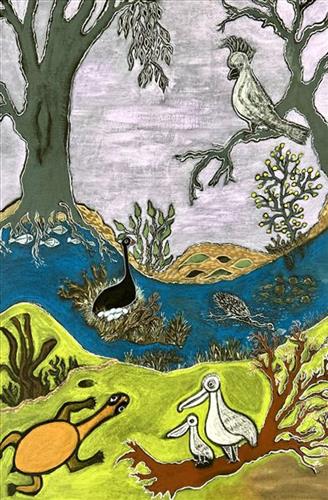
Living most of my life on the river was very important to me. Learning from my parents about the land, water and animals in which our native food was abundant with fish and yabbies and often animals at the time. My dad would always tell us ‘you only take what you need and leave the rest’ because it’s very important for preservation. Unfortunately, today our rivers and lands are not the same as I remember back in the day.
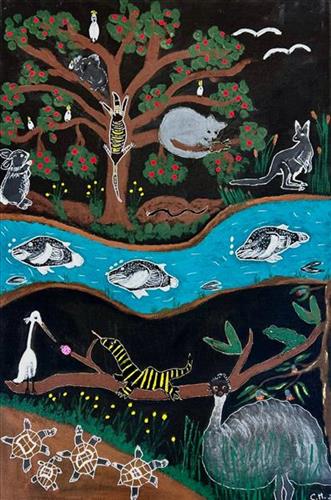
So many beautiful animals, so we should look after them. Not kill them. Let them roam free.
Let the community see and know what sort of animals Australia has.
My culture, I wouldn’t change for anything. It is so unique.
Australia is our home.
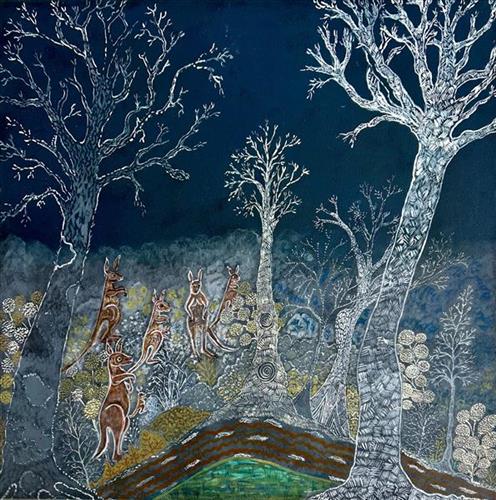
My inspiration for this painting came from memories of my early childhood. Years of going bush with my dad early in the morning gathering wood. It seemed so magical with the Kangaroos in the mist. Installed in me now is how lucky we are with nature and all the native animals around us as well as the preservation of our country and our culture.
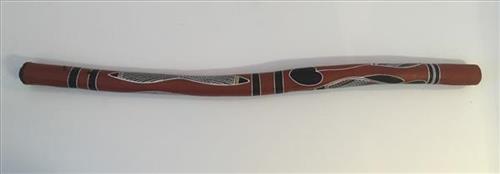
Key: D#
Toot: A
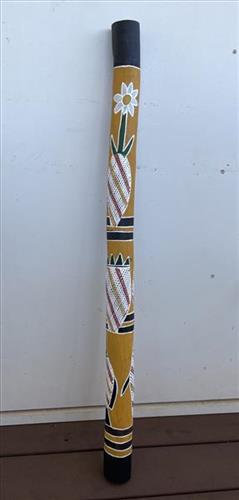
Didjeridus from this region are made in the West Arnhem style. Called Mago, they’re different and special and follow the tradition made famous by Beswick’s Mago Master, elder David Blanasi.Ghunmarn didjeridus are hand cut by Aboriginal people on Aboriginal land. They are drilled out naturally by termites, not by machines. Top quality musical instruments, they are used in ceremony and performance and feature traditional designs handed painted with a grass brush. Supplied with natural sugar-bag wax mouthpieces, these are the genuine article.Didjeridus from Ghunmarn Culture Centre are hand-cut from the woolybutt tree and naturally termite eaten. Some cheaper didjerdius can be drilled out by machine. If you want to be sure yours is termite-eaten look inside, if it is a bit rough the termites have been at work, smooth interiors are a sign of drilling. Ghunmarn artists travel considerable distances on foot to find the just right woolybutt tree. Good instruments are hand-cut and taken back to camp to be worked, shaped, sanded and tuned.Most Ghunamrn didjeridus are high pitch D, low pitch D, F, C or G. The longer the dij the lower the pitch, a shorter didj will give a higher sound.
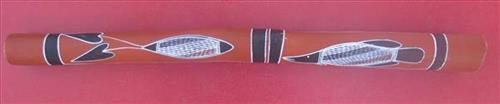
Didjeridus from this region are made in the West Arnhem style. Called Mago, they’re different and special and follow the tradition made famous by Beswick’s Mago Master, elder David Blanasi.
Ghunmarn didjeridus are sourced on country, and hand cut from Woolybutt trees. Artists travel considerable distances on foot to find the right woolybutt tree naturally hollowed out by termites. Good instruments are hand-cut and taken back to camp to be worked, shaped, sanded, tuned and then finally painted.
These are top quality musical instruments, highly regarded worldwide, and still used in ceremony and performance today. Featuring traditional designs handed painted with a Jarlk grass brush.
Most Ghunamrn didjeridus are high pitch D, low pitch D, F, C or G. The longer the dij the lower the pitch, a shorter didj will give a higher sound.
Key: F#
Toot: A#
Didjeridus from this region are made in the West Arnhem style. Called Mago, they’re different and special and follow the tradition made famous by Beswick’s Mago Master, elder David Blanasi.
Ghunmarn didjeridus are sourced on country, and hand cut from Woolybutt trees. Artists travel considerable distances on foot to find the right woolybutt tree naturally hollowed out by termites. Good instruments are hand-cut and taken back to camp to be worked, shaped, sanded, tuned and then finally painted.
These are top quality musical instruments, highly regarded worldwide, and still used in ceremony and performance today. Featuring traditional designs handed painted with a Jarlk grass brush.
Most Ghunamrn didjeridus are high pitch D, low pitch D, F, C or G. The longer the dij the lower the pitch, a shorter didj will give a higher sound.
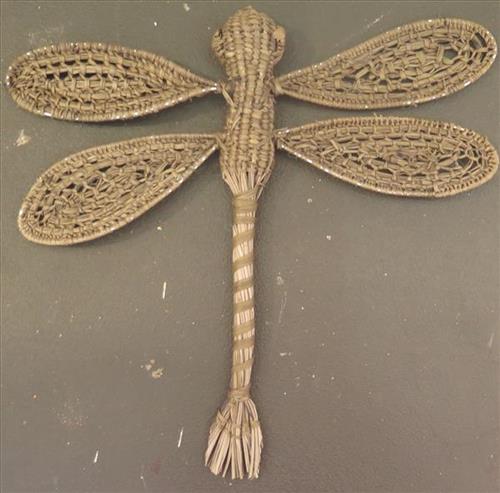
Fibre Art is an ancient Aboriginal women’s craft that is still made today using the same techniques as their ancestors. Making fibre art is labour intensive and much care and fine needlework is required to ensure the finished object is both functional and beautiful. Fibre art from the Ghunmarn Culture Centre includes dilly bags, floor mats, bush fans, woven creatures found in the landscape, plants such as yams (bush potato), baskets, place mats, and spirit figures such as mermaids and Mukuy’s. Natural pandanus fibre (Mukarra), is used to make much of the fibre art produced by the artists of Djilpin Arts. Women collect the pandaus by pulling from the top of the pandanus tree, then stripping and drying the leaves before they are dyed with natural bush colour collected from the Beswick surrounds.