221382180477


SugarBag Harvest

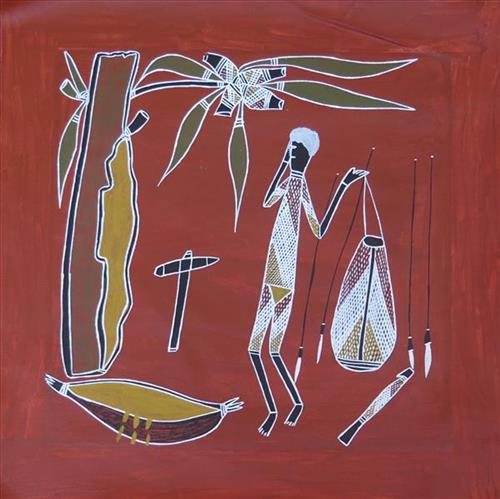
This painting depicts a Wagilak man harvesting Gugu, or sugar bag (native bush honey). The man is depicted with a dillybag, bondock or spear thrower, multiple spears and a bush axe. Above the man are some leaves and gum nuts, which when flowering are an indicator that the sugar bag is ready for harvesting. The hollow log features a “nose” or entry to the hive at the top of the cut open section. Honey is richly flowing out of the coolamon at the base of the hollow log.

Gugu is a highly prized bush tucker, and everything from the hive is used.

Painting has been completed using a mixture of modern paintbrushes along with a handmade grass reed brush called Jarlk. Jarlk are found in surrounding billabongs and wet areas, and shaped to create the fine line work. Fine line work on the body of the man, dilly bag, gum nuts and bondock are in Yirritja style and consist of multiple lines before alternating colour. Modern acrylic paint has been used.
377813282193733


Manjabu (Fish Trap)

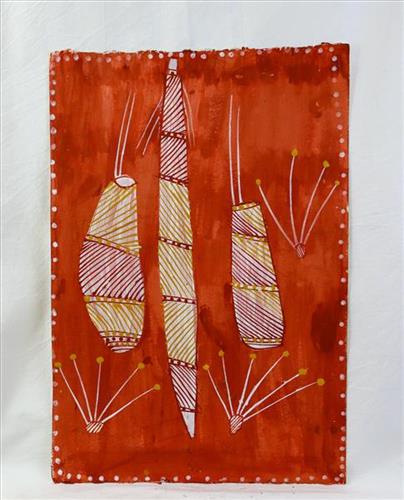
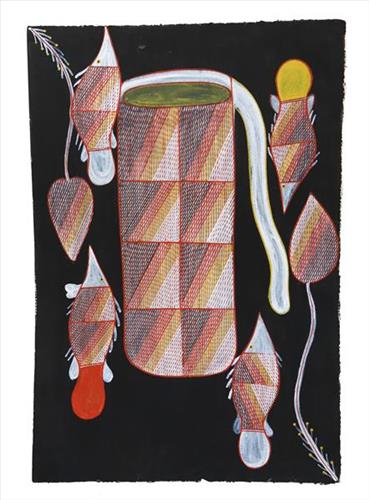
Manjabu are traditional fish traps, formed in cone like shapes they were commonly used in running water to trap the fish when the current was being pushed back the other way, resulting in trapped fish. These were important and easy to use in order to bring food home for family. Though easy to use, creating Manjabu were a timely process due the size of them and time used to collect and create. Materials used to create Manjabu are often from Kurrajong (bush string), bush cane or jungle vine. 

377813282202369


Lorrkon

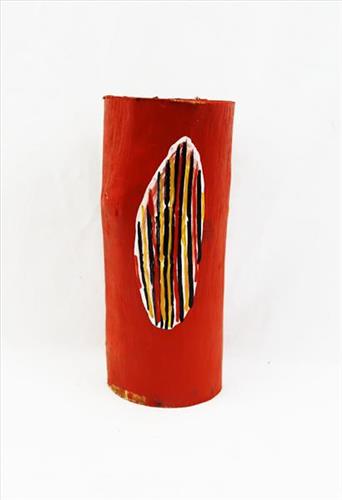
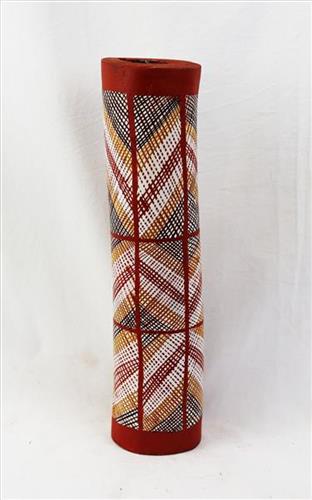
The Lorrkon is a hollow log coffin used by the people of Arnhem Land, Australia. It consists of a tree trunk hollowed out by termites and painted by a clan member of the deceased, with the bones placed inside.

The Lorrkon ceremony is the final ceremony in a sequence of mortuary rituals celebrated by the people of Arnhem Land. 

The ceremony involves the placing of the deceased’s bones into a hollow log which is decorated with painted clan designs and ceremonially placed into the ground where it remains until it slowly decays over many years.

The hollow log is made from a termite hollowed Stringybark tree (Eucalyptus tetradonta) and is decorated with totemic emblems.

The western Arnhem Land version of the Lorrkon ceremony involves the singing of sacred songs to the accompaniment of karlikarli—a pair of sacred boomerangs used as rhythm instruments.

In the past, the final evening of the ceremony involved dancers decorating themselves with kapok down. Today cotton wool is more commonly used. Much of the final segments of the ceremony are conducted in the secrecy of a restricted mens’ camp. 

The complete ceremony may stretch over a period of two weeks, but on the last night the bones of the deceased, which have been kept in a bark container (or more recently wrapped in cloth and kept in a suitcase) are taken out, painted with red ochre and placed inside the hollow log. This ceremony may take place many years after the person has died.

At first light on the final morning of the Lorrkon ceremony, the men appear, coming out of their secret bush camp carrying the pole towards the womens’ camp. The two groups call to each other using distinct ceremonial calls. The women have prepared a hole in which to stand the pole and when it is upright, women in particular kinship relationships to the deceased, dance around the pole in a jumping/shuffling motion. The Lorrkon is then often covered with a tarpaulin and left to slowly decay.

377813282209002


Waterhole at Yikarrakkal

This painting represents a sacred waterhole outside Maningrida.  It is located at a place called Yikarrakkal and is said to be inhabited by Yawkyawk. Yawkyawk are guardians of sacred waterholes and appear as young women with fish tails. Yawkyawk (freshwater mermaid) start out in a tadpole-like form, as they get older they grow tails and spend most of their time in the water but are able to sit on the banks of billabongs. When fully grown they are able to change their tails into legs and walk on land to forage for food. They also change into dragonflies at the end of the wet season, which signifies to the bininj (aboriginal people) the rains have finished. Yawkyawk are said to have namarnkol (barramundi) as pets and that Ngalyod the Rainbow Serpent as their protector.

The crosshatching pattern used to paint the bark is called rarrk. The incredibly fine lines of ochre are applied using manyilk, which is made from sedge grass, collected on country in Kakadu and West Arnhem Land. 

377813282212435


Dillybag

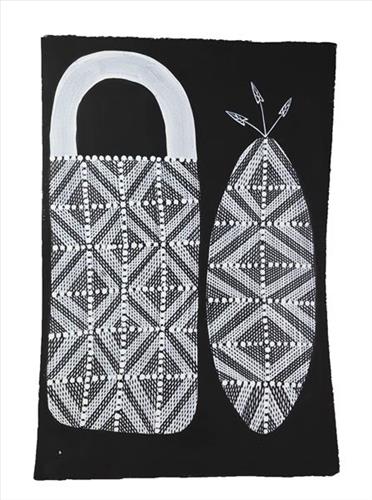
The dilly bag was traditionally used as a woven collecting basket. These baskets or bags made from varied natural materials, such as sand palm, pandanus or vine were and sometimes are, used to collect a variety of foods such as fish caught in conical fish traps, collections of yams or various other bush foods.

The tightly woven surface painted with natural pigments, again imparting a ceremonial association. Woven and dyed dilly bags were commonly used for hunting and the containment of personal possessions, whereas painted bags are more commonly the domain of ceremony. These bags, however, have a break in the painted bands towards the back end of the bag, (as often woven ridges of more sculpted bags are also broken at the back) to allow a smooth surface which is the area in contact with the wearer’s body.

On some dilly bags, a close weave can be indicative of honey-collecting bags made for harvesting native sugar bag or wild/bush honey. In addition to a tight weave, the embedding of wax into the base ensures a ‘fluid-tight’ vessel.

The creation story in Kakadu and West Arnhem centres on a female ancestor, the mother known as Yingarna, who emerged from the Arafura Sea and travelled across the inland regions. Yingarna gave birth to bininj (aboriginal people), the people of this country, and taught them their language. Suspended from a headband were many dilly bags all with different stories, people and food, one of which that contained yams, which she planted and taught bininj how to harvest.

As well as being of practical use, dilly bags are also of spiritual significance to Arnhem Land people. Dilly bags are said to be totemic objects and are associated with particular sites in the landscape.

377813282213804


Lorrkon

The Lorrkon is a hollow log coffin used by the people of Arnhem Land, Australia. It consists of a tree trunk hollowed out by termites and painted by a clan member of the deceased, with the bones placed inside.

The Lorrkon ceremony is the final ceremony in a sequence of mortuary rituals celebrated by the people of Arnhem Land. 

The ceremony involves the placing of the deceased’s bones into a hollow log which is decorated with painted clan designs and ceremonially placed into the ground where it remains until it slowly decays over many years.

The hollow log is made from a termite hollowed Stringybark tree (Eucalyptus tetradonta) and is decorated with totemic emblems.

The western Arnhem Land version of the Lorrkon ceremony involves the singing of sacred songs to the accompaniment of karlikarli—a pair of sacred boomerangs used as rhythm instruments.

In the past, the final evening of the ceremony involved dancers decorating themselves with kapok down. Today cotton wool is more commonly used. Much of the final segments of the ceremony are conducted in the secrecy of a restricted mens’ camp. 

The complete ceremony may stretch over a period of two weeks, but on the last night the bones of the deceased, which have been kept in a bark container (or more recently wrapped in cloth and kept in a suitcase) are taken out, painted with red ochre and placed inside the hollow log. This ceremony may take place many years after the person has died.

At first light on the final morning of the Lorrkon ceremony, the men appear, coming out of their secret bush camp carrying the pole towards the womens’ camp. The two groups call to each other using distinct ceremonial calls. The women have prepared a hole in which to stand the pole and when it is upright, women in particular kinship relationships to the deceased, dance around the pole in a jumping/shuffling motion. The Lorrkon is then often covered with a tarpaulin and left to slowly decay.

377813282219025


Karrakbal dja nuye kunmurrng (Moon man and his bones)

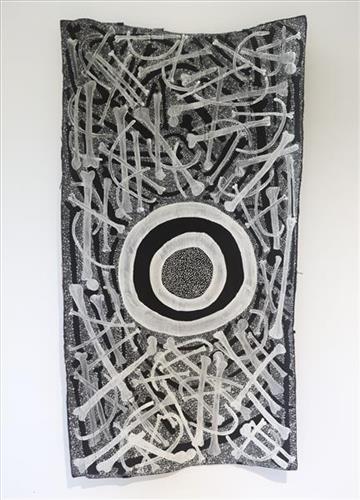
The subject matter of this bark is ‘Death’ and its connection to the conflict, as told in the ‘Dreaming’ stories, between the Moon and the Quoll about the fate of humanity.

According to local mythology, the Moon (Dird) is associated with the concept of mortality and rebirth and argued this point with his adversary, the spotted Quoll (Djabbo). Quoll believed that death was final, but they couldn’t agree so Moon proved his point by going up into the sky to where he dies and is reborn again every month. Quoll stayed on earth and died as we humans do, once and once only.


Throughout Western Arnhem land there are several Dird Djang, Moon Dreaming sites. One of these sites is at Yikarrakkal on the Mann River near Maningrida, another is in the Jawoyn country within Kakadu National Park.
Each of these sites share the common story of the argument between the Moon and Quoll. 

-Lorraine Kabbindi White, 2020

377813282224677


Karrbarda (Long Yam)

The karrbarda used to be a very important bush tucker. It grows in sandy soil and sometimes gets as big as half a meter long. The time to dig karrbarda is in yekke (early dry season) when the leaves are still green but the flowers and fruits are dry. Today we use a crow bar but the old people used a kunbarlkbu (digging stick). The best digging stick is made from mandubang (ironwood). When you dig up the karrbarda you put the narrow part at the top back in the ground to grow again. The old people used to go a favourite place for digging karrbarda and camp for a couple of nights. 

Description

Language name: Karrbarda

Scientific name: Dioscorea transversa

Family: Dioscoreaceae

Common name: Long yam

Description: Herb with annual twining stems 2 – 4m long. Leaves heart shaped to broadtriangular, usually 5 – 12cm long, 2 – 8cm wide with a pointed tip, surface smooth, petiole 1 – 9cm long. Separate male and female plants. Male plants produce flower spikes 3 – 6cm long, female plants produce flowers 10 – 20cm long. Fruit is a capsule 20 – 30mm long with lobes 15mm wide; seeds are 5mm long with a surrounding wing. Tubers, cylindrical and rarely greater than 10mm diameter, often deep in the soil. Small globular bulbils present in some leaf axils.

Habitat: Moist open forest Distribution: Northern Territory, Queensland, Western Australia and New South Wales

377813282224673


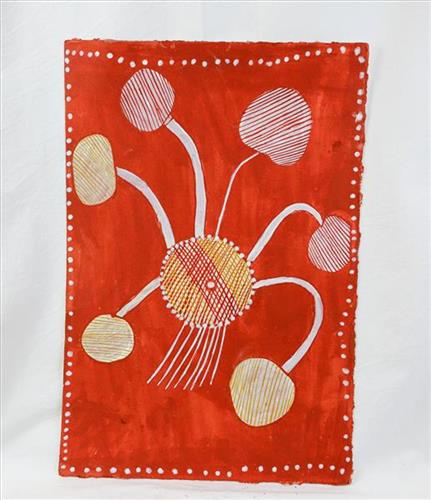
Mandem (Waterlily)

Waterlilies grow all over billabongs around the Territory’s Top End, most commonly in Kakadu and West Arnhem Land. Also known as the Lotus Flower and in Kunkwinjku language Mandem, Mandem live metres deep in water, with one large circular green leaf (lily pad) that floats on the surface of the water and throughout most of the year, Mandem flower a beautiful pink and yellow flower that smells wonderfully fragrant.

The stem connecting the lily pad is hollow and are a common food source for bininj (aboriginal people of this area), as well as the seeds which are eaten raw or cooked and can be pounded into a flour to make bread. 

377813282241703


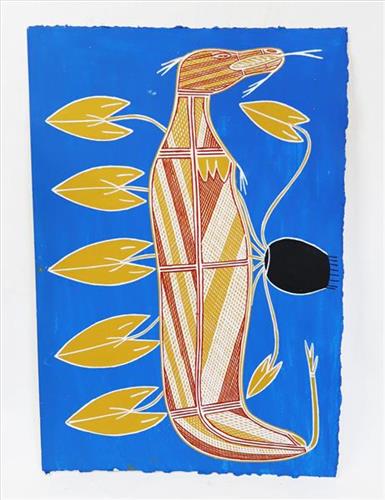
Ngalyod (Rainbow Serpent)

Ngalyod (Rainbow Serpent) is a most important ancestor spirit in western Arnhem Land and appears in various manifestations in Kunwinjku mythology. Ngalyod is daughter to the Mother One, Yingarna. Commonly Ngalyod is depicted with waterlily’s or palms growing from her serpent body, these attributes are said to be used when moving through the water or tunnels used to travel between and over Arnhem Land and Kakadu. She is generally feared as she may swallow bininj (aboriginal people) who break traditional laws. Ngalyod dwells also in various billabongs in Arnhem Land and Kakadu. In the Dreamtime Ngalyod assumed a range of animal forms, including snake, kangaroo and crocodile and at times transformed herself from one to the other, or into a combination of each.