111982303199


Wak Wak

This painting depicts a sacred site at ‘Kurrurldul’, an outstation south of Maningrida.

The ‘rarrk’, or abstract crosshatching, on this work represents the design for the crow totem ancestor called ‘Djimarr’. Today this being exists in the form of a rock, which is permanently submerged at the bottom of Kurrurldul Creek. The ‘Djimarr’ rock in the stream at Kurrurldul is said to move around and call out in a soft hooting tone at night. Both the stone itself and the area around it are considered sacred.

The imagery represents the rock mentioned above at the bottom of Kurrurldul creek, which is the final transmutation of the dreaming ancestor ‘Djimarr’. Finally, the pattern used here is also the crow design used in the sacred ‘Mardayin’ ceremony, which is a large regional patri-moiety ceremony now rarely conducted in central and eastern Arnhem Land.

111581888901


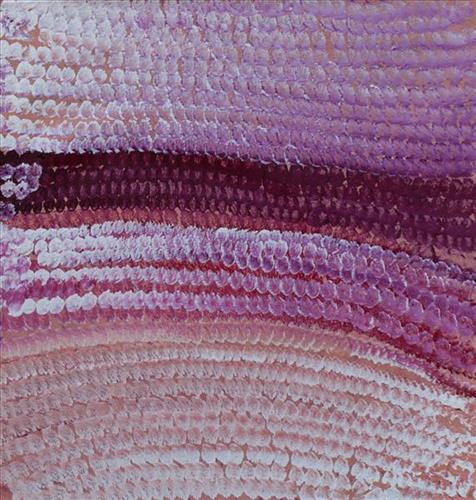
Parnngurr

Parnngurr is an Aboriginal community located 370km east of Newman, at the Southern end of the Karlimilyi area in the Pilbara region of Western Australia. Created during the Return to Country movement of the 1980s, with the recognition of Aboriginal land rights and native title, the community was named after its original primary water source, a nearby rockhole and yinta (permanent water source). Until recently the community was widely known as Cotton Creek, after the European name for the ephemeral creek running alongside the community. Parngurr and its surrounds are physically dominated by distinctively red tali (sandhills), sparsely covered with spinifex and low lying shrub.

Historically and culturally Parnngurr was an important site for Aboriginal people during the pujiman (traditional, desert-dwelling) era. In the epic jukurrpa (dreamtime) story of the Jakulyukulyu, or Minyipuru (Seven Sisters), the sisters stop to rest on the adjacent Parnngurr hill before continuing on their long journey east. Throughout the pujiman period families stopped and camped here depending on the seasonal availability of water, and the corresponding cycles of plant and animal life on which hunting and gathering bush tucker was reliant. At Parnngurr and other similarly significant camp sites families would meet for a time before moving to their next destination.

Parnngurr is Bugai’s father’s Country, as well as her own ngurra (home country). She was born nearby, close to what is now Balfour Downs Station, and travelled extensively through the Parnngurr area and up and down the Canning Stock Route as far as Kunawarritji in her youth. For Bugai, Parnngurr also signifies the location at which her nomadic bush life came to an end; it was here that she and her group were picked up by whitefellas to be taken to Jigalong Mission in 1963. Collectively the group had come to the decision to move to the mission as a result of an extended drought, which had caused a scarcity in food and water resources.
377813282302740


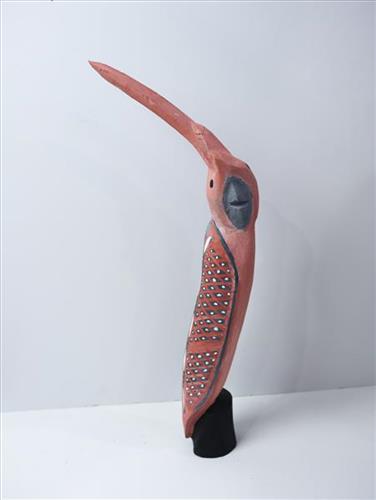
Wirliwirlih (Galah)

This piece was carved by Harold Goodman and painted by Irene Henry. Irene and Harold are partners that live at the Kakadu Outstation of Kapalga. Irene’s family are from Tiwi islands, which are represented through her artistic narrative of painting.

“My cousin brother used to make bird’s, Roy’s dad used to make the Jabiru bird. Then Harold got the idea of doing birds. Birds plays an important role in Tiwi ceremony… Harold has to look at the tree first to see if it’s strong enough [for carving], you can tell when that stringy bark peels off, then you can see if it’s right to cut it and do carving.” – Irene Henry

115682302898


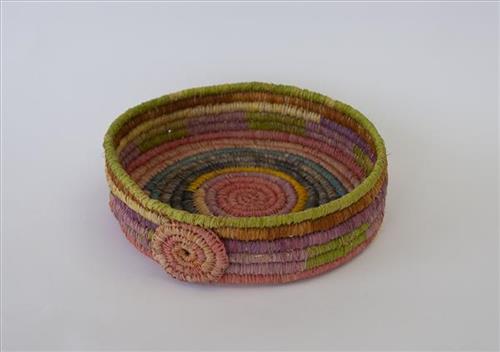
Bathi (Pandanus Basket)

Bathi are woven from the split leaves of the Screw Palm (Pandanus Spiralis). Coil weaving was introduced to Arnhem Land in the 1930s. It was adapted from techniques used by Indigenous women throughout South East Australia.

115682302896


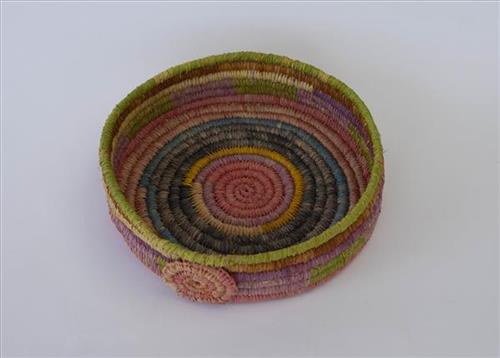
Bathi (Pandanus Basket)

Bathi are woven from the split leaves of the Screw Palm (Pandanus Spiralis). Coil weaving was introduced to Arnhem Land in the 1930s. It was adapted from techniques used by Indigenous women throughout South East Australia.

115682302893


Woven Mat

Traditionally, Nganiyal (conical mats) were used as an insect screen when erected, and as a sitting mat when folded. They are used in Ceremony as well as a functional item. 

Nowadays, artists weave many different shapes including flat, round and oblong. 

111582302910


Family Protection

This basket is created from hand dyed raffia veggie dyes, which depict the “colours of the country we live in.” [The] “spirit wheel represents all the Aunty’s and Nanna’s that watch over us from the Dream Time.”

111982302947


Wak Wak

This painting depicts a sacred site at ‘Kurrurldul’, an outstation south of Maningrida.

The ‘rarrk’, or abstract crosshatching, on this work represents the design for the crow totem ancestor called ‘Djimarr’. Today this being exists in the form of a rock, which is permanently submerged at the bottom of Kurrurldul Creek. The ‘Djimarr’ rock in the stream at Kurrurldul is said to move around and call out in a soft hooting tone at night. Both the stone itself and the area around it are considered sacred.

The imagery represents the rock mentioned above at the bottom of Kurrurldul creek, which is the final transmutation of the dreaming ancestor ‘Djimarr’. Finally, the pattern used here is also the crow design used in the sacred ‘Mardayin’ ceremony, which is a large regional patri-moiety ceremony now rarely conducted in central and eastern Arnhem Land.

111982302933


Djamo (dog)

The djamo (dog) holds special mythological as well as practical significance for people of Central Arnhem land, particularly women. The men used to go hunting with a spear and the women with a dog. If the men didn’t catch a kangaroo, the women would catch a goanna. If neither caught anything, then they could catch fish. If there was neither kangaroo nor goanna, then they would eat sugarbag. This is how it was long ago – sugarbag, lily root, yam, goanna, sand goanna, fish and more were part of the regular diet. “Don’t forget that long ago we didn’t know European food, we knew bush food. We used to grow from bush food.” Rembarrnga women have literally and metaphorically brought together strands from their country and the mythology of their heritage to produce three dimensional fibre creatures filled with mystical significance. Dog, mermaid, rainbow serpent, blue tongue and fish multiplication spirits: each creature plays an important role in the clan’s cultural landscape. Materials for this camp dog comes from the clan estate. Dayarr (pandanus) and rulk (grass) are the twines used for the creature’s bodies. Warlppurrunggu (bush turkey) and nganarrngh (black cockatoo) feathers provide bulkkan-na (hair). Marnarr (red), gamununggu (white), garlba (yellow) ochres and roerroe (black) ashes are then carefully mixed and applied for colour. The use of local materials provides an integral link between the mythological nature of the creatures, which inhabit the country and their physical form.

111982302931


Djamo (dog)

The djamo (dog) holds special mythological as well as practical significance for people of Central Arnhem land, particularly women. The men used to go hunting with a spear and the women with a dog. If the men didn’t catch a kangaroo, the women would catch a goanna. If neither caught anything, then they could catch fish. If there was neither kangaroo nor goanna, then they would eat sugarbag. This is how it was long ago – sugarbag, lily root, yam, goanna, sand goanna, fish and more were part of the regular diet. “Don’t forget that long ago we didn’t know European food, we knew bush food. We used to grow from bush food.” Rembarrnga women have literally and metaphorically brought together strands from their country and the mythology of their heritage to produce three dimensional fibre creatures filled with mystical significance. Dog, mermaid, rainbow serpent, blue tongue and fish multiplication spirits: each creature plays an important role in the clan’s cultural landscape. Materials for this camp dog comes from the clan estate. Dayarr (pandanus) and rulk (grass) are the twines used for the creature’s bodies. Warlppurrunggu (bush turkey) and nganarrngh (black cockatoo) feathers provide bulkkan-na (hair). Marnarr (red), gamununggu (white), garlba (yellow) ochres and roerroe (black) ashes are then carefully mixed and applied for colour. The use of local materials provides an integral link between the mythological nature of the creatures, which inhabit the country and their physical form.