221382299518
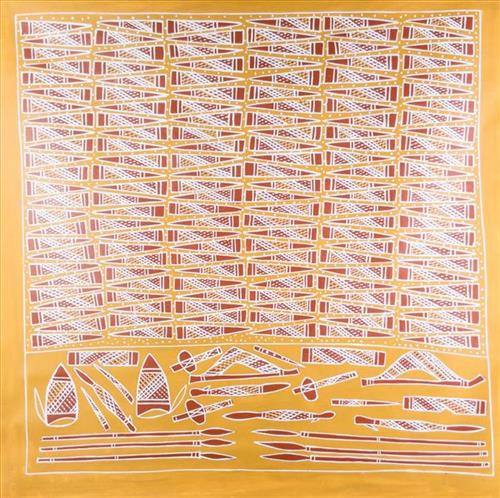
Stone Blades
Translated from Wagilak:
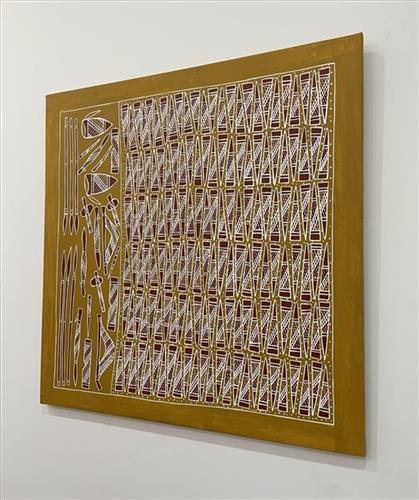
“I am Harry Malibirr. I am from Gapuwiyak. I am sitting down and doing this painting. This is my great great son’s story (skin relationship: great grandfather on mothers side). This story we do la’arda (stone blade), flint fire starter, spear, dimbooka (sacred dillybag), water carrier (coolamon), bondock (spear thrower).”
Painting has been completed using a handmade grass reed brush called Jarlk. This can be found in billabongs and wet areas and is shaped to create the fine linework called Raark. Raark is in Yirritja style and consists of multiple lines before alternating colour.
221382299511
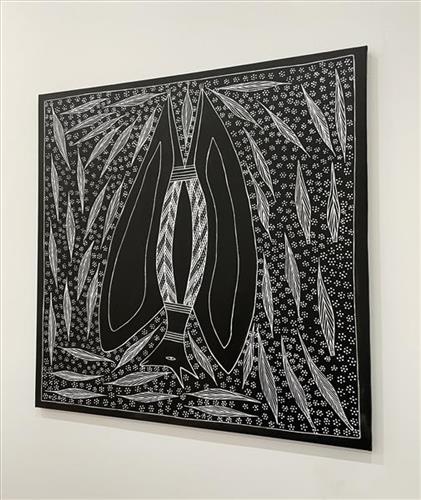
Bat Dreaming
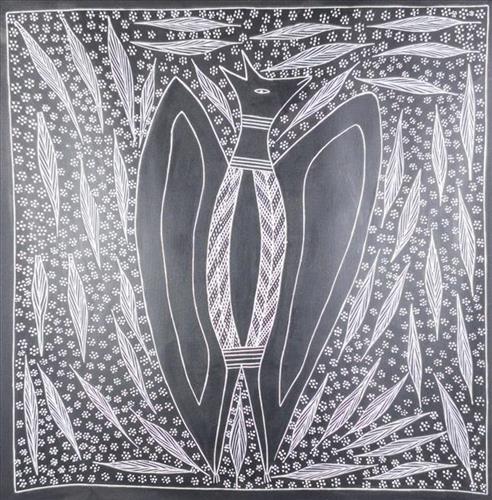
This painting represents a bat dreaming and has been completed in contrasting black and white colour. In the middle you can see a large bat, feasting on flowers and pollen. This has been represented by the multiple dots surrounding a central dot. Leaves are also visible which represent the white gum leaf of the tree which the bat is feasting from.
“This one on my songline too. Bungul.”
Painting has been completed using a handmade grass reed brush called Jarlk. Harvested from billabongs and wet areas these are hand shaped and used to paint the fine line work called Raark. Raark visible on the bats body is in Yirritja style and consists of multiple lines before alternating colour. Modern acrylic paint has been used.
114182301899
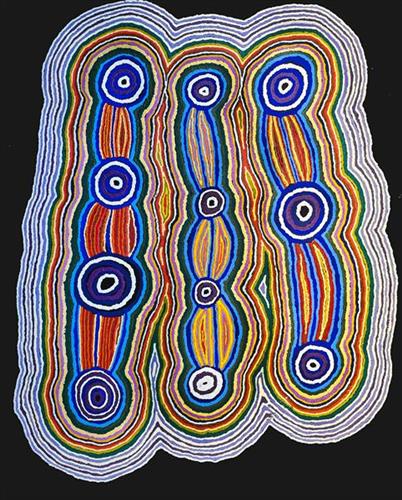
Kungkarrangkalpa (Seven Sisters)
‘Kungkarrangkalpa’ (The Seven Sisters or Pleaides) is significant Tjukurrpa (dreamtime). Its origins you may be familiar with in astronomy and its connection to ‘Wati Nyiru’ (Magic Man or Orion). The roots of this dreaming stems across indigenous groups around the world. The Australian Aboriginal songline is one part to the whole dreaming which can be traced all around the world. The ladies of the Ngaanyatjarra Lands depict their significant chapter and understanding of the journey of the sisters. The different versions of this story depend on where you live and the significance’s of local Tjukurrpa places.
Nyiru fell in love with the sisters but he was of the wrong skin group to marry, but he still pursued them on their journey. The sisters travel across the land to escape Nyiru’s unwanted attentions, but he is persistent and always finds them. There are significant land forms which can be sited today that evidence this dreaming. As Nyiru is chasing the sisters he tries to catch them by using magic to turn into the most tempting kampurarrpa (bush tomato) and the most beautiful Yirli (wild fig tree), for them to eat and camp under. However, the sisters are knowledgeable of his magic and too clever for Nyiru who they outwit again and again. They go hungry and run through the night rather than be caught by him. As the journey continues, Nyiru gets so frustrated at the wit of the sisters that he uses his magic to make the oldest sister sick to try and get closer to her. The other sisters rescue the big sister and nurse her back to health. It is said he also captures the youngest sister, but with the help of the oldest sister, she escapes back to her sisters who are waiting for her. Eventually, the sisters fly into the sky to escape Nyiru, forming the constellation. Nyiru felt lonely, longing for the sisters who were so far away. Nyiru used his magic to go to the sky, forever in pursuit.
115682301825
Bathi (Pandanus Basket)
Bathi are woven from the split leaves of the Screw Palm (Pandanus Spiralis). Coil weaving was introduced to Arnhem Land in the 1930s. It was adapted from techniques used by Indigenous women throughout South East Australia.
115682301824
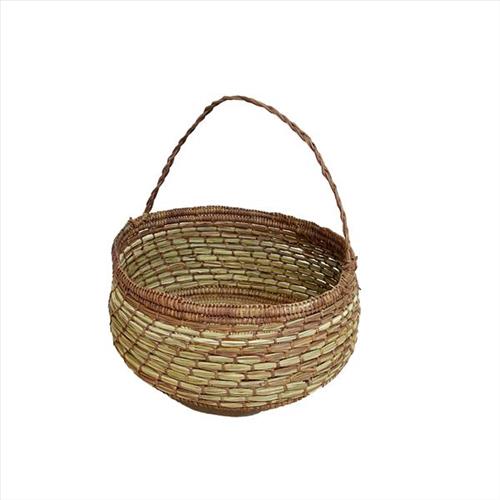
Bathi (Pandanus Basket)
Bathi are woven from the split leaves of the Screw Palm (Pandanus Spiralis). Coil weaving was introduced to Arnhem Land in the 1930s. It was adapted from techniques used by Indigenous women throughout South East Australia.
115682301822
Woven Mat
Traditionally, Nganiyal (conical mats) were used as an insect screen when erected, and as a sitting mat when folded. They are used in Ceremony as well as a functional item.
Nowadays, artists weave many different shapes including flat, round and oblong.
115682301816
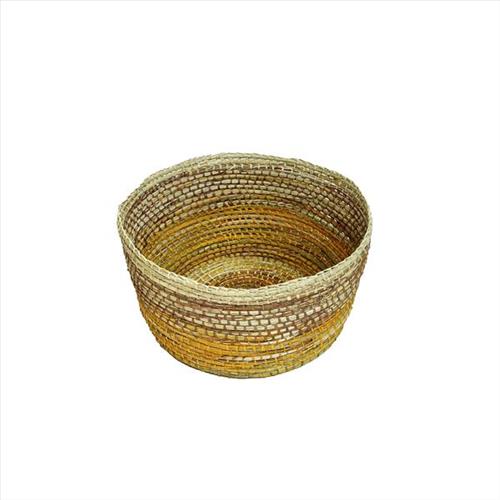
Bathi (Pandanus Basket)
Bathi are woven from the split leaves of the Screw Palm (Pandanus Spiralis). Coil weaving was introduced to Arnhem Land in the 1930s. It was adapted from techniques used by Indigenous women throughout South East Australia.