111982301960
Bark Painting
Aboriginal bark paintings have a long cultural tradition, believed to extend back many thousands of years.
In northern Australia, paintings on bark shelters in the Kimberley and Arnhem Land were stylistically similar to rock shelter paintings. The Aboriginal bark paintings were used to convey and illustrate stories which were told to the clan when holed up in the shelter for long periods in the wet season.
Bark paintings with deep cultural and ritual significance still feature in the Aboriginal sacred ceremonies of northern Australia and they, along with some coastal inhabitants are the only indigenous Aborigines still making traditional bark paintings.
The process of making a bark painting begins with choosing a suitable stringybark eucalyptus tree, preferably in the wet season when the sap is rising and the bark is fairly supple and easy to grip. After finding a section of bark that is devoid of knots and termite damage, cuts are made top and bottom and after some encouragement by tugging and prying, a hollow open cylinder of bark is removed. The bark sheet is trimmed and a fire made ready, over which the bark will be cured to drive out any moisture. The bark is then flattened to the ground with feet and then held down with heavy weights to ensure that it doesn’t curl or warp.
The Aboriginal bark painters of Arnhem Land adhere to four basic pigments – red, black, white and yellow. The reds and yellows come from ochres, crushed and powdered rocks. White comes from pipeclay and black generally comes from charcoal. Sometimes natural fixatives are mixed in to bind the pigments and which includes wax, yolk of eggs, resins and the sap of orchid plants. The paint can then be applied to the bark with perhaps a rarrk design by using a wood comb, or with brushes made from human hair or even feathers.
359709482301959
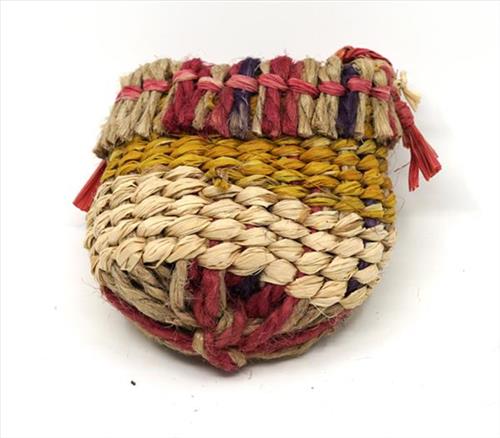
Bag
111982301958
Djomi
There are two Dreaming ladies at Bábbarra billabong – Djómi and Bábbarra. These two are sisters: one freshwater ‘mermaid’ and one saltwater one. Big long head, big stomach and very skinny legs that Bábbarra.
Their mother is the crocodile who lives in the Bábbarra billabong.
Both sisters will give people babies through the drinking water at Bábbarra. That’s why men stay away and Bábbarra is a sacred women’s site. Too strong our Dreaming – even men can get that baby in their tummies!
When it rains at Bábbarra, or when a cyclone comes, it’s because our Dreaming is too strong. There are lots of women spirits. When the storms come, the spirits go in the underground rivers and hide safely.
If you go fishing in our country, you have to be careful not to catch the Bábbarra and Djómi ‘mermaids’. Some people catch them thinking they are barramundi, but they are actually the ‘mermaid’ spirits. You will know, because they have white hair.
Lena Djabibba, djungkay (mother’s country and ceremonial manager of Bábbarra) and Joy Garlbin (landowner for Bábbarra)
Text courtesy of Bábbarra Women’s Centre copyright 2017
111982301957
Djomi
There are two Dreaming ladies at Bábbarra billabong – Djómi and Bábbarra. These two are sisters: one freshwater ‘mermaid’ and one saltwater one. Big long head, big stomach and very skinny legs that Bábbarra.
Their mother is the crocodile who lives in the Bábbarra billabong.
Both sisters will give people babies through the drinking water at Bábbarra. That’s why men stay away and Bábbarra is a sacred women’s site. Too strong our Dreaming – even men can get that baby in their tummies!
When it rains at Bábbarra, or when a cyclone comes, it’s because our Dreaming is too strong. There are lots of women spirits. When the storms come, the spirits go in the underground rivers and hide safely.
If you go fishing in our country, you have to be careful not to catch the Bábbarra and Djómi ‘mermaids’. Some people catch them thinking they are barramundi, but they are actually the ‘mermaid’ spirits. You will know, because they have white hair.
Lena Djabibba, djungkay (mother’s country and ceremonial manager of Bábbarra) and Joy Garlbin (landowner for Bábbarra)
Text courtesy of Bábbarra Women’s Centre copyright 2017
359709482301956
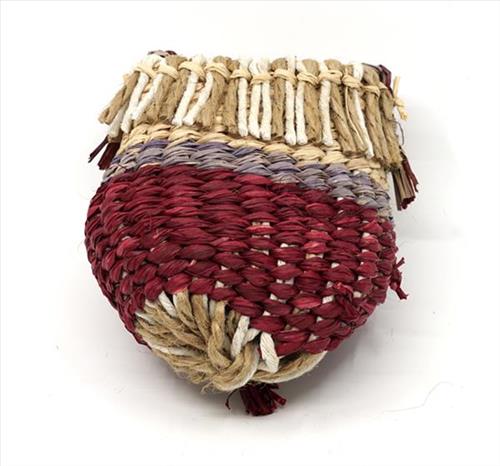
Bag
111982301955
Ngalkordow (Brolga)
Works in fibre from the Maningrida region are widely recognised as some of the finest in Australia. Artists confidently push the boundaries of fibre craft and cultural expression, adapting traditional techniques and forms to produce strikingly inventive and aesthetically exquisite artworks.
In 2003, Kuninjku artist Marina Murdilnga brought a revolutionary new form of pandanus weaving to Maningrida Arts & Culture: a flat yawkyawk made from knotted pandanus on a jungle-vine frame, painted with natural pigments. She next explored using dyed pandanus and feathers in this way. Murdilnga’s innovation inspired many other weavers, who are producing an array of beautifully resolved flat figurative works (stingray, butterflies, spiderwebs) and spiritual figures and Ancestral beings. Alongside Murdilnga, leading artists of this form of fibre art are Anniebell Marnngamarnnga, Frewa Bardaluna and Rembarrnga artists Vera Cameron and Maisie Cameron. Lulu Larandjbi has woven interpretations of the rock pools at Kobumi where Ngalyod (the Rainbow Serpent) entered and died.
Commonly used fibres include the leaves of pandanus (Pandanus spiralis), and palms (Livistonus), mírlírl (burney or jungle vine, Malaisia scandens), and the inner bark of kurrajong and stringybark eucalyptus trees. Weaving is physically hard work, now done only by women. They colour the pandanus using natural dyes made from the roots, leaves or flowers of plants within the weaver’s clan estate. The same dye bath is often used to dye a number of batches of fibre, with variations in the colours depending on the time spent in the dye bath and the potency of the bath. The women skilfully use salt and wood ash as mordants and colour enhancers.
111982301954
Ngalkordow (Brolga)
Works in fibre from the Maningrida region are widely recognised as some of the finest in Australia. Artists confidently push the boundaries of fibre craft and cultural expression, adapting traditional techniques and forms to produce strikingly inventive and aesthetically exquisite artworks.
In 2003, Kuninjku artist Marina Murdilnga brought a revolutionary new form of pandanus weaving to Maningrida Arts & Culture: a flat yawkyawk made from knotted pandanus on a jungle-vine frame, painted with natural pigments. She next explored using dyed pandanus and feathers in this way. Murdilnga’s innovation inspired many other weavers, who are producing an array of beautifully resolved flat figurative works (stingray, butterflies, spiderwebs) and spiritual figures and Ancestral beings. Alongside Murdilnga, leading artists of this form of fibre art are Anniebell Marnngamarnnga, Frewa Bardaluna and Rembarrnga artists Vera Cameron and Maisie Cameron. Lulu Larandjbi has woven interpretations of the rock pools at Kobumi where Ngalyod (the Rainbow Serpent) entered and died.
Commonly used fibres include the leaves of pandanus (Pandanus spiralis), and palms (Livistonus), mírlírl (burney or jungle vine, Malaisia scandens), and the inner bark of kurrajong and stringybark eucalyptus trees. Weaving is physically hard work, now done only by women. They colour the pandanus using natural dyes made from the roots, leaves or flowers of plants within the weaver’s clan estate. The same dye bath is often used to dye a number of batches of fibre, with variations in the colours depending on the time spent in the dye bath and the potency of the bath. The women skilfully use salt and wood ash as mordants and colour enhancers.
359709482301953
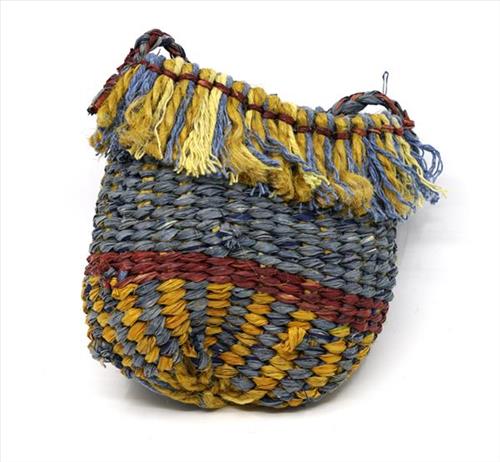
Bag
111982301952
Yok (Bandicoot)
The ancestral site for yok (bandicoot) is a hill called kordeme near Buluhkaduru outstation. It is a restricted place. People used to hunt yok regularly, however they are rarely seen anymore. Lena Yarinkura explains that in the past djungkay (cultural managers) would perform rituals at the site, calling out all different kured (country): Korlobidahdah, Mankorlod, Buluhkaduru, Ankadbarrbirri, Malyarngak, Ramingining, Ji-balbal, Ji-be – na. Baby yok would then spread throughout these areas. However, today there are fewer yok as djungkay have not been able to perform these rituals as often. Yok also has a powerful inside essence, mardayin, but this work is an ‘out – side’, public story.