111982301909


Wak Wak

This painting depicts a sacred site at ‘Kurrurldul’, an outstation south of Maningrida.

The ‘rarrk’, or abstract crosshatching, on this work represents the design for the crow totem ancestor called ‘Djimarr’. Today this being exists in the form of a rock, which is permanently submerged at the bottom of Kurrurldul Creek. The ‘Djimarr’ rock in the stream at Kurrurldul is said to move around and call out in a soft hooting tone at night. Both the stone itself and the area around it are considered sacred.

The imagery represents the rock mentioned above at the bottom of Kurrurldul creek, which is the final transmutation of the dreaming ancestor ‘Djimarr’. Finally, the pattern used here is also the crow design used in the sacred ‘Mardayin’ ceremony, which is a large regional patri-moiety ceremony now rarely conducted in central and eastern Arnhem Land.

111982301908


Warraburnburn

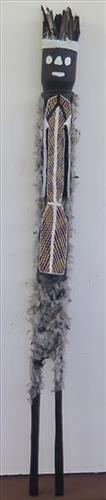
In Burarra and Gun-nartpa languages the figure represented in this artwork is generally known as a wangarra ‘ghost spirit’. For the Warrawarra clan ghost spirits have their own particular characteristics and their own name – Warraburnburn.

The Warraburnburn and the closely related Galabarrbarr spirit (owned by the Balkarranga clan) are also manikay song topics.  The spirits are related to each other as maternal grandparent and grandchild, just as the people of Warrawarra and Balkarranga are. The dancing of the two ghost spirit figures forms the finale performance for funerals, and is the final goodbye to a deceased family member.

In many ways the Warraburnburn and Galabarrbarr ghost spirits are like people. They emerge from the patches of jungle on Warrawarra and Balkarranga country in the late afternoon and go hunting in family groups of men, women and children. They stay in contact with each other by calling out as the men hunt for fish and the women walk with their dillybags looking for vegetable food. 

The ghost spirits are associated closely with white ochre and artists commonly paint the bodies of carved figures in white. Different types of ghost spirit wear different patterns. Warraburnburn is decorated with uniform white dots while others are painted white all over. Some ghost spirits are shown with a design painted on their chest infilled with rarrk ‘cross-hatching’, the same designs that are painted onto japi an-guyinda ‘male initiations’. 

They also have supernatural characteristics including superhuman size (jarra anbaykarda ‘super tall’). They know the country intimately – some are malevolent towards humans and will lead people astray, taking them to unfamiliar and dangerous places. These malevolent spirits are likened to an-muburda ‘sorcerers’ and can conduct dangerous rituals that cause harm to people. Others are benign and will lead humans back to familiar paths and their own camps.
 

111982301907


Buluwana at Dilebang

The Kuninjku people of Arnhem Land tell of a time when their ancestors suffered a terrible drought. People living in the rocky outlier region near the middle Mann River dug wells to get water until these too dried up. Then they obtained water by cutting the trunks of Melaleuca trees called djidjdjerok which store brackish water inside. When these trees were exhausted, people were surviving only on wild honey. Eventually people died of thirst. The bones of these people are said to be those found in the caves of the escarpment country of Western Arnhem Land in the Mann River district. In the ancestral time of creation was a great drought. During this time Buluwana and her family camped at Ngandarrayo on Kurulk clan land. They were weak from thirst and close to death. The malevolent gigantic form of the Death Adder snake confronted the group. Buluwana attempted to run away with the rest of her family but was crushed and turned to stone. Today an arrangement of rocks standing in the ground remains as Buluwana’s present day form. Only her head protrudes as a prismic standing stone, the rest of her body is under the ground. Other human remains lying on rock ledges are said to be the remains of other early ancestors. This painting is a reference to the very early time, before the people died. It depicts Buluwana superimposed on the background of crosshatching with her kun-madj (dilly bag) and digging stick. She is depicted at a site called Dilebang. Dilebang is regarded as one of the most dangerous and sacred of sites in the Kun-Kurulk clan estate. Travel in the area is undertaken with caution as site custodians are aware of the ancestral power of the area. The billabong at Dilebang is near escarpment country rich in rock art and with a high concentration of sacred sites. The use of rarrk (crosshatching) all over the surface of the bark painting creates a shimmering effect, which imbues the image with a spiritual power.

221382175019


Wyadda Spirit Figure

This finely crafted figure represents a Whyadda or Mukuy Spirit creatures. The Mukuy belong in Yirritja country called Galanbirni. At night you might hear them playing the Didjeridu. The Mukuy travel around a lot and are often found in sacred places. They are mysterious, sometimes playful and sometimes cheeky characters, often referred to as Devil Devil. Mukuy figures tell the stories of country, culture and spiritual beliefs.

This Whyadda is crafted from Kurrajong with Lorikeet and Pigeon feathers.

221382184953


Wagilak Man

This striking piece depicts the Wagilak Man, carved from a Kapok tree sourced locally, and detail finished in acrylic paints. The Wagilak Man is an important story for James’s clan and is depicted with a removable spear, bondok or woomera, and dimbooka or dilly bag. Naga or loin cloth has also been constructed from the Kapok inner-bark. This same material (Kapok inner-bark) has traditionally been used to create bush string, and in this instance has been used to secure Laarda or spear blade to the spear, bondock to its tip, and dimbooka to hang from the shoulder.

Raark or fine line work has been completed using a handmade Jarlk reed brush harvested from local billabongs and wet areas.

221382198326


Dilly Bag

Fibre Art is an ancient Aboriginal women’s craft that is still made today using the same techniques as their ancestors. Making fibre art is labour intensive and much care and fine needlework is required to ensure the finished object is both functional and beautiful. Fibre art from the Ghunmarn Culture Centre includes dilly bags, floor mats, bush fans, woven creatures found in the landscape, plants such as yams (bush potato), baskets, place mats, and spirit figures such as mermaids and Mukuy’s.Natural pandanus fibre (Mukarra), is used to make much of the fibre art produced by the artists of Djilpin Arts. Women collect the pandaus by pulling from the top of the pandanus tree, then stripping and drying the leaves before they are dyed with natural bush colour collected from the Beswick surrounds.

221382200324


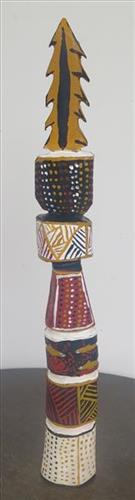
Pukumani Pole

Pukumani Poles are part of Tiwi Island culture which honour those who have passed. These poles are placed on a grave during ceremony and left until they too are reclaimed by country. The poles reflect Tiwi culture, and this miniature version features a fish spear blade at the top. Halfway down are representations of the four Tiwi moieties; Sun, Mullet, Pandanus & Rock. This is a miniature version of the Pukumani Pole which the artists made, presented to and is proudly displayed at Batchelor Institute.

221382219812


Fishing In A Canoe

Wood carving has always been part of Aboriginal culture and Djilpin artists continue this tradition. Wood was carved for many purposes – tools for hunting or gathering food, axes and knives for building shelters, spears and clubs for protection of their lives and territory, objects for ceremony and to mark sacred sites.

Hunting implements include the boomerang, woomera and spear. The woomera is a lever which helps to increase the speed and distance the spear travels. Clapsticks are used as percussion instruments by the Songmen to accompany dancing along with the didgeridoo (mago).

As well as the more functional carvings, artists portray animals and birds in wood, and these carvings are often painted. Ceremonial carvings include spirit creatures including mukuy (devil devils) and mimi.

221382258058


Fish & Turtle

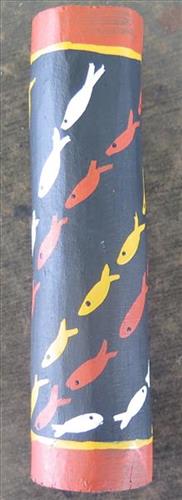
Bernadette’s painted logs are often offcuts from mako or didjeridu manufacture. Rather than wasting the pieces or relegating them to the fire, Bernadette collects these, sands them smooth and then experiments with different painting techniques.

Painted using a combination of brushes; handmade traditional Jarlk grass reed brush harvested from local billabongs and wet areas, along with modern paintbrushes. Bernadette sometimes paints using a stippling effect (modern paintbrush), a modern panting style (fish using a modern brush for example), raark (fine line work using a jarlk brush), or dots (using the end of a jarlk brush).

Painted entirely using modern acrylic paints.

221382273324


Fish

Bernadette’s painted logs are often offcuts from mako or didjeridu manufacture. Rather than wasting the pieces or relegating them to the fire, Bernadette collects these, sands them smooth and then experiments with different painting techniques.

Painted using a combination of brushes; handmade traditional Jarlk grass reed brush harvested from local billabongs and wet areas, along with modern paintbrushes. Bernadette sometimes paints using a stippling effect (modern paintbrush), a modern panting style (fish using a modern brush for example), raark (fine line work using a jarlk brush), or dots (using the end of a jarlk brush).

Painted entirely using modern acrylic paints.