115682282371


Woven Mat

Traditionally, Nganiyal (conical mats) were used as an insect screen when erected, and as a sitting mat when folded. They are used in Ceremony as well as a functional item. 

Nowadays, artists weave many different shapes including flat, round and oblong. 

115682282762


Gumang (Magpie Geese)

The Yolngu people of Arnhem Land originate from a spiritual source, fixed in a particular place in their land or the sea. These ‘Spiritual Reservoirs’ are often in the form of special waterholes made by Wangarr (Creative Beings) long ago close to the beginning of time.

The creator beings moved across the country side, shaping the land and implanting in each tract of country, the spiritual life force for the people who were to own it. These Creative Spirits took many forms. When they gave the land to each group they also gave songs, dances, ceremony, the associated laws and language. The Creation story for Ganalbingu people took place near the middle section of the Glyde River where it becomes the Goyder River. Their land, Ngaliyindi, sits astride the Arafura Swamp in Central Arnhem Land.

In this painting, the artist has depicted Gumang (magpie geese), which are sacred to the Ganalbingu people. To the east of the Arafura Swamp is a freshwater billabong which is said to have been made by the Goose Spirit and is in the shape of a goose nest. As a result, geese, their eggs and their nests are sacred.

115682282758


Jabiru

This is a story for the Wanybarrnga clan family.  The Jabiru is in the water and he flaps his wings, hitting the water and causes it to ripple.

After a funeral ceremony, leaders for this clan family draw the Jabiru’s water ripples into the sand/earth. This symbolises a cleansing and washing for Yolngu to be free to go on with normal life.

115682282726


Raypiny Dhawu (Fresh Water Story)

All Aboriginal people originate from a spiritual source, fixed in a particular place in their land or the sea. These ‘spiritual reservoirs’ are often in the form of special waterholes made by Wangarr (creative spirits) that were created long ago close to the beginning of time. These creator beings moved across the countryside, shaping the land and implanting in each tract of country, the spiritual life force for the people who were to own it. These creative spirits took many forms and when they gave the land to each group, they also gave songs, dances, ceremony, the associated laws and language.


The creation story for Ganalbingu people took place near the middle section of the Glyde River where it becomes the Goyder River. Their land, Ngaliyindi, sits astride the Arafura Swamp in Central Arnhem Land. Many Ganalbingu artists paint totemic species significant to their clan. These can include baru (crocodile), banda (long necked turtle), buliya (catfish), yalman (waterlilies), gumang (magpie geese), dakawa (fresh water yabby), ratjuk (barramundi), warrnyu (flying fox) and more.


115682282685


Baru Dhawu (Crocodile Story)

Baru (the crocodile man), was from the Gumatj clan. People usually call him Gurdu Gurdu or Baru which means crocodile. He lived his life at a place called Yirrkala. Living near him were other people, and when Baru didn’t have enough to eat he began to kill and eat these other people. After a while others noticed that some people were missing. When Baru went to the toilet, the people could smell this strong smell, so they knew that he ate the other people. Some men went to get help and they took message sticks to the other tribes. Some were sending smoke signals. When they came to Baru’s camp they started to spear him in the left side of his ribs. He dropped into the fire and burnt his left hand and maybe his right hand. He then ran into the bush and yelled to his countrymen – the animals, birds and fish that live on the land and in the sea. He stopped and he named the tribes and clans and also the places until he came to a place called Gamarru/Guyurru. There he took a rest and said to himself “This is where I stop and call this place Gamarru/Guyurru”. Baru, still in pain from the fire, then jumped into the water and turned himself into a crocodile. The fire left scars on his back. Baru paintings belong to Gumatj and Warrawarra and also the Marpi clan. This painting is used at death ceremonies or initiations and it normally is painted on the belly, which means the person the design is painted on is part of Gurdu Gurdu (the crocodile people).

221382282659


Painted log

Painted logs are often offcuts from mako or didjeridu manufacture. Rather than wasting the pieces or relegating them to the fire, artists collect these, sand them smooth and then experiments with different painting techniques and styles.

Painted using a combination of brushes; handmade traditional Jarlk grass reed brush harvested from local billabongs and wet areas, along with modern paintbrushes. Raark or fine line work has been completed using a Jarlk grass reed brush. Painted entirely using modern acrylic paints.

115682282597


Woven Mat

Traditionally, Nganiyal (conical mats) were used as an insect screen when erected, and as a sitting mat when folded. They are used in Ceremony as well as a functional item. 

Nowadays, artists weave many different shapes including flat, round and oblong. 

115682283164


Dhawurr/batjbarra fish trap

Fish traps are placed into the river to face the oncoming fish. The woven tunnel traps the fish and prevents their escape. The traps are tapered so when they are submerged in the water, the water pressure wedges them into place. Traditionally, the fish traps are operated at night time.

115682283103


Warrnyu Dhawu (Flying Fox Story)

Back in the Creation time, Warrnyu (Flying Foxes) once lived, like men, in the cave at the place called Kurrki Warrnyu Yirri Djaringal (they also lived in caves called Wadatilmurr & Gurngurmirrngu). Warrnyu lived in these caves for many years and then one day Djanyarr (The Dog), an ancestral being in the form of a man, came along. He was looking around for a place to live. Djanyarr heard the sound of a Flying Fox screaming. He went down to the cliff and pushed the rock and the water came out at the Ganalbingu place called Gurrkawakarrmurr. He then went into the cave and into the sacred hole, frightening all the Flying Fox away. When he went into the hole he left his dilly bag in the tree and went out on the other side of the sacred cave and leaving his spear and woomera. He sat there for a long time. The Dog made three streams and the water went inside the cave. Two of these streams are good drinking water. In the middle it is a sacred water. No-one drinks from the middle of the stream. Children, men, women, young boys or girls are not allowed to drink from the middle of the stream. If they drink the water from the middle of the stream they will go grey too early.

At Kurrki Warrnyu Yirri Ngilaya Djaringal, the Flying Fox made himself into a young man… that’s what Aboriginal people do today. They have ceremonies and dances to make the young boys into men. The songs are called Yirrarwu, Gulumu, Rruburra and Burryun. Dhapi (initiation ceremony) happen today because the Warrnyu (Flying Fox) people performed them a long time ago before the Yolgnu people. It was the Warrnyu people who first performed circumcision of the young boys to make them into men. It all happened at Kurrki Warrnyu Yirri Ngilaya Djaringal, this is how this place got its name.

Leaving behind the cave at Kurrki Warrnyu Yirri Djaringal, the Dog travelled west across the Arafura Swamp and came to Djalkulmurr (Mount Delight). From there he travelled north and came to Dunganda (a hill situated a few kilometres east of Ramingining). There he met a female Dog, then they both headed north and came to a place called Garanydjirrmurr where they spoke the Mildjingi language. From Garanydjirrmurr they changed their direction and went west through Guliny’barra, Burgumara and onto the plains. When they reached the plains they smelled something cooking, way up in the north – at Wessel Islands. The aroma they smelt was so enticing that they decided to go there. Lungurrma (the north-east wind) was carrying the smell. One Dog headed north again, but the other Dog decided not to go with him and went back the opposite way. The first Dog that went to Malwanatharra (Sandy Point) went into the sea following its nose to wherever the smell was coming from. It is believed that this Dog still lives in the sea…

221382283478


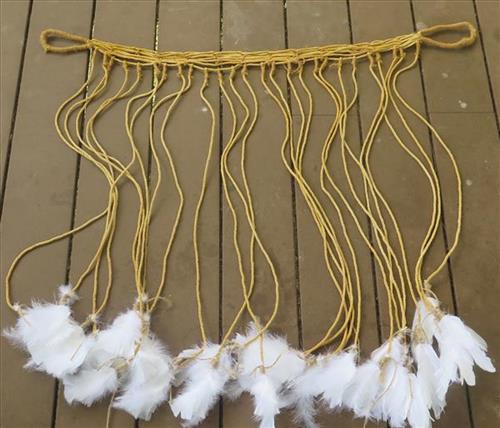
Dance Belt

Dance belts are an important cultural component of ceremony. This belt has been made predominantly from cotton string, along with kurrajong bush string details on the belt component. This can be seen on the wrap around the two end loops, the detailing holding the dangle components, along with the ties holding the belt bands together. Cotton string has been used for the dangling components, with white cockatoo feathers forming the end detail.

Bush String is incredibly labour intensive to construct. Artists collect Anputput (Kurrajong, pronounced “but but”), and then steam the logs in a fire. Bark is peeled off and the outer darker skin discarded. The softer inner fibre is mashed and separated into usable strips which has a lace-like visual look. From here the strips are rolled – usually on a leg or thigh – and spun into the string form. This alone is very time consuming as the artist needs to create the material from which she weaves. For thicker ropes, this process is repeated so each strand is actually constructed from two pre-constructed strands (four or even more strands in total).

At this point, with a functional material to start with, the artist begins to construct the belt; wrapping, weaving and tying. Raw rope can be colour dyed, or painted using ochre or modern acrylic paint. White cockatoo feathers are often used, along with biddih, or sugar bag bee wax.