Dhirrithirri (ceremonial skirt)
Dhirrithirri is a ceremonial skirt made from balgurr (kurrajong). They are worn by both men and women for different ceremonies particularly dhapi (boys initiation ceremony).
Dhirrithirri is a ceremonial skirt made from balgurr (kurrajong). They are worn by both men and women for different ceremonies particularly dhapi (boys initiation ceremony).
Miṉḏirr (dilly bags) are made from gunga (Pandanus spiralis), baḻgurr (kurrajong) and natural bush dyes. The body of the miṉḏirr is made from gunga, and the handles from baḻgurr. Once the gunga fronds and baḻgurr bark have been collected, they are stripped and prepared then boiled with the dyes.
Miṉḏirr were used traditionally for every day utilitarian purposes, particularly collecting bush foods such as bäḻtji (yam). Traditionally, the baḻgurr handles were worn across the forehead while the body of the miṉḏirr sat at the back, between the shoulder blades making it easily accessible when collecting ŋatha (food).
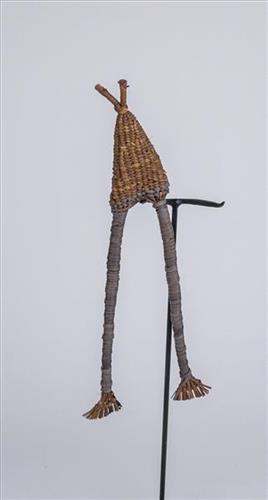
These finely crafted woven figures represent Mukuy Spirit creatures. The Mukuy belong in Yirritja country called Galanbirni. At night you might hear them playing the Didjeridu. The Mukuy travel around a lot and are often found in sacred places. They are mysterious, sometimes playful and sometimes cheeky characters, often referred to as Devil Devil. Mukuy figures tell the stories of country, culture and spiritual beliefs.
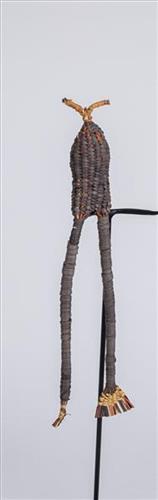
These finely crafted woven figures represent Mukuy Spirit creatures. The Mukuy belong in Yirritja country called Galanbirni. At night you might hear them playing the Didjeridu. The Mukuy travel around a lot and are often found in sacred places. They are mysterious, sometimes playful and sometimes cheeky characters, often referred to as Devil Devil. Mukuy figures tell the stories of country, culture and spiritual beliefs.
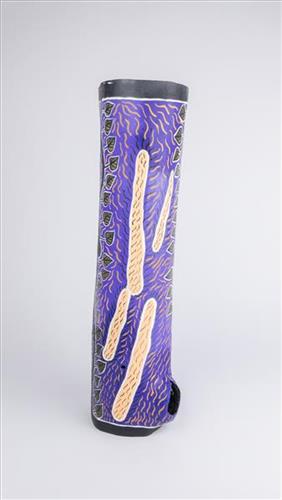
This Lorrkon (hollow coffin log) depicts two different species of yams. Cheeky Yam along with its trailing arm of heart shaped leaves can be seen in two locations. This yam is round and visible in the middle of the vine. This bush tucker can be eaten only after preparation. If the flesh is not properly prepared it is considered poisonous and too cheeky to eat.
Also included is a different yam, known as hairy yams. These are depicted in a lighter colour and are a prized bush tucker. They are one of the tastiest yams available, somewhat similar in taste to a commercial sweet potato.
Painting has been completed using modern paintbrushes as well as a handmade Jarlk brush harvested from local billabongs and wet areas. Fine line work uses this Jarlk brush. Modern acrylic paint has been used.
This is the story for the Djambarrpuyngu Wanybarrnga people of their country Djarraya & Lungurrungur, south-east of Galiwinku.
A long time ago the darrpa (king brown snake) left his home and went hunting when a dhamiling (blue tongue lizard) found a hole and thought it would be a good home, so the dhamiling crawled on in to the darrpa’s hole. The darrpa came back to discover the dhamiling in his hole and said “this is my home where is yours?” and told him to go away. The dhamiling said “no this is my home” and they had a fight. The darrpa tried to beat the dhamiling but he couldn’t. The dhamiling spat in the face of the darrpa, killing him. Through his passing the darrpa took his land and crawled back into his hole where he will stay forever.
When telling the story of her people, Burruna says “this is telling a story that happened on my country. That my father and mother told me and this story gets told and passed down through the family. All my tribe, Djambarrpuyngu, we dance, there is a king brown dance.”
This painting depicts a sacred site at ‘Kurrurldul’, an outstation south of Maningrida.
The ‘rarrk’, or abstract crosshatching, on this work represents the design for the crow totem ancestor called ‘Djimarr’. Today this being exists in the form of a rock, which is permanently submerged at the bottom of Kurrurldul Creek. The ‘Djimarr’ rock in the stream at Kurrurldul is said to move around and call out in a soft hooting tone at night. Both the stone itself and the area around it are considered sacred.
The imagery represents the rock mentioned above at the bottom of Kurrurldul creek, which is the final transmutation of the dreaming ancestor ‘Djimarr’. Finally, the pattern used here is also the crow design used in the sacred ‘Mardayin’ ceremony, which is a large regional patri-moiety ceremony now rarely conducted in central and eastern Arnhem Land.
Coil basketry is a well-established fibre art form in the Maningrida region, especially for women from the Kuninjku, Rembarrnga, Ndjebbana and Nakkara language groups.
Artists make coiled baskets of many shapes and sizes, ranging from small round baskets to large oval baby baskets, and made mostly from pandanus fibre that is dyed with natural pigments. Bundles of fibre are formed into coils which are covered and stitched together with strands of fibre threaded onto a needle. Artists combine colours and patterns to obtain intricate new graphic patterns.
These techniques are believed to have been introduced to Arnhem Land by Greta Matthews, a missionary on Goulburn Island in the 1920s. She had probably learnt coil basketry from Aboriginal people in the south-east of Australia, possibly the Murray River people such as the Yorta Yorta or the coastal Ngarrindjeri.
The coiling technique spread quickly from Goulburn Island to people on mainland Arnhem Land.