225182304804


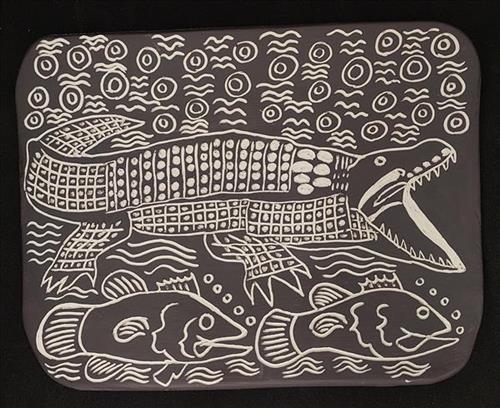
Bilngkumu (Saltwater Crocodile)

The Salt water crocodile is a very important animal for us. We call it Bilgkamu in our Kuku Yalanji language. Our ancestors – only the men – used to hunt the saltwater crocodile for food. My father told me that the hunters were given specific roles and responsibilities on how to hunt crocodiles. This knowledge was passed down from generation to generation.  

225182304803


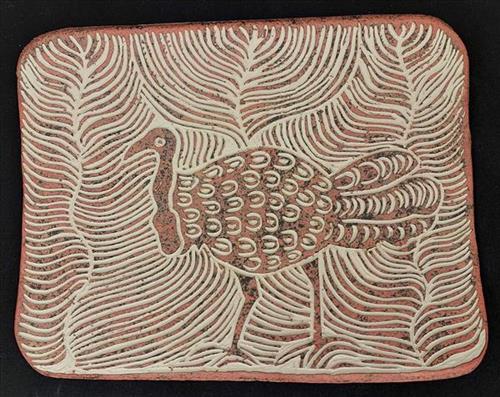
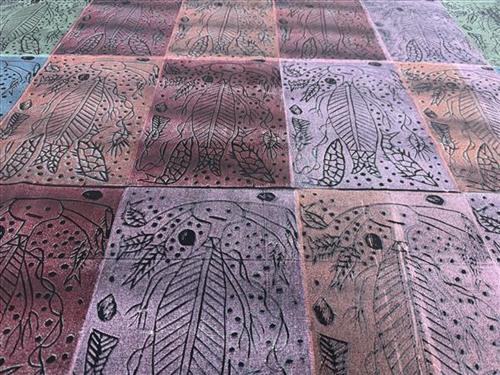
Diwan (Scrub Turkey)

Diwan are bush food – an important source of meat. We also eat the eggs. They are a delicacy. The male bird looks after the nest and will not go far, as he has to protect the nest from bush goanna’s. If they come around, he will send out an alarm call to other Diwan to alert therm. The nesting time for Diwan is September to December. The bush goanna knows when the eggs will be ready to hatch. When the goannas start hanging around, this is a good sign that the eggs are ready. We dig for eggs with digging sticks or by hand. The nest is very deep and when you can feel the warmth with your hands, you know that the eggs are close-by. The eggs are very good for health and make you strong.

221382304986


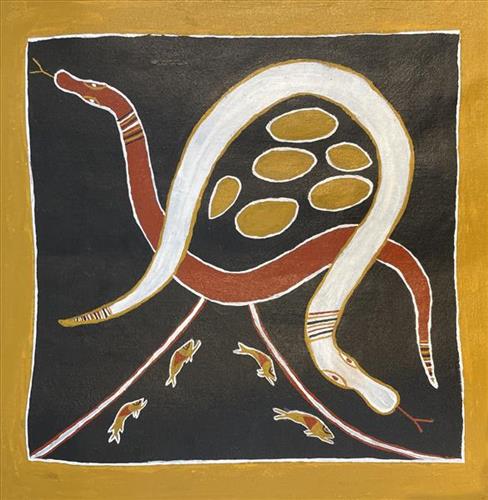
Filesnake Eggs

This painting depicts two file snakes, one protecting its clutch of eggs. Also visible are barramundi fingerlings. File snakes are a common water snake found in local billabongs. They are harmless and very tasty when cooked in coals.

115682304976


Woven Mat

Traditionally, Nganiyal (conical mats) were used as an insect screen when erected, and as a sitting mat when folded. They are used in Ceremony as well as a functional item. 

Nowadays, artists weave many different shapes including flat, round and oblong. 

115682304975


Woven Mat

Traditionally, Nganiyal (conical mats) were used as an insect screen when erected, and as a sitting mat when folded. They are used in Ceremony as well as a functional item. 

Nowadays, artists weave many different shapes including flat, round and oblong. 

115682304974


Bathi (Pandanus Basket)

Bathi are woven from the split leaves of the Screw Palm (Pandanus Spiralis). Coil weaving was introduced to Arnhem Land in the 1930s. It was adapted from techniques used by Indigenous women throughout South East Australia.

377810582305023


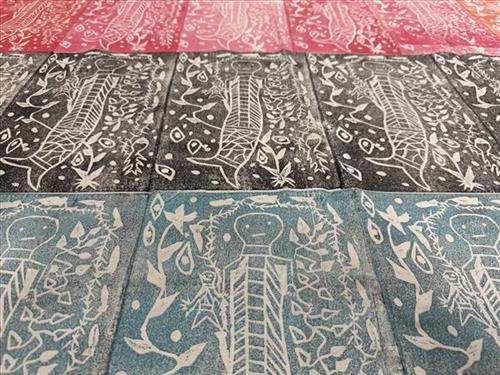
Djomi (Fresh Water Spirit)

This design depicts the story of the artist’s ancestral dreaming, the Djomi fresh water spirit mermaid.

The Djomi figure is a mermaid like spirit with fish tail that lives in the fresh water stream that flows out to the sea cliff near Maningrida. Djomi is a known to be a very powerful fertility symbol.

‘If you go there you can get pregnant easily. Djomi has babies, and they can give others babies too. The Djomi spirit is so powerful, that women can end up with multiple babies at once, twins or sometimes even more. The Djomi spirits lay eggs near the sacred freshwater stream in Maningrida. Inside the eggs are human babies as well as young Djomi.

Men do not go near that swamp, because Djomi is so powerful that men might get pregnant there too. So men, they are too scared of that Djomi. When we visit the Djomi freshwater spring, we can hear young Djomi crying. They sound like normal babies crying, those Djomi spirits. They are looking for a mother.

This Djomi is my dreaming, I got permission from my djunguys to paint this Djomi design. For me I always ask my djunguy permission to paint, because that is our cultural way.

This design also depicts the fresh water lily leaves, and seaweed from the base of the sea floor.
377810582305022


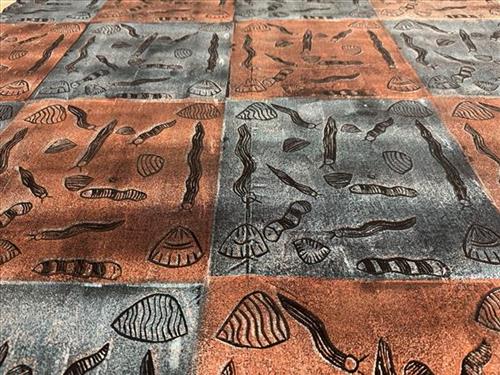
Warrangarla (bush caterpillar)

This design has lots of types of bush tucker including njanamaya(mud Muscle), kangodjbaya (mangrove worm) and warrangarla (caterpillar). The latter can be eaten cooked or raw. 

377810582305021


Djomi (Fresh Water Spirit)

This design depicts the story of the artist’s ancestral dreaming, the Djomi fresh water spirit mermaid.

The Djomi figure is a mermaid like spirit with fish tail that lives in the fresh water stream that flows out to the sea cliff near Maningrida. Djomi is a known to be a very powerful fertility symbol.

‘If you go there you can get pregnant easily. Djomi has babies, and they can give others babies too. The Djomi spirit is so powerful, that women can end up with multiple babies at once, twins or sometimes even more. The Djomi spirits lay eggs near the sacred freshwater stream in Maningrida. Inside the eggs are human babies as well as young Djomi.

Men do not go near that swamp, because Djomi is so powerful that men might get pregnant there too. So men, they are too scared of that Djomi. When we visit the Djomi freshwater spring, we can hear young Djomi crying. They sound like normal babies crying, those Djomi spirits. They are looking for a mother.

This Djomi is my dreaming, I got permission from my djunguys to paint this Djomi design. For me I always ask my djunguy permission to paint, because that is our cultural way.

This design also depicts the fresh water lily leaves, and seaweed from the base of the sea floor.