111982304424


Wak Wak

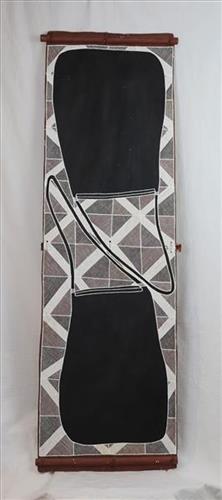
This painting depicts a sacred site at ‘Kurrurldul’, an outstation south of Maningrida.

The ‘rarrk’, or abstract crosshatching, on this work represents the design for the crow totem ancestor called ‘Djimarr’. Today this being exists in the form of a rock, which is permanently submerged at the bottom of Kurrurldul Creek. The ‘Djimarr’ rock in the stream at Kurrurldul is said to move around and call out in a soft hooting tone at night. Both the stone itself and the area around it are considered sacred.

The imagery represents the rock mentioned above at the bottom of Kurrurldul creek, which is the final transmutation of the dreaming ancestor ‘Djimarr’. Finally, the pattern used here is also the crow design used in the sacred ‘Mardayin’ ceremony, which is a large regional patri-moiety ceremony now rarely conducted in central and eastern Arnhem Land.

111982304423


Kunkurra (The Spiralling Wind)

‘Kunkurra’, the spiralling wind is associated with several sites in the Kardbam clan estate. On one level, this painting can be interpreted as a depiction of the kinds of mini-cyclones common during the wet season in Arnhem Land, where the artist lives. In this painting, Kunkurra also relates specifically to a site called Bilwoyinj, near Mankorlod.

At this site, two of the most important Kuninjku creation beings, a father and son known as na-korrkko, are believed to have hunted and eaten a goanna. They left some of the goanna fat behind at the site, which turned into the rock that still stands there today. The word Bilwoyinj, which is the name of this site, also refers to the fat of the goanna. Bilwoyinj site is also a ceremonial ground for a ceremony called Yabbaduruwa, a major ceremony owned by the Yirridja patrimoiety. The Yabbaduruwa ceremony is primarily concerned with initiation, land ownership and promoting the cyclical regeneration of the human and natural worlds.

111982304422


Ngalng (Freshwater yabby);-

This narrative is closely associated with Ngalng (yabby) which are depicted in this work in figurative form, placed alongside the circular holes in which they can be found in creeks and waterholes. Namunjdja explains,

‘Kunkurra is for the Mankorlod area. [It] has songs, so when we sing, kunkurra comes out. Kunkurra is not easy, kunkurra is really hard. It blows everything away, like a cyclone. My father, he painted all these together, kalawan (goanna), ngalng (yabby), narawan (Oenpelli Python), the sacred sites, their ceremonies, they are all linked.’

377813281991711


Manberlnginj (Clapsticks)

Clapsticks are commonly cut from Iron Bark or Strinybark Trees, which are then sanded down and used for ceremonial practises, or simply as a musical instrument. These can be played by men and women and help to keep tempo in musical gatherings 

377813282000601


Mimih Spirit

Aboriginal people of western Arnhem Land say that their Mimih rock pictures were painted not by humans but by the Mimih spirits. The drawings, usually in red ochre, show elegant, graceful stick-like human figures in action – fighting, running, dancing, leaping and hunting , preparing meat and using fire.

The Mimih live in the nooks and crannies of the rocky landscape, coming out at night. They are said to be so thin and frail that they can emerge from their hiding places only when there is no wind, otherwise they would be blown away. The Mimih not only created these lively self-portraits, but also are the Dreaming ancestors who taught people to paint, hunt, dance and compose songs.

They are like humans but they live in a different dimension. They were depicted during the freshwater period.

The Mimih are dangerous if approached the wrong way, may kick, knee, slap, smash with a racket like object or sit on someone; which causes sometimes fatal injuries.

377813282050911


Dillybag

The creation story in West Arnhem centres on a female ancestor, the mother known as Yingana, who emerged from the Arafura Sea and travelled across the inland regions.  Yingana gave birth to the Bininj, the people of this country, and taught them each their proper language. Suspended from a headband were many dilly bags that contained yams, which she planted and taught the Bininj how to harvest. As well as being of practical use, dilly bags are also of religious significance to Arnhem Land people. Dilly bags are said to be totemic objects and are associated with particular sites in the landscape.

The bags and baskets are made by the women.

Women of Arnhem Land go out bush to collect kunngobarn (Pandanus spiralis). It means that the ladies can keep an eye on country, maintain their relationships with the ancestors and possibly do some hunting along the way. Upon returning to the community the process of stripping the leaves to manageable size and dyeing it with natural dyes gives people time to sit together and talk. Children watch and learn at the same time.

The wet season is the perfect time to make baskets, as the Pandanus is fresh and full of water from the rains meaning plenty of new shoots. Only the newest shoots are suitable for stripping. At this time of year some colours, like purple, become available for a short time as different plants flower or fruit. You can tell wet season baskets by their vibrant colours and often their larger size.

Plants are collected for their colour properties.

Yellow-orange: Mandjurndum (the bright orange roots of the Pognolobus reticulatus bush)  ( Stinky cheese fruit tree)
Brown:             Wirdilwirdil (the red bulb of Haemadorum breviculae grass) or by adding ashes or a rusted object to mandjurndum.
Green: The growing shoot of the pandanus itself (Pandanus spiralis), boiled with the ashes of pandanus leaves.
Purple-pink       Windilk (the seeds of the Haemodorum coccineum plant, related to Kangaroo Paw) or the Rosella plant.
Grey-Black –   Manbedde (the leaves of the quinine bush, Petalostigma pubescens)

The string dilly bag, is a large woven collecting basket. These large baskets or bags are often made from the vine Malasia scandens, a strong pliable plant which grows along the floor and into the canopy of monsoon vine thickets, the sand palm or stringy bark tree. The baskets are used to collect a variety of heavy foods such as fish caught in conical fish traps, or large collections of yams.

Traditional bush honey collecting bags can also be made from Pandanus spiralis. These dilly bags are very finely made, tightly woven collecting baskets. They are often used to collect sugarbag—the native honey.

The tightly woven surface painted with natural pigments, again imparting a ceremonial association. Woven and dyed dilly bags were commonly used for hunting and the containment of personal possessions, whereas painted bags are more commonly the domain of ceremony. These bags, however, have a break in the painted bands towards the back end of the bag, (as often woven ridges of more sculpted bags are also broken at the back) to allow a smooth surface which is the area in contact with the wearer’s body.

The close weave is indicative of honey-collecting bags made for hunting sugar bag or wild/bush honey. In addition to a tight weave, the embedding of wax into the base ensures a ‘fluid-tight’ vessel.
377813282071604


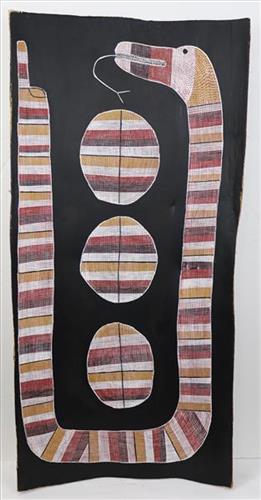
Ngalyod (Rainbow Serpent)

Ngalyod (Rainbow Serpent) is a most important ancestor spirit in western Arnhem Land and appears in various manifestations in Kunwinjku mythology. Ngalyod is daughter to the Mother One, Yingarna. Commonly Ngalyod is depicted with waterlily’s or palms growing from her serpent body, these attributes are said to be used when moving through the water or tunnels used to travel between and over Arnhem Land and Kakadu. She is generally feared as she may swallow bininj (aboriginal people) who break traditional laws. Ngalyod dwells also in various billabongs in Arnhem Land and Kakadu. In the Dreamtime Ngalyod assumed a range of animal forms, including snake, kangaroo and crocodile and at times transformed herself from one to the other, or into a combination of each.

377813282082948


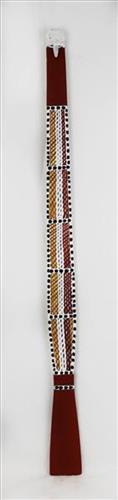
Bondok

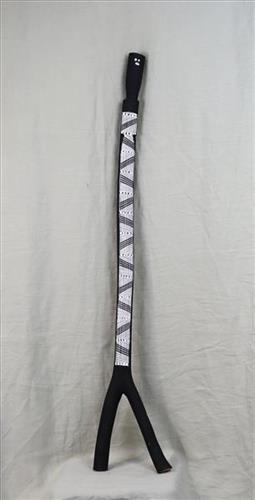
Bondok, which is more commonly known as a woomera is a “spear thrower”, traditionally and still to this day used as a hunting tool, handled as an extension of the arm to enable a longer and more powerful throw of the spear. The woomera is held in one hand, with the spear placed in the hook at the top of the bondok.  

Like spears and boomerangs, bondok’s are more commonly used by men. Spears in the Kakadu/West Arnhem region are exclusive to ‘mens business’, meaning women are forbidden to use. If touched or held by women, women will be cursed to have bad luck or in some cases infertility. 

377813282168550


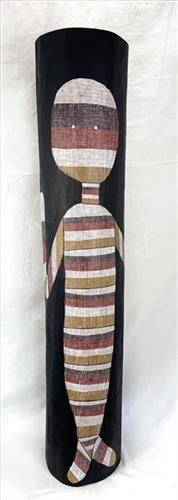
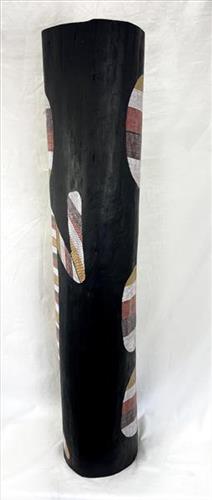
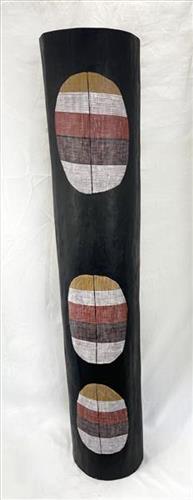
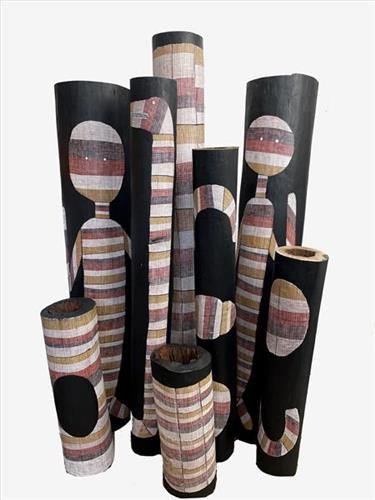
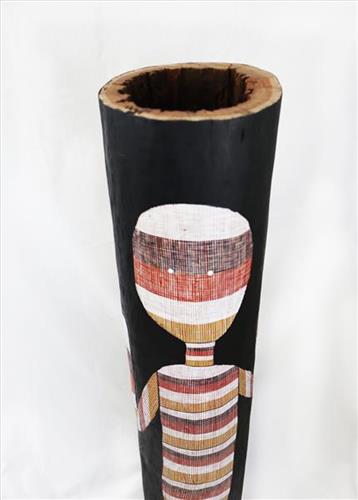
Lorrkon – Yawk Yawk (Freshwater Mermaid)

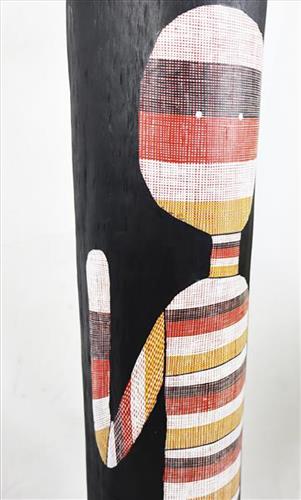
The Lorrkon is a hollow log coffin used by the people of Arnhem Land, Australia. It consists of a tree trunk hollowed out by termites and painted by a clan member of the deceased, with the bones placed inside.

The Lorrkon ceremony is the final ceremony in a sequence of mortuary rituals celebrated by the people of Arnhem Land. 

The ceremony involves the placing of the deceased’s bones into a hollow log which is decorated with painted clan designs and ceremonially placed into the ground where it remains until it slowly decays over many years.

The hollow log is made from a termite hollowed Stringybark tree (Eucalyptus tetradonta) and is decorated with totemic emblems.

The western Arnhem Land version of the Lorrkon ceremony involves the singing of sacred songs to the accompaniment of karlikarli—a pair of sacred boomerangs used as rhythm instruments.

In the past, the final evening of the ceremony involved dancers decorating themselves with kapok down. Today cotton wool is more commonly used. Much of the final segments of the ceremony are conducted in the secrecy of a restricted mens’ camp. 

The complete ceremony may stretch over a period of two weeks, but on the last night the bones of the deceased, which have been kept in a bark container (or more recently wrapped in cloth and kept in a suitcase) are taken out, painted with red ochre and placed inside the hollow log. This ceremony may take place many years after the person has died.

At first light on the final morning of the Lorrkon ceremony, the men appear, coming out of their secret bush camp carrying the pole towards the womens’ camp. The two groups call to each other using distinct ceremonial calls. The women have prepared a hole in which to stand the pole and when it is upright, women in particular kinship relationships to the deceased, dance around the pole in a jumping/shuffling motion. The Lorrkon is then often covered with a tarpaulin and left to slowly decay.

377813282175165


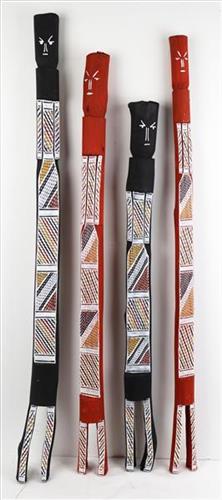
Mimih Spirit

Aboriginal people of western Arnhem Land say that their Mimih rock pictures were painted not by humans but by the Mimih spirits. The drawings, usually in red ochre, show elegant, graceful stick-like human figures in action – fighting, running, dancing, leaping and hunting , preparing meat and using fire.

The Mimih live in the nooks and crannies of the rocky landscape, coming out at night. They are said to be so thin and frail that they can emerge from their hiding places only when there is no wind, otherwise they would be blown away. The Mimih not only created these lively self-portraits, but also are the Dreaming ancestors who taught people to paint, hunt, dance and compose songs.

They are like humans but they live in a different dimension. They were depicted during the freshwater period.

The Mimih are dangerous if approached the wrong way, may kick, knee, slap, smash with a racket like object or sit on someone; which causes sometimes fatal injuries.