225182337895


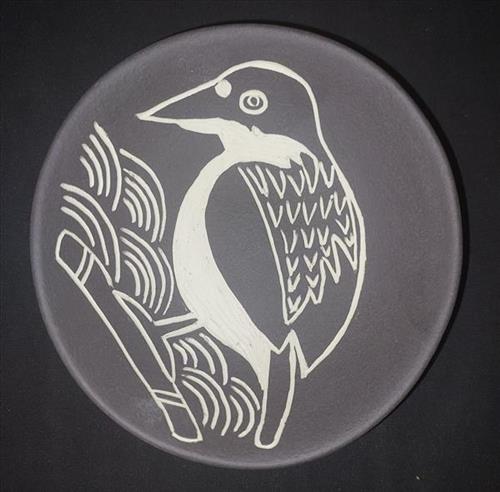
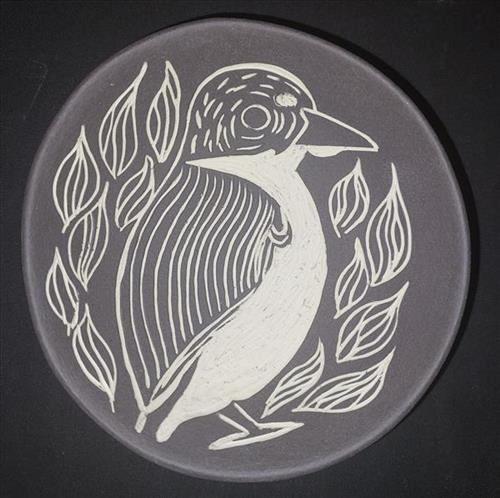
Yindili (Kingfisher)

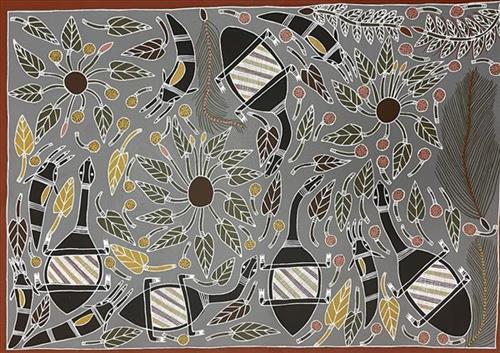
The Kingfisher, known as Yindili in Kuku Yalanji language, is according to our culture one of the significant messenger birds.  The Kingfisher will let us know when to expect a visit from families living in another community, And when we see a Kingfisher close by, we know that something good will soon happen in our personal life.

225182337894


Yindili (Kingfisher)

The Kingfisher, known as Yindili in Kuku Yalanji language, is according to our culture one of the significant messenger birds.  The Kingfisher will let us know when to expect a visit from families living in another community, And when we see a Kingfisher close by, we know that something good will soon happen in our personal life.

225182337891


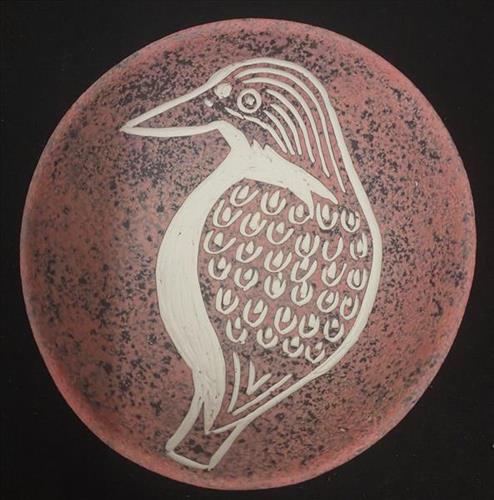
Yindili (Kingfisher)

The Kingfisher, known as Yindili in Kuku Yalanji language, is according to our culture one of the significant messenger birds.  The Kingfisher will let us know when to expect a visit from families living in another community, And when we see a Kingfisher close by, we know that something good will soon happen in our personal life.

221776323213


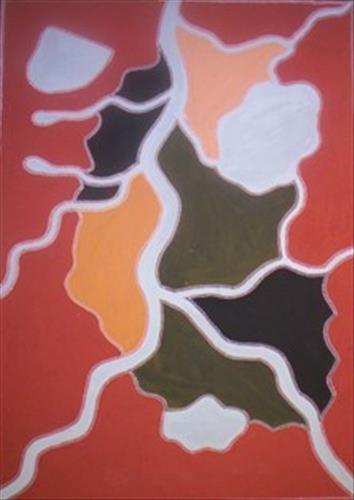
Wirrigirrig

Wirrigirrig – the Victoria River flows from the lower left across to the centre right joined by Goongoolooloo – the Wickham River from the upper left. This is an area of the artist’s traditional country and in naming it states his knowledge of and therefore traditional ownership of that country. Left of the river junction is Big Mulligan Lagoon – Yallarungmyi. In the lower right is Mock Billabong – Yadbiyi near Yarriyiy creek. The small creeks flowing through this billabong are overflow creeks dring the wet season. In the upper right is Anderson Billabong – Giminiyi. Beside it is Woolnarmii Spring then Lizard Spring – Wangoo and Crawford Creek – Mandaloongoo. The red ochre areas are the surrounding hils and ridges. The areas at the centre of the painting are open plain country.

220982332237


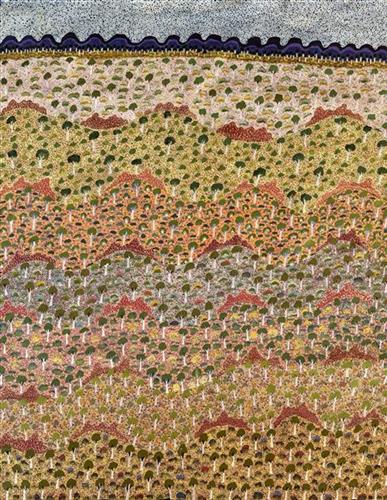
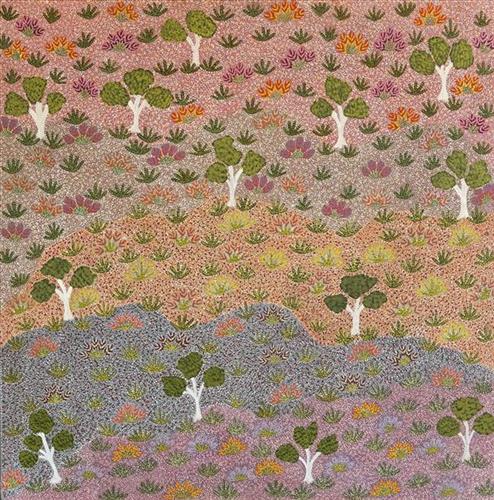
My Grandmothers Country – Denise Ngwarraye Bonney

The community of Ampilatwatja made a conscious decision not to paint ‘altyerr’ dreaming stories. The artists paint their country where those stories belong.

Denise paints ‘Tijamburra’, her Grandmothers country.

“This is my Mothers Mothers country, out near Canteen Creek, we go hunting  for wild onions, goannas, echidnas and sugar bag honey in the trees. I like to hunt in my country, there is water all year round even if it look dry, we follow the bird tracks to know where to dig and then we find water.


This painting is after rain, many grasses are out, but the riverbed is still sandy.”


220982333346


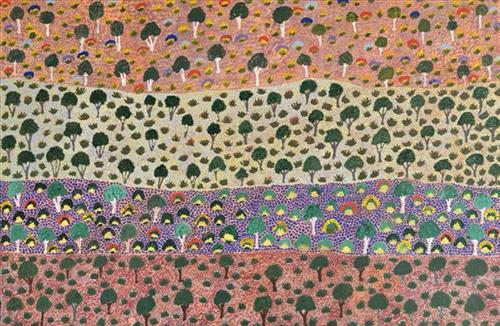
My Father’s Country – Rita Pitjara Beasley

“This is my Father’s country.

This place is our hunting place. I always go with my daughters and their children, I show them this place and teach them about the swampy country. We hunt for goannas, bush potato, bush tomato and after the big rain the bush medicine is picked and the roots are dug up to be used.

It is important as my mother taught me this and now I teach my family.”

The community of Ampilatwatja made a conscious decision not to paint ‘altyerr’ dreaming stories. The artists paint their country where those stories belong.

220982333954


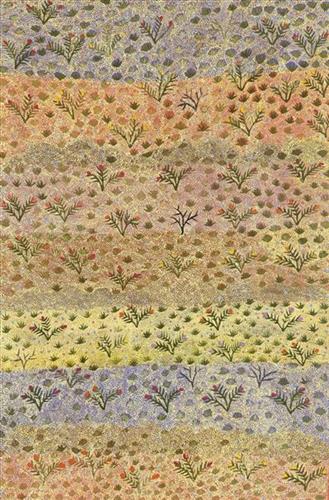
Antarrengeny – Edie Kemarre Holmes

 Antarrengeny is Edie’s country and also her Father’s.

In this painting Edie depicts Antarrengeny, “when there has been no rain and the land shimmers like jewels. It is the open flat country, after a bushfire, when only the young grasses and the trees are growing and where there is good hunting.”

Edie has a strong connection to Antarrengeny. She gave birth to two of her daughters ‘out bush’ on this land. It is her country and she loves it dearly.

220982333937


Bush Flowers – Nancy Pitjara Frank

I was born in the bush at Ammaroo Station, along the Sandover.  I have never seen the ocean or a big city. My mother and father were strong healthy people who taught me and my younger sister Rita the traditional way to hunt for Kangaroo, Goanna and Porcupine.  We know how to gather bush tucker (secrets of the earth) and bush medicine plants.  My mother used grinding stones to make seed damper.

When I paint I think about good memories, being a young girl and walking through the land.  My mother made paint from two stones and showed us ceremony painting and how to sing and dance for ceremonies.  I still sing and dance and collect the bush medicines, I like to make tea from the small purple flowers of Arreth (hill fuchsia).

Painting bush medicine stories is important because it helps to maintain a strong knowledge and culture for the community.

115682335436


Raypiny Dhawu (Fresh Water Story)

All Aboriginal people originate from a spiritual source, fixed in a particular place in their land or the sea. These ‘spiritual reservoirs’ are often in the form of special waterholes made by Wangarr (creative spirits) that were created long ago close to the beginning of time. These creator beings moved across the countryside, shaping the land and implanting in each tract of country, the spiritual life force for the people who were to own it. These creative spirits took many forms and when they gave the land to each group, they also gave songs, dances, ceremony, the associated laws and language.


The creation story for Ganalbingu people took place near the middle section of the Glyde River where it becomes the Goyder River. Their land, Ngaliyindi, sits astride the Arafura Swamp in Central Arnhem Land. Many Ganalbingu artists paint totemic species significant to their clan. These can include baru (crocodile), banda (long necked turtle), buliya (catfish), yalman (waterlilies), gumang (magpie geese), dakawa (fresh water yabby), ratjuk (barramundi), warrnyu (flying fox) and more.