111982337209


Ngalngarelyi (Turtle)

Works in fibre from the Maningrida region are widely recognised as some of the finest in Australia. Artists confidently push the boundaries of fibre craft and cultural expression, adapting traditional techniques and forms to produce strikingly inventive and aesthetically exquisite artworks.

In 2003, Kuninjku artist Marina Murdilnga brought a revolutionary new form of pandanus weaving to Maningrida Arts & Culture: a flat yawkyawk made from knotted pandanus on a jungle-vine frame, painted with natural pigments. She next explored using dyed pandanus and feathers in this way. Murdilnga’s innovation inspired many other weavers, who are producing an array of beautifully resolved flat figurative works (stingray, butterflies, spiderwebs) and spiritual figures and Ancestral beings. Alongside Murdilnga, leading artists of this form of fibre art are Anniebell Marnngamarnnga, Frewa Bardaluna and Rembarrnga artists Vera Cameron and Maisie Cameron. Lulu Larandjbi has woven interpretations of the rock pools at Kobumi where Ngalyod (the Rainbow Serpent) entered and died.

Commonly used fibres include the leaves of pandanus (Pandanus spiralis), and palms (Livistonus), mírlírl (burney or jungle vine, Malaisia scandens), and the inner bark of kurrajong and stringybark eucalyptus trees. Weaving is physically hard work, now done only by women. They colour the pandanus using natural dyes made from the roots, leaves or flowers of plants within the weaver’s clan estate. The same dye bath is often used to dye a number of batches of fibre, with variations in the colours depending on the time spent in the dye bath and the potency of the bath. The women skilfully use salt and wood ash as mordants and colour enhancers.
 

111982337203


Gomarla (Egret bird)

The artist has carved the ‘Gomarla’, which in the Burarra word for Egret. This bird is native to the country of Yilan, which is the coastal region North West of Maningrida Community. 

People use feathers from gomarla to make ceremonial regalia for Yirrichinga. Many Yirrichinga groups own manikay ‘song’ for gomarla.

Gomarla mun-baparrurr Gopungorra. Jin-gubatbatcha jin-banga jiny-yorkiya. Gomarla waykin makukuya mu-guyinda.

The egret belongs to the Gopungorra clan. It always eats grasshoppers. The egret is high in a nest (builds its nest in the tree).

221776313453


Kirrthang – Blanket Lizard Dreaming

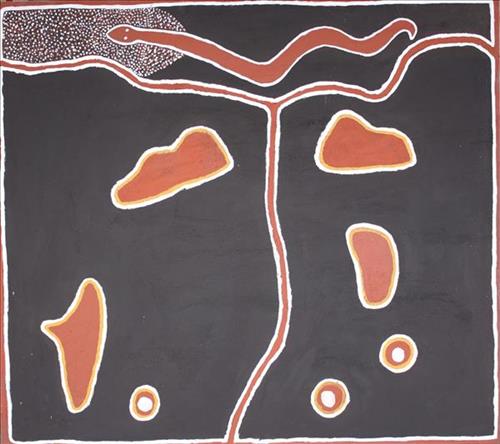
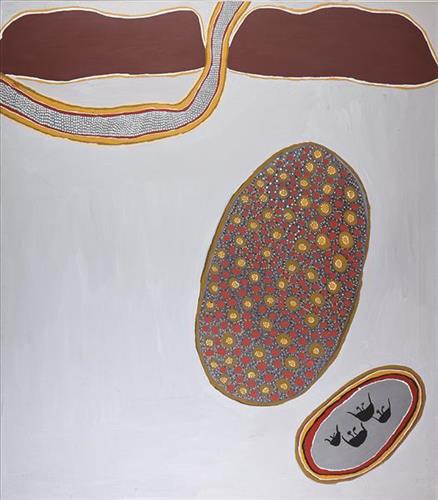
This is an area of the artist’s traditional country near Bullo River Station in the Northern Territory. Along the bottom of the painting runs the Victoria River. Flowing down the centre between the two hills is Goorbadjim – Bullo River. The two hills form the Bullo River gorge. Kirrthang – Blanket Lizard Dreaming is the main hill in the lower left corner. Beside it is a waterhole – Goorlaling. This is where the dingo passed in the dreamtime and crossed the Victoria River by jumping onto a rock situated in the middle of the river at low tide. On the right of the painting are two waterholes – Barrwii on the left and Balungnulla. Above is a hill called Barrkbim. At the top of the painting is Wulajabi the snake travelling through country in the dreamtime. His head lies in an area of bull grass.

221776325855


Yoorloorloo

Yoorloorloo is a dreaming place for “belly ache”. “I can fix that that, cut a little piece of hair, burn it, call out to that country and belly ache – he’s gone! People call out to me for that.” Mignonette is a traditional healer. This painting shows the site that gives her this power. Situated in a large cave is Yoorloorloo. Around the dreaming site are small hills and spinifex clumps. “If anyone burns the spinifex inside the cave they will get sick.”

221776307036


Warridja

“This is my country near Kildirk station. Down from Moornboo River between two hills is a place called Warridja. In the Narrangarni there were women having bogey (wash) in the creek water. The women were naked. Some young boys tried to sneak up to them and swim through the women’s legs. The women got a big fright and died. Now in the river you can see the black rocks where the women died of fright!”

221776308173


Beasley Knob

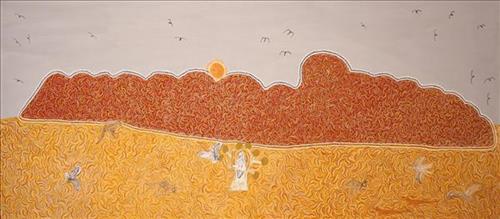
In this painting the artist has depicted her traditional country at the WA – NT Border. Peggy has now moved back to this part of her country with her husband Alan, their kids and grand kids.

221776317422


Traditional Country

In this painting Judy has depicted her mother’s country in the Northern Territory. At the top of the painting is Keep River and the Keep River Hills. Below and to the left that is Bucket Spring area and on the right is Police Hole area. On Police Hole area is a Billabong with plenty of water lillies and the orange oval shape below the billabong is a crab dreaming.