220982341035


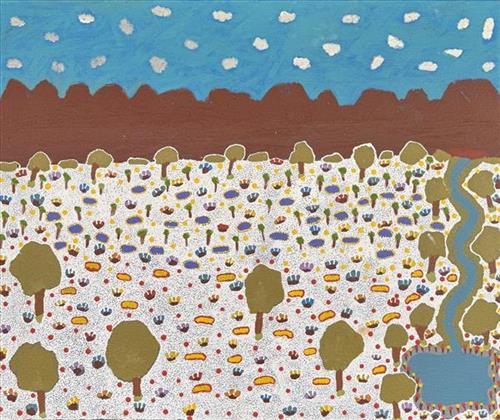
View Of Country

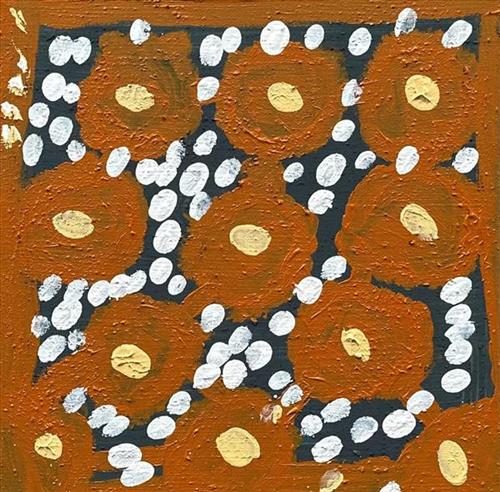
The community of Ampilatwatja made a conscious decision not to paint ‘altyerr’ dreaming stories, the artists paint their country where those stories sit.

This painting shows the layered landscape of Alyawarr, Central Australia. Knowing your country is an important part of living in a remote community like Ampilatwatja. Knowing when and where to go hunting and gathering, knowing where there is ‘soakage’ (where you can dig for water), travelling with family for ceremonies, and maintaining a connection with the land.

“This is my country, my view of country.”

115682342926


Djerrk (Bush String Bag)

Djerrk are primarily made from the bark of Baḻgurr (Red-flowered Kurrajong – Brachychiton megaphyllus) but sometimes Banyan tree (Ficus virens) and Cocky Apple tree (Planchonia careya). Sections of the tree are cut, and depending on the size, whole portions or part portions from the trunk. The inner bark is beaten or chewed to soften then dyed with natural bush dyes. Once softened and dyed, parts of the fibre are separated into fine strips then rolled on the thigh to create a rope otherwise known as bush string. The bush string is then woven and knotted to create a djerrk (string bag). Djerrk were used for every day utilitarian purposes, particularly collecting bush foods such as bäḻtji (yam).


111982342852


Ngalkodjek Yawkyawk

This artwork depicts the Ngalkodjek Yawkyawk of Barrihdjowkkeng country.

“This story is very old. That old man [my father Crusoe Kuningbal] when he was alive, told that story to me, to all of us. He told us about the yawkyawk (mermaid) spirit women called Ngalkodjek who lives in the billabong on my country. He told us how they call out loudly, how they call out as they walk along.

That is what they do, calling out. They walked around eating bush foods like those little bush yams. They would pound the yams into a pulp and eat them. That is their traditional food which they eat.

When they walk down from the bush, they follow a set path that belongs to them and they walk along calling out. That is their path which they take. It is an old traditional route.

They placed a woman’s breast into the country. That rock was not there originally, but it was a woman’s breast. It is the breast of those women.

They put that djang [sacred place] there, and then at the time when non-Aboriginal people arrived in the region, then the breast turned to stone. Now it has turned solid into rock.”

– Owen Yalandja

220182343112


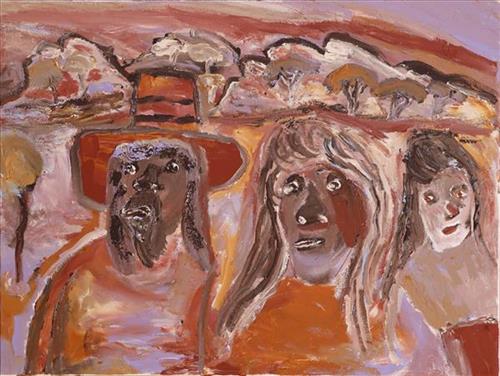
Family in Yalpirakinu

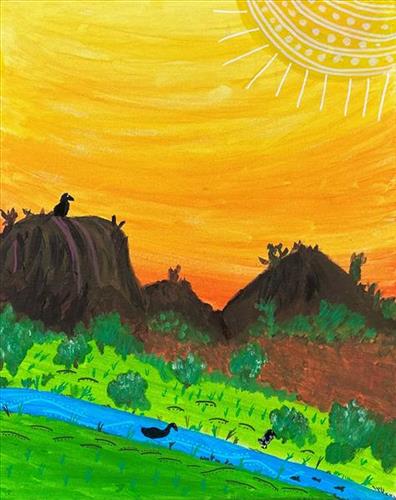
Yalpirakinu is Adrian’s mother’s country. Adrian’s mother is the late Eunice Napangardi, a well known painter herself. His artworks consistently refer to the desert mountains, ridges and trees which are part of Yalpirakinu. Using a restricted colour palette, Adrian’s brushwork is loaded with energy, drama and memories. In this painting Adrian has drawn from his memory to portray his family in Yalpirakinu.

220182343086


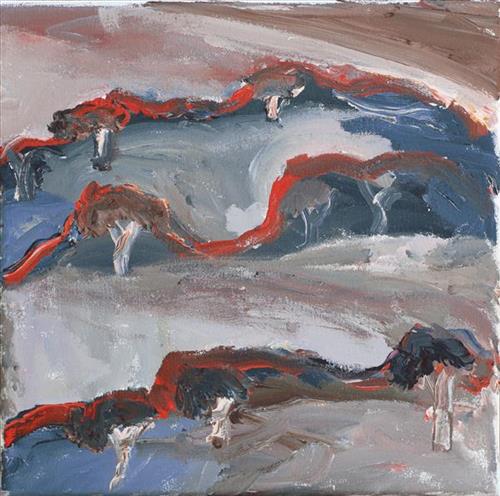
Yalpirakinu

Yalpirakinu is Adrian’s mother’s country. Adrian’s mother is the late Eunice Napangardi, a well known painter herself. His artworks consistently refer to the desert mountains, ridges and trees which are part of Yalpirakinu. Using a restricted colour palette, Adrian’s  brushwork is loaded with energy, drama and memories. He is a deliberate and thoughtful painter; reworking, pushing and pulling the image to completion.

220182343046


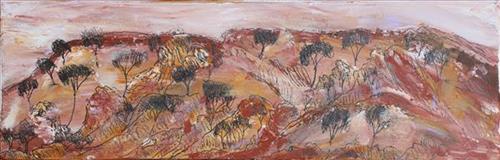
Yalpirakinu

Yalpirakinu is Adrian’s mother’s country. Adrian’s mother is the late Eunice Napangardi, a well known painter herself. His artworks consistently refer to the desert mountains, ridges and trees which are part of Yalpirakinu. Using a restricted colour palette, Adrian’s  brushwork is loaded with energy, drama and memories. He is a deliberate and thoughtful painter; reworking, pushing and pulling the image to completion.

220182343042


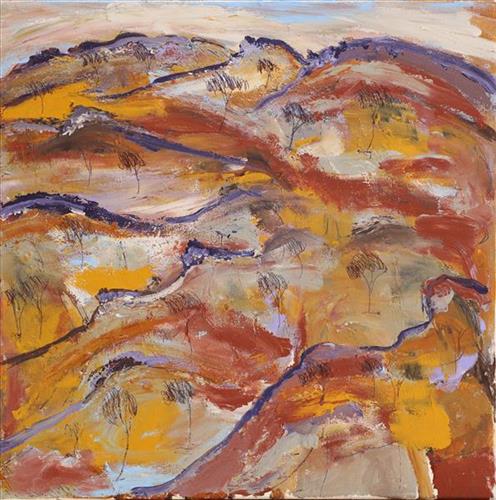
Yalpirakinu

Yalpirakinu is Adrian’s mother’s country. Adrian’s mother is the late Eunice Napangardi, a well known painter herself. His artworks consistently refer to the desert mountains, ridges and trees which are part of Yalpirakinu. Using a restricted colour palette, Adrian’s  brushwork is loaded with energy, drama and memories. He is a deliberate and thoughtful painter; reworking, pushing and pulling the image to completion.

111982343461


Mun-dirra (fish fence)

Mun-dirra, in Burarra language, means “fish fence”. Mun-dirra were traditionally made by men using coastal sedge grass called gurdagarra and were designed to fence in schools of fish in ocean shallows or riverbeds. They were used in conjunction with conical traps, called an-gujechiya, which are woven with mirlarl, a hardy jungle vine, and burdaga, the sinewy inner bark from Kurrajong trees. 

Fish traps and fish fences have been used throughout west and central Arnhem Land by various language groups; in Kuninjku, people call them kunkarlewabe (fish fence) and mandjabu (fish trap).

Artist Doreen Jinggarrabarra explains, “In the old days, they didn’t have any casting nets, [so] they made a fish trap and a long fence net, [put] them side to side, and put the fish trap in the middle. Then the fish came and went in the fish trap.”

To make a fish trap (an-gujechiya), jungle vine (mirlarl) is soaked in water for one night to make it soft. Then, the structural form of the fishtrap would be worked on, with hibiscus (bardainy) rings fashioned inside to keep the fish trap’s shape. Kurrajong string (burdaga) would be made to attach the inner rings and to tie the conical end of the fish trap closed. This fish trap is used in both saltwater and freshwater.

 The fish fences (mun-dirra) would be set up across rivers and creeks, with the fish trap (an-gujechiya) placed in the middle of the two fences. Sticks, rocks, mud and grass would be used to hold the fences in position and funnel the fish into the trap. This ingenious system could catch fish like saltwater barramundi (rajarra), freshwater barramundi (janambal), small black freshwater catfish (buliya), bonefish (an-guwirrpiya), and sand bass (dalakan).

Doreen remembers seeing the traps in riverbeds around Maningrida when she was young: “The older ladies and the older men [would] usually go down, say about seven or eight o’clock, to go and check the trap. Maybe seven fish can go in, crabs and catfish,” she recalls.

Today, people generally use fishing lines and casting nets for fishing, but the woven traps and fences continue to be made as works of art. Women are now considered the knowledge holders, and are leaders in the development of sophisticated examples of woven design and material culture.

 *Maningrida Arts & Culture acknowledges the work of many academic and non-academic voices when writing on this topic. It is important to note Anna Freeland and Myles Russell-Cook, whose writing have informed this text.