Moving forward
Emu represents moving forward on a journey in life.
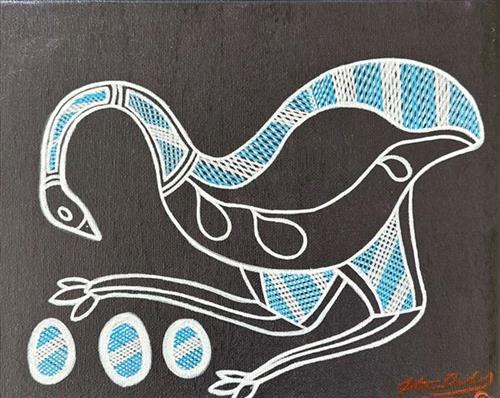
Emu represents moving forward on a journey in life.
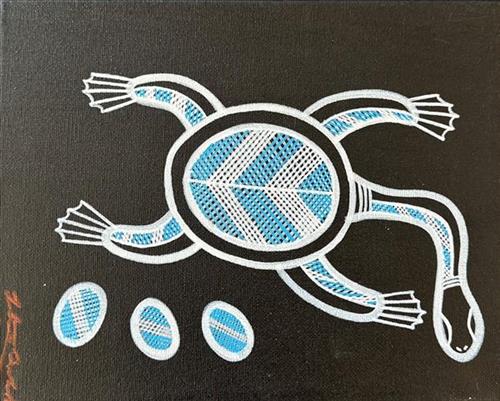
Turtle represents ‘longevity’ (Long Life), living a long life.
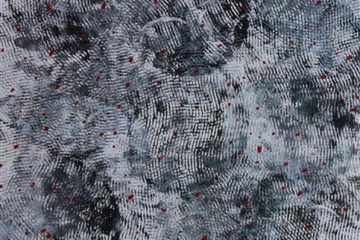
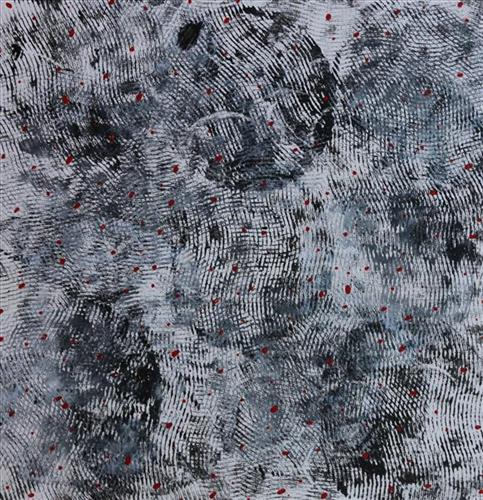
In her recent series of black and white works, Melissa is interested in exploring painting using only two colours on a textured surface. She says: “It’s a nice change from my big coloured paintings. I spend a lot of time thinking about the painting so I can get it right from the start. I like to start with a clear idea of what I want to do. If I don’t get it right, I won’t touch it until I know where I want it to go, and that might take days of looking and thinking. I have to have the vision of the painting clearly in my mind. When the experiment has gone right, I love it. Knowing that the buyer will love it and cherish it makes it worthwhile – to make someone else happy.””
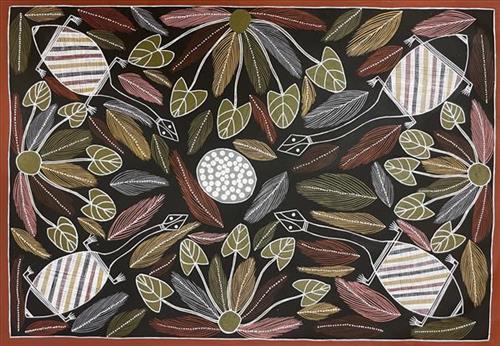
The long necked turtle is a dreaming totem for the freshwater people, the Ganalbingu, whose country includes the World Heritage listed, Arafura Wetlands in Central Arnhem Land, Northern Territory
The Yolngu (people) of Arnhem Land originate from a spiritual source, fixed in a particular place in their land or the sea. These ‘Spiritual Reservoirs’ are often in the form of special waterholes made by Wangga (Creator Beings), long ago close to the beginning of time. These creator beings moved across the country side, shaping the land and implanting in each tract of country, the spiritual life force for the people who were to own it.
These creator spirits took many forms. When they gave the land to each group they also gave songs, dances, ceremony, the associated laws and language. The Creation story for Ganalbingu people took place near the middle section of the Glyde River where it becomes the Goyder River. Their land, Ngaliyindi, sits astride the Arafura Swamp in Central Arnhem Land. Some of their major Creative Beings include Banda (freshwater long neck turtle) and Yalman (water lilies).
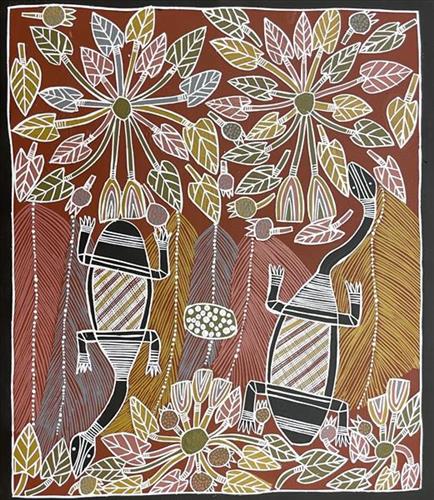
The long necked turtle is a dreaming totem for the freshwater people, the Ganalbingu, whose country includes the World Heritage listed, Arafura Wetlands in Central Arnhem Land, Northern Territory
The Yolngu (people) of Arnhem Land originate from a spiritual source, fixed in a particular place in their land or the sea. These ‘Spiritual Reservoirs’ are often in the form of special waterholes made by Wangga (Creator Beings), long ago close to the beginning of time. These creator beings moved across the country side, shaping the land and implanting in each tract of country, the spiritual life force for the people who were to own it.
These creator spirits took many forms. When they gave the land to each group they also gave songs, dances, ceremony, the associated laws and language. The Creation story for Ganalbingu people took place near the middle section of the Glyde River where it becomes the Goyder River. Their land, Ngaliyindi, sits astride the Arafura Swamp in Central Arnhem Land. Some of their major Creative Beings include Banda (freshwater long neck turtle) and Yalman (water lilies).
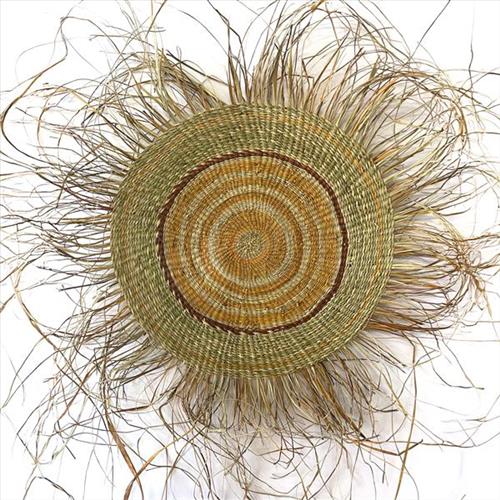
Traditionally, Nganiyal (conical mats) were used as an insect screen when erected, and as a sitting mat when folded. They are used in Ceremony as well as a functional item.
Nowadays, artists weave many different shapes including flat, round and oblong.
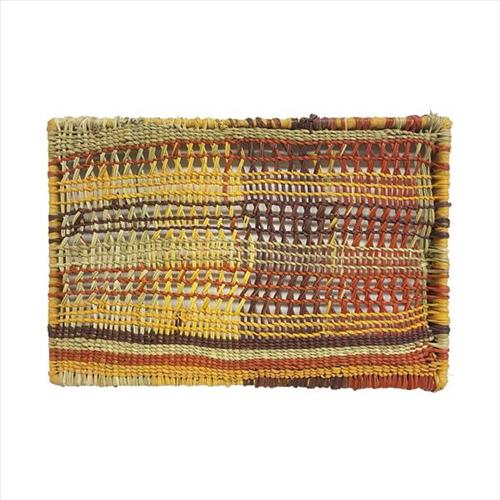
At the end of May 2024, Bula’bula artists, along with Milingimbi Arts and Culture, Maningrida Arts, and Gapuwiak Arts, were invited to attend the Langarra Bush Gallery—a three-day camp that included an exhibition, workshops, and discussions for the Weavers of Arnhem Land. Langarra is an island located a 20-minute boat ride from Elcho Island in the Arafura Sea.
The Bush Gallery provided weavers with an opportunity to create work that pushed their boundaries, encouraging them to experiment with new techniques or showcase unique skills. The goal was to foster a supportive environment where weavers could create and present work they were excited about, facilitate discussions, connections, growth, and instilling pride in their craft.
As a result of this project, our weavers produced traditional Yolngu items from hand-spun bush string, including bags, hunting and fishing items, and wearable ceremonial pieces. Additionally, they explored new approaches by creating canvas-shaped formats. This format invite viewers to examine the intricate details, colours, and craftsmanship, highlighting the inherent beauty of the gunga.
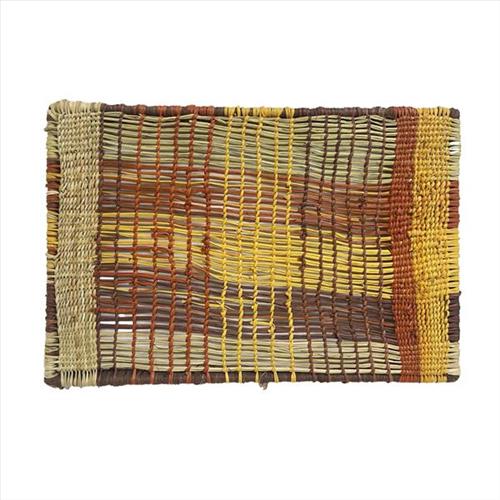
At the end of May 2024, Bula’bula artists, along with Milingimbi Arts and Culture, Maningrida Arts, and Gapuwiak Arts, were invited to attend the Langarra Bush Gallery—a three-day camp that included an exhibition, workshops, and discussions for the Weavers of Arnhem Land. Langarra is an island located a 20-minute boat ride from Elcho Island in the Arafura Sea.
The Bush Gallery provided weavers with an opportunity to create work that pushed their boundaries, encouraging them to experiment with new techniques or showcase unique skills. The goal was to foster a supportive environment where weavers could create and present work they were excited about, facilitate discussions, connections, growth, and instilling pride in their craft.
As a result of this project, our weavers produced traditional Yolngu items from hand-spun bush string, including bags, hunting and fishing items, and wearable ceremonial pieces. Additionally, they explored new approaches by creating canvas-shaped formats. This format invite viewers to examine the intricate details, colours, and craftsmanship, highlighting the inherent beauty of the gunga.

Wood carving has always been part of Aboriginal culture and Djilpin artists continue this tradition. Men carved wood for many purposes – tools for hunting or gathering food, axes and knives for building shelters, spears and clubs for protection of their lives and territory, objects for ceremony and to mark sacred sites.
Hunting implements include the boomerang, woomera and spear. The woomera is a lever which helps to increase the speed and distance the spear travels. Clapsticks are used as percussion instruments by the Songmen to accompany dancing along with the didgeridoo (mago).
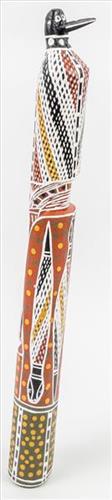
As well as the more functional carvings, artists portray animals and birds in wood, and these carvings are often painted. Ceremonial carvings include spirit creatures including mukuy (devil devils) and mimi.
Some fine mimi figures have been cast in bronze.
Wood carving has always been part of Aboriginal culture and Djilpin artists continue this tradition. Men carved wood for many purposes – tools for hunting or gathering food, axes and knives for building shelters, spears and clubs for protection of their lives and territory, objects for ceremony and to mark sacred sites.
Hunting implements include the boomerang, woomera and spear. The woomera is a lever which helps to increase the speed and distance the spear travels. Clapsticks are used as percussion instruments by the Songmen to accompany dancing along with the didgeridoo (mago).
As well as the more functional carvings, artists portray animals and birds in wood, and these carvings are often painted. Ceremonial carvings include spirit creatures including mukuy (devil devils) and mimi.
Some fine mimi figures have been cast in bronze.