111982352437


Mandjabu

Kuninjku people traditionally make two sorts of conical fish traps. One called Mandjabu made from milil a vine. And another smaller one called manyilk Mandjabu, made from the grass manylik. The milil conical fish trap is bigger and stronger and used in tidal reaches of creeks to catch large fish. the smaller and lighter manylik trap is used in freshwater flowing creeks to catch smaller fish and freshwater prawns. Traditionally only men were involved in the construction of the large fish traps, but smaller children were used to crawl inside and assist.
111982352436


Wak Wak

This painting depicts a sacred site at ‘Kurrurldul’, an outstation south of Maningrida.

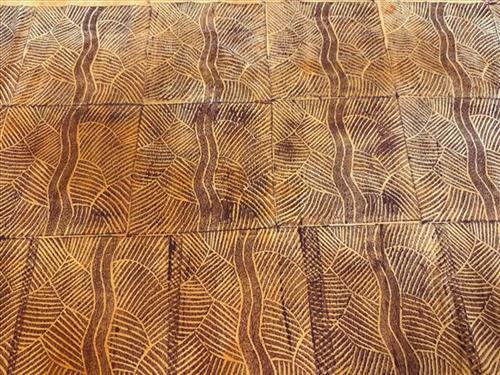
The ‘rarrk’, or abstract crosshatching, on this work represents the design for the crow totem ancestor called ‘Djimarr’. Today this being exists in the form of a rock, which is permanently submerged at the bottom of Kurrurldul Creek. The ‘Djimarr’ rock in the stream at Kurrurldul is said to move around and call out in a soft hooting tone at night. Both the stone itself and the area around it are considered sacred.

The imagery represents the rock mentioned above at the bottom of Kurrurldul creek, which is the final transmutation of the dreaming ancestor ‘Djimarr’. Finally, the pattern used here is also the crow design used in the sacred ‘Mardayin’ ceremony, which is a large regional patri-moiety ceremony now rarely conducted in central and eastern Arnhem Land.

359709482352403


Akana Ngurpay (Grandmothers teachings)

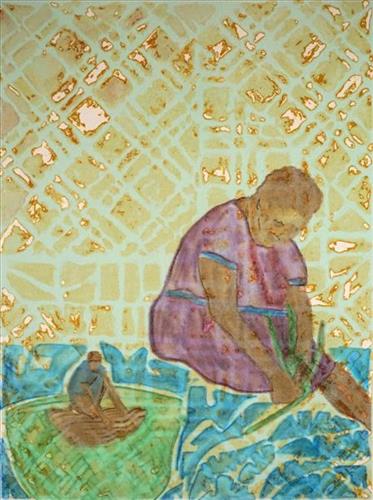
My grandmother’s teachings and values in weaving were rooted in patience, precision, and a deep respect for tradition. She believed that weaving was more than just a craft; it was a way to connect with the past, and express creativity. Every piece she created told a story, woven with care and skill passed down through generations. She emphasized the importance of mindfulness and attention to detail, teaching me that every knot, every thread mattered. To her, weaving was not only about the final product but the process itself—the rhythm of the loom, the meditative repetition, and the joy found in the act of creating something by hand.

359709482352401


Akana Ngurpay (Grandmothers teaching)

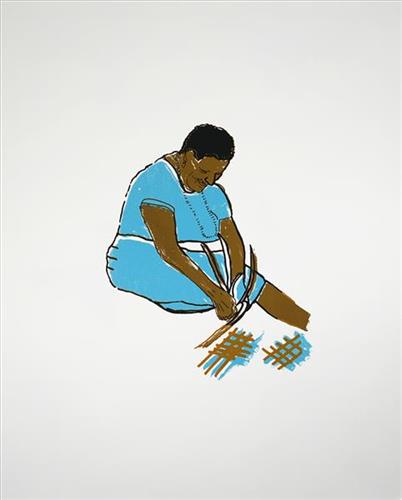
My grandmother’s teachings and values in weaving were rooted in patience, precision, and a deep respect for tradition. She believed that weaving was more than just a craft; it was a way to connect with the past, and express creativity. Every piece she created told a story, woven with care and skill passed down through generations. She emphasized the importance of mindfulness and attention to detail, teaching me that every knot, every thread mattered. To her, weaving was not only about the final product but the process itself—the rhythm of the loom, the meditative repetition, and the joy found in the act of creating something by hand.

377810582352386


Kunkurra (Spiral Wind) – Margot

Margot has depicted kunkurra, the spiralling wind associated with several sites in the Kardbam clan. On one level, this design can be interpreted as a depiction of the kinds of mini-cyclones common during the wet season in Arnhem Land. Kunkurra also relates specifically to a site called Bilwoyinj, near Mankorlod, on the artist’s clan estate.

At this site, two of the most important Kuninjku creation beings, a father and son known as na-korrkko, are believed to have hunted and eaten a goanna. They left some of the goanna fat behind at the site, which turned into the rock that still stands there today.

Bilwoyinj site is also a ceremonial ground for a ceremony called Yabbaduruwa, a major ceremony owned by the Yirridja patrimoiety. The Yabbaduruwa ceremony is primarily concerned with initiation, land ownership and promoting the cyclical regeneration of the human and natural worlds.

220982352684


Maisie Petyarre Bundey – Bush Tucker

Maisie paints the bush tucker found in her country, the area that surrounds Boundary Bore in the Utopia homelands. She paints bush plums, bush bananas, bush potatoes and bush medicine plants. The main motif which recurs often in Maisie artworks is a full coolamon. When she paints she always speaks of gathering and hunting on her country ‘long way from here, long time ago’, filling up coolamons with ‘bush potato, bush banana, goanna and porcupine.’ Maisie always says her family are ‘happy ones, healthy ones.’
 

221282352767


Strong Family Connection

This is a story of how life was before. It’s a beautiful landscape without problems like we have today. There were no problems then, people were happy. They were connected as families. It shows what life was like for our people in the past before we had houses. Everything was silent, and all the animals were close by to the people. Everyone looked after the animals and the environment. People don’t have that life anymore.

111982352500


Wititj and Two Sisters

There were two sisters out hunting lizards with their dog when they found Brolga eggs. They started cooking when a quoll approached them. One of the sisters wanted to keep the quoll but the other sister warned that it was dangerous and would bring trouble. Then Ngalyod, the Rainbow Serpent, crashed down into the earth, making a billabong and drowning the two sisters