115682361173


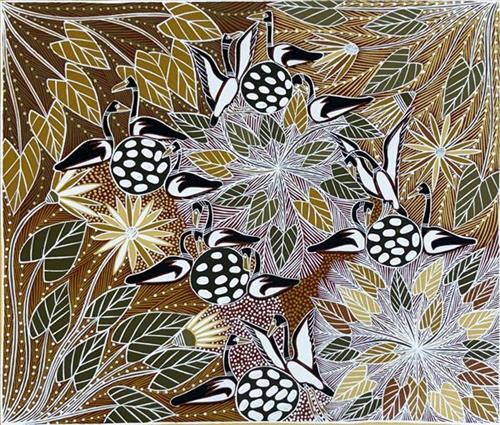
Gumang (Magpie Geese)

The Yolngu people of Arnhem Land originate from a spiritual source, fixed in a particular place in their land or the sea. These ‘Spiritual Reservoirs’ are often in the form of special waterholes made by Wangarr (Creative Beings) long ago close to the beginning of time.

The creator beings moved across the country side, shaping the land and implanting in each tract of country, the spiritual life force for the people who were to own it. These Creative Spirits took many forms. When they gave the land to each group they also gave songs, dances, ceremony, the associated laws and language. The Creation story for Ganalbingu people took place near the middle section of the Glyde River where it becomes the Goyder River. Their land, Ngaliyindi, sits astride the Arafura Swamp in Central Arnhem Land.

In this painting, the artist has depicted Gumang (magpie geese), which are sacred to the Ganalbingu people. To the east of the Arafura Swamp is a freshwater billabong which is said to have been made by the Goose Spirit and is in the shape of a goose nest. As a result, geese, their eggs and their nests are sacred.
115682361889


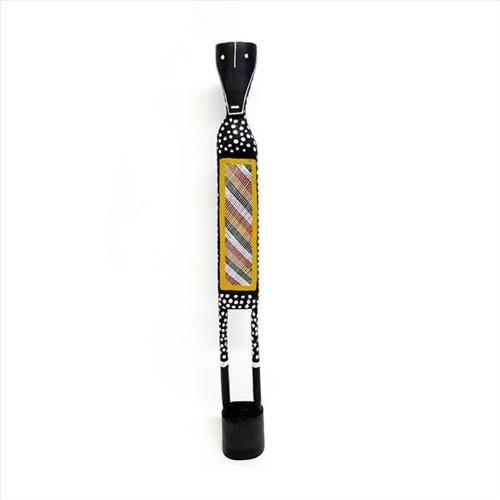
Warraburnburn (spirit)

Like people, warraburnburn live in family groups. Though they cannot be seen, they can sometimes be heard calling out to one another as they move across the country to hunt. They also have the ability to communicate internally with people, warning them when strangers enter their land. Warraburnburn know the country intimately and can be both protective and dangerous. Some may mislead people, turning the land over to make it confusing and unfamiliar, while others guide people to safety.

22544008042


Status: Stock


Boab nut (general)

Ngarinyin, Woddorda  (Worrorra) and Wunambal are the three main languages of the North Kimberley language families. The Boab Tree is known by Wurnambal people as Jungurri, in  Woddorda as Jungurim and in Ngarinyin as Jungulan jirri, Larrgari jirri and Malawudi jirri.

Boab or Larrgardi Trees (lt.: Adansonia Gregorii) – is an Australian native species only found in the Kimberley region of Western Australia. They are very recognisable due to their unusual shape – reminding one of a full-bodied bottle. Some trees are more then 1500 years old and can hold more than 100,000 litres of water in their trunks.

Every part of the tree is used either as a food-resource, as medicine or otherwise. Almost every part of the tree is edible from the young leaves and tubers to the internal fruit pods and seeds.

The tree produces beautiful large fragrant yellow flowers. Inside the fruit pod the fruit is naturally dried on the tree itself. This is the only fruit in the world that does this.

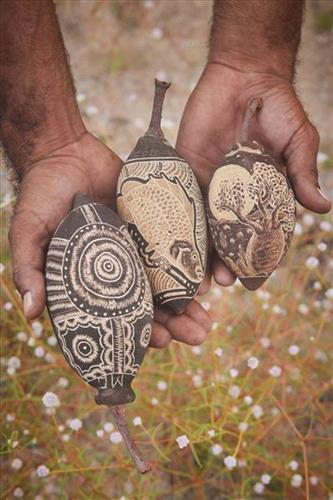
Indigenous artists carve designs into shell of the boab nut or paint it with different designs and children use it as a rattle. The designs on the nuts vary from Wandjina’s to different animals, like the Brolga, turtles, and fish to people’s faces and landscapes.

“Boab nut Carving was a way of expressing ones artistic skills. Aboriginal people across the Kimberley Region of Western Australia was carving along time ago it started with our ancestors.”

22544008040


Status: Stock


Boab nut (general)

Ngarinyin, Woddorda  (Worrorra) and Wunambal are the three main languages of the North Kimberley language families. The Boab Tree is known by Wurnambal people as Jungurri, in  Woddorda as Jungurim and in Ngarinyin as Jungulan jirri, Larrgari jirri and Malawudi jirri.

Boab or Larrgardi Trees (lt.: Adansonia Gregorii) – is an Australian native species only found in the Kimberley region of Western Australia. They are very recognisable due to their unusual shape – reminding one of a full-bodied bottle. Some trees are more then 1500 years old and can hold more than 100,000 litres of water in their trunks.

Every part of the tree is used either as a food-resource, as medicine or otherwise. Almost every part of the tree is edible from the young leaves and tubers to the internal fruit pods and seeds.

The tree produces beautiful large fragrant yellow flowers. Inside the fruit pod the fruit is naturally dried on the tree itself. This is the only fruit in the world that does this.

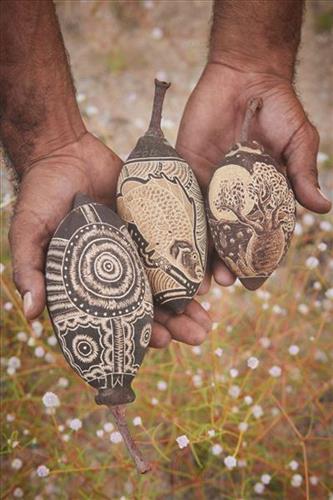
Indigenous artists carve designs into shell of the boab nut or paint it with different designs and children use it as a rattle. The designs on the nuts vary from Wandjina’s to different animals, like the Brolga, turtles, and fish to people’s faces and landscapes.

“Boab nut Carving was a way of expressing ones artistic skills. Aboriginal people across the Kimberley Region of Western Australia was carving along time ago it started with our ancestors.”

22514008052


Status: Stock


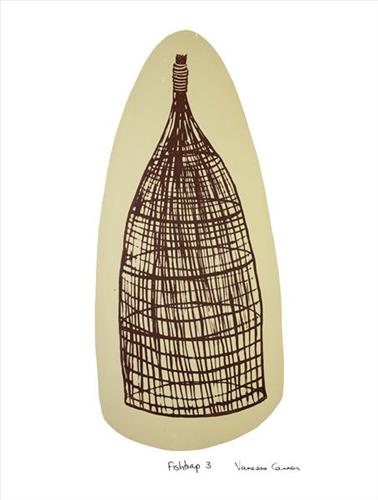
A5 Makarr (Fish Trap) 3

Fish traps are called Makarr in our language. They were made by men only. Our fathers and uncles used to make them with the lawyer vine. They stripped the stems and then soaked them in the river to keep them soft and bendy. They also had a special way of weaving the fish traps. They used them in the river to catch eels, jungle perch, fresh water catfish and turtle. To attract fish our old people used to sprinkle rain forest berries as bait over the trap.

22514008051


Status: Stock


A3 Kadanji (Palm Cockatoo) 1

Kadanji (Palm Cockatoo) is my family Totem. It is very important to me because it holds all the stories relating to the traditional land that was passed down to me and my siblings through my fathers, grand fathers and great grand fathers side.

22514008050


Status: Stock


A4 Kadanji (Palm Cockatoo) 1

Kadanji (Palm Cockatoo) is my family Totem. It is very important to me because it holds all the stories relating to the traditional land that was passed down to me and my siblings through my fathers, grand fathers and great grand fathers side.

22514008049


Status: Stock


A5 Kadanji (Palm Cockatoo) 1

Kadanji (Palm Cockatoo) is my family Totem. It is very important to me because it holds all the stories relating to the traditional land that was passed down to me and my siblings through my fathers, grand fathers and great grand fathers side.

22514008048


Status: Stock


A5 Karrangkal 2(Corals of the Great Barrier Reef)

Our beautiful Yalanji coastline has many places where the rainforest and the reef come very close together. The colourful corals on this print are a reminder of the rich ocean environments of the Great Barrier Reef that have nourished generations of our Kuku Yalanji families and culture.

For me the corals summarize our traditional knowledge and family histories of how we Kuku Yalanji used to live with the ocean. Our Elders gave us the knowledge and taught us the rules for hunting and cooking various sea animals, sharing the food with our families and making fish hooks, spears and fish traps.