111582359505


Rabbit Proof Fence

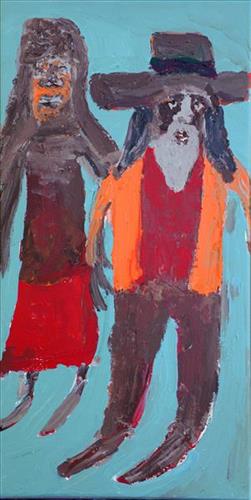
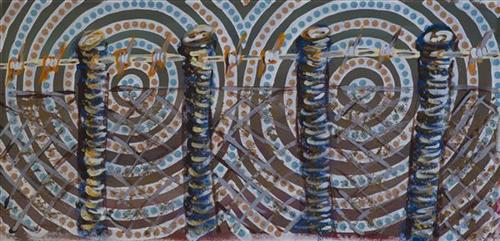
“When I was a little girl, my sister and I would visit our nanna [Molly Craig]. We really looked after her and checked if she had any food and sometimes she would say ” I’m hungry one.” We would race home to make damper and cook some meat and take it back to her before it got dark. She was a caring and beautiful lady but she never told her story about what happened when she was young because my sister and I were part of welfare. That’s why my sister and I had a great connection with our nanna, an unspoken connection.”

– Kathleen Sorenson

In 1931 sisters Molly Craig, Daisy Kadibil and Gracie Fields were taken from their families, like many other Aboriginal children at that time, and transported to Moore River Native Settlement, north of Perth. They were taken away in the belief that part-Aboriginal children should be trained as domestic servants. 

The three girls escaped the next day and, incredibly, walked 1600 kilometres home to Jigalong using the Rabbit-Proof Fence to navigate. The Rabbit Proof Fence remains the world’s longest fence, and was built in the early 1900s to separate rabbits from pasture. For nine weeks, the girls followed its length in order to be reunited with their family. They crossed a flooded river, sand dunes, heathlands, wheatbelts and plains, claypans and salt lakes. They slept in dug-out rabbit burrows, and caught and cooked rabbits, along with other plant based bush tucker. For the duration of their journey they were pursued by policeman and an Aboriginal police tracker.

The girls’ story has been immortalised in the novel “Follow the Rabbit-Proof Fence” by Doris Pilkington (Nugi Garimara, 1996), and was adapted into the film “Rabbit Proof Fence” (2002). This story retains special significance for the Martu, and in particular those inhabitants of Jigalong Aboriginal community. The three girls were Martu, and their children and grandchildren continue to live in the Martu homelands today.

111582359504


Kiwirrkurra

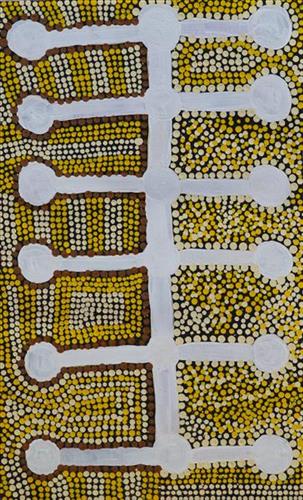
Kiwirrkurra is a rockhole located in the tali (sandhill) Country of the Gibson Desert, to the south west of Lake McKay. An Aboriginal community by the same name is now located nearby, to the west of the water source. 

Kiwirrkurra lies just east of Marapinti rockhole, an important site in the Minyipuru (Jakulyukulyu, Seven Sisters) Jukurrpa (Dreaming) narrative. At Marapinti the travelling women danced and pierced their noses, a practice also known as marapinti. Today the Minyipuru can be seen at Marapinti as a group of rocks, sitting up like women.

Minyipuru is a central Jukurrpa narrative for Martu, Ngaanyatjarra, Pitjantjatjara and Yankunytjatjara people that is associated with the seasonal Pleiades star constellation. Relayed in song, dance, stories and paintings, Minyipuru serves as a creation narrative, a source of information relating to the physical properties of the land, and an embodiment of Aboriginal cultural laws. Beginning in Roebourne on the west coast of Western Australia, the story morphs in its movement eastward across the land, following the women as they walk, dance, and even fly from waterhole to waterhole. As they travel the women camp, sing, wash, dance and gather food, leaving markers in the landscape and creating landforms that remain to this day, such as groupings of rocks and trees, grinding stones and seeds. During the entirety of their journey the women are pursued by a lustful old man, Yurla, although interactions with other animals, groups of men, and spirit beings are also chronicled in the narrative.

111582359503


Tuwa

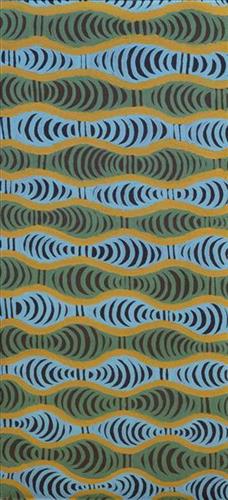
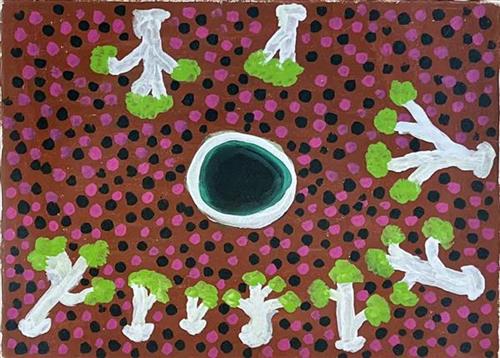
‘’Went with Martumili. Old Jigalong. Judith’s nanna Country, where Judith nanna was born. Went from old Jigalong to Jigalong to right through Parnngurr, Camped the night and then Judith’s pop went to pick him up. His name is Mr Rowlands and I call him brother. He showing me where my nanna’s Country started from Parnngurr towards Lake Disappointment. We camped the night. Judith’s nanna was getting cheeky bossing him (Mr Rowland) around; “we not married anymore that’s why I left him.” Between Lake Disappointment and Durba Springs (Pinpi) there were these beautiful rolling sand hills, we winding through them over top, we stopped half way and I looked out to the sunset saw all the glistening spinifex. The orange from the sunset lit the sand dunes up. When I do the Tuwa paintings I think of that day.’’

– Kathleen Sorensen

The traditional lands of the Martu people encompass the Great Sandy Desert and Rudall River regions of Western Australia, an enormous tract dominated by distinctive red tali, or tuwa (sandhills). These sandhills present an unforgiving landscape; sparse vegetation covers a seemingly never ending expanse of dunes, and yet these lands and the location of resources within them was known intimately by its pujiman (traditional, desert dwelling) inhabitants. At this time, Martu traversed very large distances annually in small family groups, moving from water source to water source through the harsh desert landscape with incredible stamina and resourcefulness. Travel was often undertaken at night, and when travelling during the day, Martu wore yakipiri (woven bark sandals) to protect their feet from the hot desert sand.

220182359413


Family in Yalpirakinu

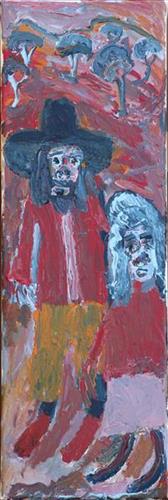
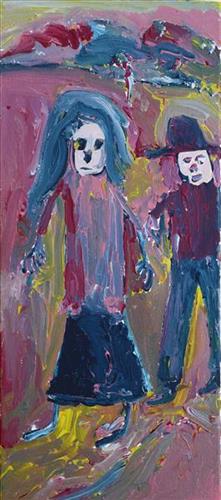
Yalpirakinu is Adrian’s mother’s country. Adrian’s mother is the late Eunice Napangardi, a well known painter herself. His artworks consistently refer to the desert mountains, ridges and trees which are part of Yalpirakinu. Using a restricted colour palette, Adrian’s brushwork is loaded with energy, drama and memories. In this painting Adrian has drawn from his memory to portray his family in Yalpirakinu.

220182359381


Yalpirakinu

Yalpirakinu is Adrian’s mother’s country. Adrian’s mother is the late Eunice Napangardi, a well known painter herself. His artworks consistently refer to the desert mountains, ridges and trees which are part of Yalpirakinu. Using a restricted colour palette, Adrian’s  brushwork is loaded with energy, drama and memories. He is a deliberate and thoughtful painter; reworking, pushing and pulling the image to completion.

114082359021


Coiled Pandanus Basket

This basket is made from natural, local materials sourced from the Gunbalanya area. Weavers gather fresh young leaves from the pandanus palm using a hooked stick, then strip and dry them. The pandanus is then boiled up on the campfire with local plant dyes.

Today’s coiled fibre works are the result of rich cultural exchange and artistic innovation. The coiling technique was traditionally used by southern Aboriginal people of the Murray River, and was introduced to Goulburn Island by missionary Greta Matthews in the 1920s. From here it spread amongst Aboriginal people throughout Arnhem Land. These works are living embodiments of Australia’s history. Kunwinjku women have been developing the artform for almost 100 years, experimenting with new forms and adapting it to local materials.

The old plant dyes used in Europe like indigo, saffron, woad and logwood fell out of use with the Industrial Revolution. But here, a natural “paintbox” thrives.

The most common dyes include:
Yellow-orange: Mandjurndum (the bright orange roots of the Pognolobus reticulatus bush)
Brown: Wirdilwirdil (the red bulb of Haemadorum breviculae grass)
Green: The growing shoot of the pandanus itself (Pandanus spiralis), boiled with the ashes of pandanus leaves.
Purple-pink – Windilk (the seeds of the Haemodorum coccineum plant, related to Kangaroo Paw)
Grey-Black – Manbedde (the leaves of the quinine bush, Petalostigma pubescens)

Source: Louise Hamby (ed.) “Twined Together”.

11452957161


Pinti

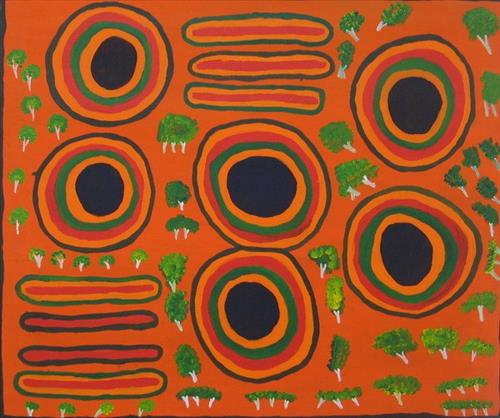
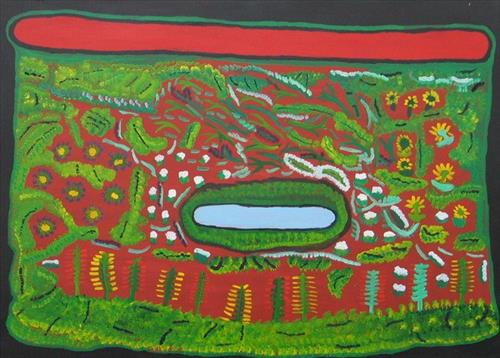
Pinti is a jila (living waterhole).There are white flowers that grow all around this waterhole after the fire comes through.We collect Karlaka (wild honey) from the Kuparnu (grevillea) tree.There is a big jilji (sandhill) here too.