Status: Stock
37781614008127
Status: Stock
Birmba
Birmba, the white cockatoo is a cheeky bird. Stealing fruit all the time.
In our culture some birds are messengers. In our lore Birmba brings us news.
My mothers Bubu is the Shipton Flat/Helenvale area.
I love taking family to our bubu, fishing and hunting for food and having a fire with damper.
s dfsad fsf
115682361827
Warrnyu Dhawu (Flying Fox Story)
Back in the Creation time, Warrnyu (Flying Foxes) once lived, like men, in the cave at the place called Kurrki Warrnyu Yirri Djaringal (they also lived in caves called Wadatilmurr & Gurngurmirrngu). Warrnyu lived in these caves for many years and then one day Djanyarr (The Dog), an ancestral being in the form of a man, came along. He was looking around for a place to live. Djanyarr heard the sound of a Flying Fox screaming. He went down to the cliff and pushed the rock and the water came out at the Ganalbingu place called Gurrkawakarrmurr. He then went into the cave and into the sacred hole, frightening all the Flying Fox away. When he went into the hole he left his dilly bag in the tree and went out on the other side of the sacred cave and leaving his spear and woomera. He sat there for a long time. The Dog made three streams and the water went inside the cave. Two of these streams are good drinking water. In the middle it is a sacred water. No-one drinks from the middle of the stream. Children, men, women, young boys or girls are not allowed to drink from the middle of the stream. If they drink the water from the middle of the stream they will go grey too early.
At Kurrki Warrnyu Yirri Ngilaya Djaringal, the Flying Fox made himself into a young man… that’s what Aboriginal people do today. They have ceremonies and dances to make the young boys into men. The songs are called Yirrarwu, Gulumu, Rruburra and Burryun. Dhapi (initiation ceremony) happen today because the Warrnyu (Flying Fox) people performed them a long time ago before the Yolngu people. It was the Warrnyu people who first performed circumcision of the young boys to make them into men. It all happened at Kurrki Warrnyu Yirri Ngilaya Djaringal, this is how this place got its name.
Leaving behind the cave at Kurrki Warrnyu Yirri Djaringal, the Dog travelled west across the Arafura Swamp and came to Djalkulmurr (Mount Delight). From there he travelled north and came to Dunganda (a hill situated a few kilometres east of Ramingining). There he met a female Dog, then they both headed north and came to a place called Garanydjirrmurr where they spoke the Mildjingi language. From Garanydjirrmurr they changed their direction and went west through Guliny’barra, Burgumara and onto the plains. When they reached the plains they smelled something cooking, way up in the north – at Wessel Islands. The aroma they smelt was so enticing that they decided to go there. Lungurrma (the north-east wind) was carrying the smell. One Dog headed north again, but the other Dog decided not to go with him and went back the opposite way. The first Dog that went to Malwanatharra (Sandy Point) went into the sea following its nose to wherever the smell was coming from. It is believed that this Dog still lives in the sea…
115682363654
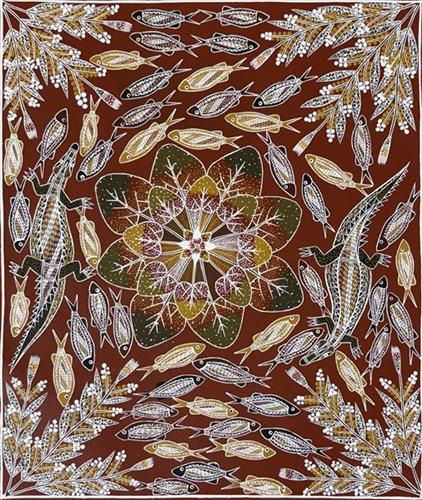
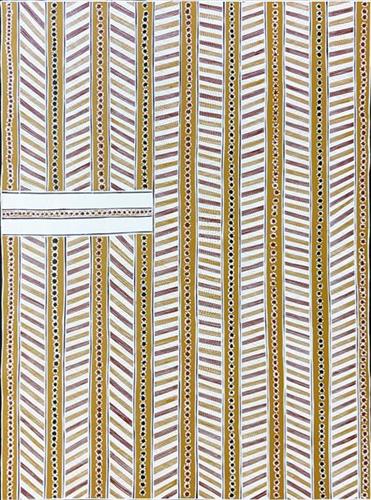
Raypiny Dhawu (Fresh Water Story)
All Aboriginal people originate from a spiritual source, fixed in a particular place in their land or the sea. These ‘spiritual reservoirs’ are often in the form of special waterholes made by Wangarr (creative spirits) that were created long ago close to the beginning of time. These creator beings moved across the countryside, shaping the land and implanting in each tract of country, the spiritual life force for the people who were to own it. These creative spirits took many forms and when they gave the land to each group, they also gave songs, dances, ceremony, the associated laws and language.
The creation story for Ganalbingu people took place near the middle section of the Glyde River where it becomes the Goyder River. Their land, Ngaliyindi, sits astride the Arafura Swamp in Central Arnhem Land. Many Ganalbingu artists paint totemic species significant to their clan. These can include baru (crocodile), banda (long necked turtle), buliya (catfish), yalman (waterlilies), gumang (magpie geese), dakawa (fresh water yabby), ratjuk (barramundi), warrnyu (flying fox) and more.
221382366819
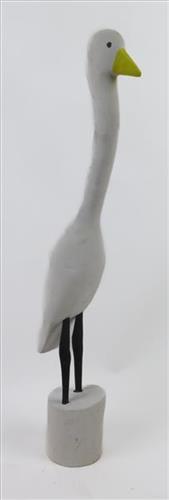
Heron
Wood carving has always been part of Aboriginal culture and Djilpin artists continue this tradition. Men carved wood for many purposes – tools for hunting or gathering food, axes and knives for building shelters, spears and clubs for protection of their lives and territory, objects for ceremony and to mark sacred sites.
Hunting implements include the boomerang, woomera and spear. The woomera is a lever which helps to increase the speed and distance the spear travels. Clapsticks are used as percussion instruments by the Songmen to accompany dancing along with the didgeridoo (mago).
As well as the more functional carvings, artists portray animals and birds in wood, and these carvings are often painted. Ceremonial carvings include spirit creatures including mukuy (devil devils) and mimi.
Some fine mimi figures have been cast in bronze.
111982366717
Burlupurr – dillybag
Burlupurr, or dilly bag, is usually a large woven collecting basket. These large bags are often made from the vine ‘Malasia scandens’, a strong pliable plant which grows along the floor and into the canopy of monsoon vine thickets. The bags are used to collect any kind of large numbers of heavy foods such as fish caught in conical fish traps or large collections of yams.
They can also be made from Pandanus spiralis, a plant which grows in many areas of Arnhem Land. These dilly bags are a tightly woven collecting basket, very finely made. These dilly bags are often used to collect sugarbag, the native honey.
Common colours used to dye pandanus used for weaving burlupurr include:
– barra gu-jirra: the soft, white and fleshy end of the pandanus leaf imparts green to the fibre.
– mun-gumurduk/ gala (Pogonolobus reticulatus): a bright yellow root that is crushed and put in a billycan with the fibre and boiled. It creates yellow when boiled once and deep orange hues when boiled multiple times.
– ngalpur (Haemodorum brevicaule): a bright red root which yields a range of purply red to brown colours.
– Baluk: ashes of certain plants are added to the boiling billycan with the fibre and dye plants to alter the colour that is imparted to the fibre. The fruiting body of gulpiny (Banksia denanta) is burnt and the ashes added to other day plants to make the colour pink.
As well as being of practical use, dilly bags are also of religious significance to Arnhem Land people. Dilly bags are said to be totemic objects and associated with particular sites in the landscape.
111982366873
Ngokngok (Owl)
Ngokngok or mun-ngokngok is the Southern Boobook owl. Their clan is Warrawarra and the are connected to traditional healers.
111982366872
Ngokngok (Owl)
Ngokngok or mun-ngokngok is the Southern Boobook owl. Their clan is Warrawarra and the are connected to traditional healers.
111982366870
Ngokngok (Owl)
Ngokngok or mun-ngokngok is the Southern Boobook owl. Their clan is Warrawarra and the are connected to traditional healers.
111982366869
Ngokngok (Owl)
Ngokngok or mun-ngokngok is the Southern Boobook owl. Their clan is Warrawarra and the are connected to traditional healers.