221282363449


Tjukula/Waterholes

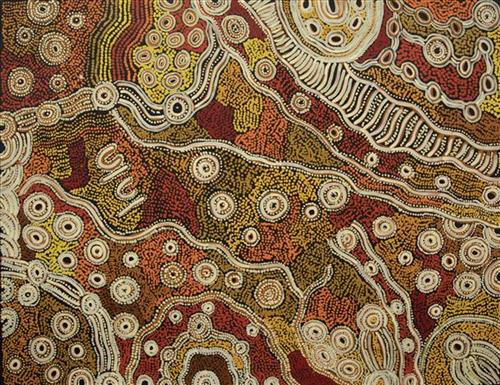
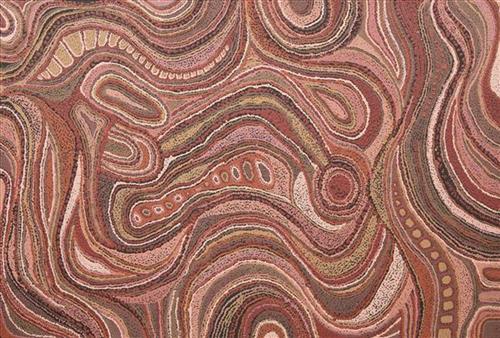
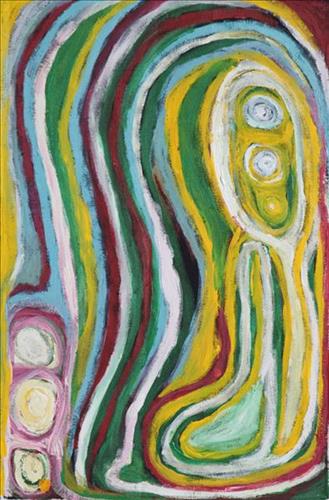
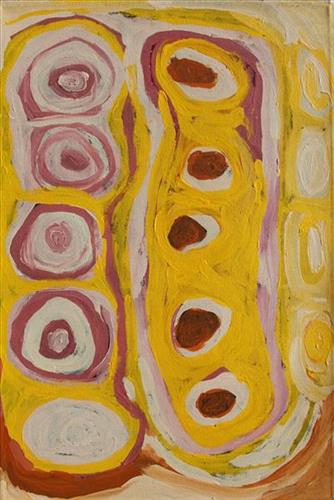
For the Pitjantjatjara people living in the desert, knowledge of their water sources was critical to their survival. This resulted in an intimate understanding of the landscape which continues today. Water is an essential element in the desert. These rock holes were particularly important during the dry season when most of the water holes and creeks dried up.  Deep familiarity with the topography of their country and the way rain would interact with the land ensured constant sources of water could be found. Knowledge of rock hole sites is passed on from generation to generation and revered by all Anangu (people).

Tjukula means rock-holes, which are found with surprising frequency in the Musgrave Ranges and country around Ernabella.  Between visits, Anangu would use a construction of rocks and spinifex to guard these important water sources from spoilage by feral and stock animals such as cattle, camels, horses and donkeys.

221282363446


Minyma Kutjara

There is a story of deep significance to women which contains metaphorical references to female cycles. It tells of two women travelling north. The pair meet with a group of women, including Kutungu, who are caring for a man who then passes away. They then travel to the area known as Mantaruta, near Uluru, where they chase a curious wanampi (serpent) deep into the ground while trying to catch him. They burn their body hair to attract him and hit him on the head and run away. From afar they throw a manguri/traditional head-ring for carrying which also hits him. He then comes and hits the women who travel on bleeding and hurt.

221282363439


Piltati

There were two sisters who married two brothers and they all lived together. One day the women went wandering and they went such a long way that they forgot about their husbands. Back at the camp, the two husbands were thinking, ‘Where are our wives?’ and they decided to go looking for them. One brother said to the other, ‘What should we become to go looking for them?’ and the other brother said ‘Why don’t we become Rainbow Serpents?’ And they travelled in the sky looking down for their wives. Finally they see them hunting for carpet snakes and they put something in the hole where the women were digging. The women find it and then dig another hole and once again the men have put something in there. And this is how the men lure the women back to Piltati where the men make the sisters transform into Wanampi, swallow them and keep .them in their throats. All four of them live together in the waterhole and still live there today.

221282363437


Kungkarangkalpa / Seven Sisters

Kungkarangkalpa means the Seven Sisters. This is an extensive creation story that relates to the Pleiades constellation in the southern hemisphere. The story traverses Australia taking on different forms, however local women are privy to the part of the story which takes place in the country near Ernabella. For this part of the story, the man called Nyiru is chasing the sisters as he wants to sleep with the oldest sister. All the younger sisters are deeply afraid of him. As Nyiru is chasing the sisters, he tries to catch them by using magic to turn himself into the most tempting bush tomatoes for the sisters to eat and the most beautiful ili (fig) tree for the sisters to camp under. However, the sisters are aware of his magic and go hungry and run through the night rather than be caught by Nyiru. Eventually, to escape Nyiru, the sisters fly into the sky where they turn into stars and form the constellation.

114182363417


Kungkarrangkalpa (Seven Sisters)

‘Kungkarrangkalpa’ (The Seven Sisters or Pleaides) is significant Tjukurrpa (dreamtime). Its origins you may be familiar with in astronomy and its connection to ‘Wati Nyiru’ (Magic Man or Orion).  The roots of this dreaming stems across indigenous groups around the world. The Australian Aboriginal songline is one part to the whole dreaming which can be traced all around the world. The ladies of the Ngaanyatjarra Lands depict their significant chapter and understanding of the journey of the sisters. The different versions of this story depend on where you live and the significance’s of local Tjukurrpa places.

Nyiru fell in love with the sisters but he was of the wrong skin group to marry, but he still pursued them on their journey. The sisters travel across the land to escape Nyiru’s unwanted attentions, but he is persistent and always finds them. There are significant land forms which can be sited today that evidence this dreaming. As Nyiru is chasing the sisters he tries to catch them by using magic to turn into the most tempting kampurarrpa (bush tomato) and the most beautiful Yirli (wild fig tree), for them to eat and camp under. However, the sisters are knowledgeable of his magic and too clever for Nyiru who they outwit again and again. They go hungry and run through the night rather than be caught by him. As the journey continues, Nyiru gets so frustrated at the wit of the sisters that he uses his magic to make the oldest sister sick to try and get closer to her. The other sisters rescue the big sister and nurse her back to health. It is said he also captures the youngest sister, but with the help of the oldest sister, she escapes back to her sisters who are waiting for her. Eventually, the sisters fly into the sky to escape Nyiru, forming the constellation. Nyiru felt lonely, longing for the sisters who were so far away. Nyiru used his magic to go to the sky, forever in pursuit.

11151030307


Two snakes travelling

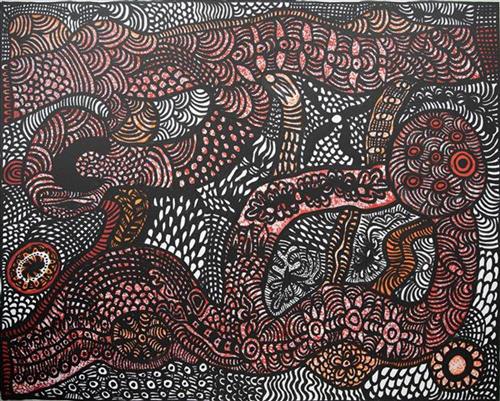
This painting depicts 2 snakes travelling across Yiritijanu and Punmu Hill in the artists country.

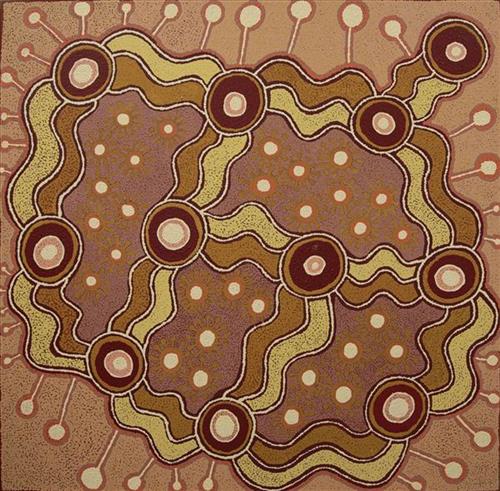
This is Nungabar’s Country- her ‘ngurra’ (home Country, camp). People identify with their ngurra in terms of specific rights and responsibilities, and the possession of intimate knowledge of the physical and cultural properties of one’s Country. Painting ngurra, and in so doing sharing the Jukurrpa (Dreaming) stories and physical characteristics of that place, has today become an important means of cultural maintenance. Nungabar’s ngurra encompasses her birthplace, near Lipuru well (Libral Well, Canning Stock Route Well 37) and the Country that became Wells 33 through to 38 along the Canning Stock Route, where her family walked in the pujiman (traditional, desert-dwelling) era. From an early age Nungabar and her family had encounters with the white men who drove cattle along the route. As a young woman, together with her close friend Nora Wompi, Nungabar followed the drovers north to Balgo Mission, where she settled and raised a family.

Portrayed in this work are features of Nungabar’s family’s ngurra, such as the striking salt lakes, permanent red tali (sandhills), warta (trees, vegetation), and the individually named water sources they camped at. Rock holes, waterholes, soaks and springs were all extremely important sites for Martu people during the pujiman period, and are generally depicted with circular forms. 

The encyclopaedic knowledge of the location, quality and seasonal availability of the hundreds of water bodies found in one’s Country sustained Martu as they travelled across their Country, hunting and gathering, visiting family, and fulfilling ceremonial obligations. They would traverse very large distances annually, visiting specific areas in the dry and wet season depending on the availability of water and the corresponding cycles of plant and animal life on which hunting and gathering bush tucker was reliant. As they travelled and hunted they would also burn areas of Country, generating a greater diversity of plant and animal life.
11151032882


Nattery

This artist primarily paints her country in the Canning Stock Route area. As a younger woman the artist lived and travelled traditionally with her family during the pujiman (bush) days. They travelled up and down the Stock Route from well 33 to well 38 and as far as Balgo. Well 33 is now known as Kunawarritji Community and is the artist’s ngurra (home).

11152117953


Untitled

This is Nungabar’s Country- her ‘ngurra’ (home Country, camp). People identify with their ngurra in terms of specific rights and responsibilities, and the possession of intimate knowledge of the physical and cultural properties of one’s Country. Painting ngurra, and in so doing sharing the Jukurrpa (Dreaming) stories and physical characteristics of that place, has today become an important means of cultural maintenance. Nungabar’s ngurra encompasses her birthplace, near Lipuru well (Libral Well, Canning Stock Route Well 37) and the Country that became Wells 33 through to 38 along the Canning Stock Route, where her family walked in the pujiman (traditional, desert-dwelling) era. From an early age Nungabar and her family had encounters with the white men who drove cattle along the route. As a young woman, together with her close friend Nora Wompi, Nungabar followed the drovers north to Balgo Mission, where she settled and raised a family.

Portrayed in this work are features of Nungabar’s family’s ngurra, such as the striking salt lakes, permanent red tali (sandhills), warta (trees, vegetation), and the individually named water sources they camped at. Rock holes, waterholes, soaks and springs were all extremely important sites for Martu people during the pujiman period, and are generally depicted with circular forms. 

The encyclopaedic knowledge of the location, quality and seasonal availability of the hundreds of water bodies found in one’s Country sustained Martu as they travelled across their Country, hunting and gathering, visiting family, and fulfilling ceremonial obligations. They would traverse very large distances annually, visiting specific areas in the dry and wet season depending on the availability of water and the corresponding cycles of plant and animal life on which hunting and gathering bush tucker was reliant. As they travelled and hunted they would also burn areas of Country, generating a greater diversity of plant and animal life.
111576333942


Rockholes

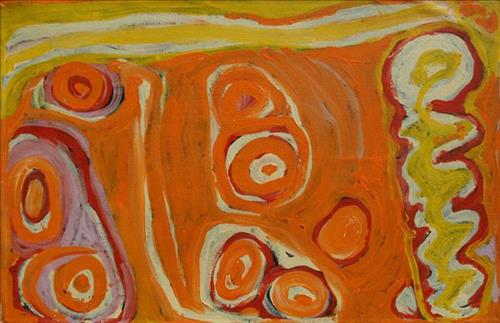
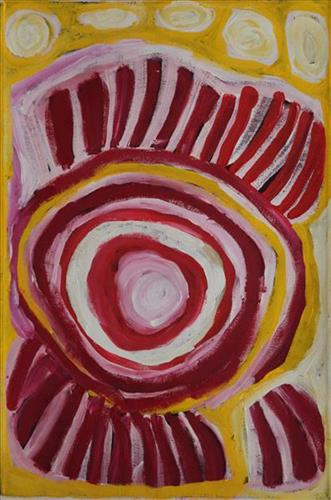
This work depicts a waterhole within the artists’ ngurra (home Country, camp), typically represented with circular forms. Waterholes are sites that require maintenance, including digging to increase flow, clearing out surrounding growth, and cleaning up after sullying by camels or cattle.

During the pujiman (traditional, desert dwelling) period, knowledge of water sources was critical for survival, and today Martu Country is still defined in terms of the location and type of water. Each of the hundreds of claypans, rockholes, waterholes, soaks and springs found in the Martu desert homelands is known through real life experience and the recounting of Jukurrpa (Dreaming) narratives by name, location, quality and seasonal availability. This encyclopedic knowledge extends even to the nature and movement of arterial waterways, and sustained Martu as they travelled across their Country, hunting and gathering, visiting family, and fulfilling ceremonial obligations. They would traverse very large distances annually, visiting specific areas in the dry and wet season depending on the availability of water and the corresponding cycles of plant and animal life on which hunting and gathering bush tucker was reliant.

115682357373


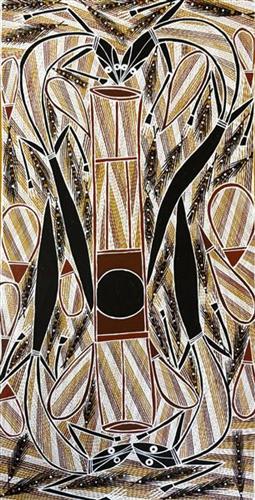
JB Fisher – Djanda (lizard)

JB paints stories from his Dhuwa homeland in northeast Arnhem Land. Stories are passed on either paternally or maternally and JB would have learnt these stories from his ancestors. The cross-hatching style (Rrark) is a traditional painting style of this area and can represent elements such as water, air and wind.

His paintings often feature totemic animals of the fresh waters of North East Arnhem Land.