114182360137


Kuntjanu – Rockhole and Water Snake

Kuntjanu is a women’s site, a powerful place from the Pitjantjatjara Lands in South Australia.
Long ago, the women came to Kuntjanu. The land was good — rich with bush foods, and the Rockhole there was full, a sweet place to rest for a while. They gathered, they stayed, they shared that time together.

But they were uneasy.

A water snake lived in that Rockhole. They could feel it, watching. Its presence made them nervous.
They worried it might do something — harm them, chase them.
So even in the midst of plenty, they held close to each other, alert, always listening to the land.

220982360531


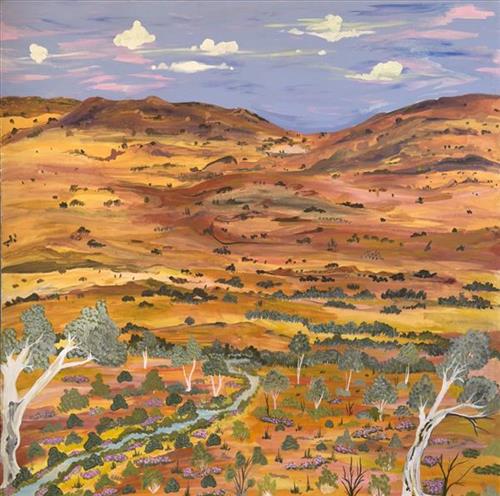
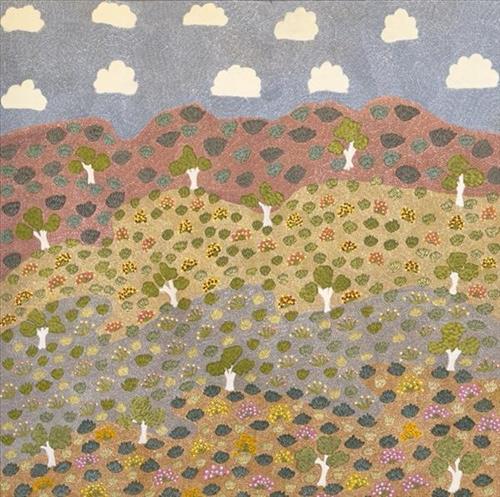
Elizabeth Ngwarraye Bonney – My Grandmothers Country

I still hunt my Grand Mothers country for goanna, bush medicine and yams.

I hunt all year round, hunting and walking through the country makes me happy.  When I look at the distant hills I can feel my grandmother.  Bush flowers are everywhere.

Painting and printing my grandmother’s country reminds about those times.

220982360528


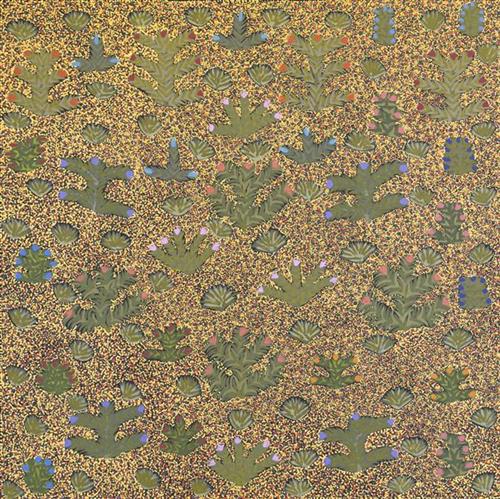
Beverly Pula Luck – My Mother’s Country

Beverly paints her Mother’s country. When Beverly was a child her mother took her all around her country and showed her the bush medicine and bush tucker.

The knowledge of the bush plants has been handed down through generation to generation and Beverly still spends time hunting and collecting bush medicine plants to use in everyday life.  Taught by her mother and grand mother, Beverly also sings the songs of the bush medicine plants. 

Beverly’s paintings are joyous and full of information regarding bush medicine plants.

The artists of Ampilatwatja made a conscious decision not to paint altyerr (dreaming stories). The artists paint their country where those stories sit.

220982360527


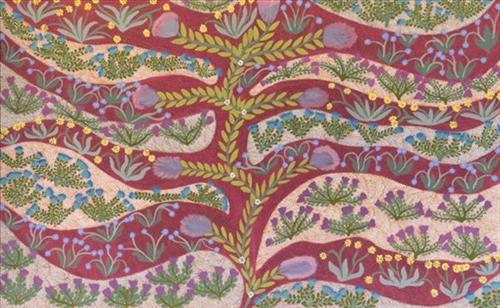
Kathleen Nanima Rambler – Awerle Anatye (Yam Plant)

When I go visit my family this is where I see the big cream coloured bush tomatos, pink desert roses and goannas running across the road.  All along the road is a sea of desert roses. The secret yams grow under the ground, you follow the cracks in the dirt and this is where you find the ripe yams.  The secrets of the earth we call them.

The community of Ampilatwatja made a conscious decision not to paint altyerr (dreaming stories). The artists paint their country where those stories sit.

220982360525


Edie Kemarre Holmes – Antarrengeny

Edie depicts Antarrengeny when there has been no rain and the land shimmers like jewels. It is the open flat country, after a bushfire, when only the young grasses and the trees are growing and where there is good hunting.”

Antarrengeny is Edie’s country and also her Father’s.

Edie has a strong connection to Antarrengeny. She gave birth to two of her daughters out bush on this land. It is her country and she loves it dearly.

115682361582


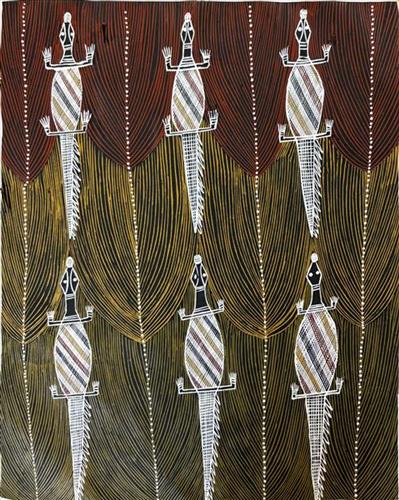
Baru Dhawu (Crocodile Story)

Baru (the crocodile man), was from the Gumatj clan. People usually call him Gurdu Gurdu or Baru which means crocodile. He lived his life at a place called Yirrkala. Living near him were other people, and when Baru didn’t have enough to eat he began to kill and eat these other people. After a while others noticed that some people were missing. When Baru went to the toilet, the people could smell this strong smell, so they knew that he ate the other people. Some men went to get help and they took message sticks to the other tribes. Some were sending smoke signals. When they came to Baru’s camp they started to spear him in the left side of his ribs. He dropped into the fire and burnt his left hand and maybe his right hand. He then ran into the bush and yelled to his countrymen – the animals, birds and fish that live on the land and in the sea. He stopped and he named the tribes and clans and also the places until he came to a place called Gamarru/Guyurru. There he took a rest and said to himself “This is where I stop and call this place Gamarru/Guyurru”. Baru, still in pain from the fire, then jumped into the water and turned himself into a crocodile. The fire left scars on his back. Baru paintings belong to Gumatj and Warrawarra and also the Marpi clan. This painting is used at death ceremonies or initiations and it normally is painted on the belly, which means the person the design is painted on is part of Gurdu Gurdu (the crocodile people).

115682361760


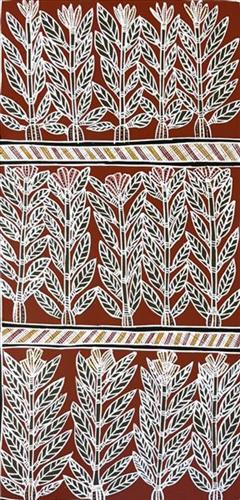
Ritjano (bush carrot)

This artwork depicts the Ritjano. Ritjano is similar to a carrot, and grows abundantly in North East Arnhem Land. The vegetable is a staple food in traditional Yolngu culture, and has been a reliable food source when other foods are scarce. The ladies will collect and roast the ritjano, which has a very sweet flavour. 

111982362655


Marrchila (Saltwater crocdile)

Marrchila, ana-munya gu-nirra, gu-bugula a-waywunga a-boya, lika guna-gepiya, a-warrchinga a-rracha a-yurra. Nipa a-weya a-workiya, a-yinaga, “Garr-rru.”

The crocodile swims around at night, then after sunrise it climbs up out of the water and lies in the sun getting warm. It always makes a sound, it goes “Garr-rru.”


An-guna mernda a-jirra Gupanga. Ana-mernda a-bawuna, gojilapa Murlulu marrchila a-yurra rrapa gu-gapala.

This is the river at Gupanga. The crocodile came up out of the river and is lying on the island and at Murlulu.


Michpa jal nyi-ni ny-boy barra galang, ny-jarlapiya barra ny-boy, marrchila nula. Galaypa bi-barda.


If you want to go fishing, you should take care of yourself as you go, because of crocodiles. Otherwise, one might bite you.

Rrapa nyina barra ny-boy bugula gochila gu-jirra, o gun-nga gu-waywa barra gu-bamba, gun-gora. Nyi-na barra lorr, waygiji gun-nerranga nipa galaypa a-waywin a-bambun, marrchila.
 

You should always look out to the middle of the water, and at whatever is floating along, it might be harmless. You should look carefully, maybe it’s something else, it might be a crocodile swimming along

111982362654


Rajarra (Barramundi)

Bark paintings have a long cultural tradition, believed to extend back many thousands of years. In northern Australia, the walls of bark shelters in the Kimberley and Arnhem Land may well have been painted to convey and illustrate stories in the same way that rock shelters were. Bark painters in the Maningrida region invoke customary practices and experiment with visual forms. Their paintings merge the natural and spiritual worlds, the secular and sacred, and embody and evoke ancestral presence.The subject matter of some works on bark express or focus on djang, the power of country itself; others the ancestral activities that created it or inhabit it: the powerful Rainbow Serpent Ngalyod, female water spirits including Yawkyawk and jin-Merdewa, and spirit beings such as Namorrorddo and Wangarra. Some paintings feature geometric designs inspired by body painting. Spirit figures such as the long thin Mimih spirits said to live in the rock country are also frequently depicted, as are animals hunted as game, including kangaroo and barramundi. 

The process of making a bark painting begins with the artist choosing a suitable tree (stringybark gum tree, Eucalyptus tetrodonta), in the wet season when the sap is rising and the bark is fairly supple and easy to grip. After finding a section of bark that is free of knots and termite damage, cuts are made top and bottom and, after some encouragement by tugging and prying, a hollow open cylinder of bark is removed. The rough outer bark is stripped off and the bark sheet is trimmed and placed over a fire, inner side downwards, to drive out moisture, including the sap. The bark sheet, pliable from its steaming session, is next placed on the ground and trodden on to flatten it out. Heavy weights are placed on it as it cools to ensure that it doesn’t curl or warp.

Artists use a rich palette of colours derived from natural pigments that can be sourced from their clan estates. The reds, purples, pinks and yellows come from ochres (forms of iron oxide or limonite). Black generally comes from charcoal, and white is from pipeclay. All of these earth pigments are strongly associated with djang. The pipeclay used to create the brilliant white paint, for example, is said to be the faeces of the powerful Rainbow Serpent (Ngalyod in the Kuninjku language) and the spirit essence of the Mardayin ceremony.

Sometimes natural fixatives are mixed in to bind the pigments: wax, yolk of eggs, resins and the sap of orchid plants. Today PVA glue is more commonly used as a binding agent for the pigments. The tool that an artist uses to apply colour to the bark depends on the style of painting and available resources. It may be a feather, or a brush made from a few strands of straight human hair. Cyperus javanicus, a tough sedge grass, may be used to make the slim reed brush required to execute the fine rarrk designs. 
115682362594


Woven Mat

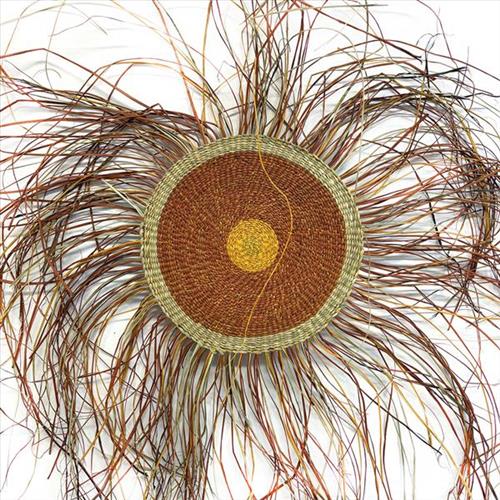
Yolŋu weavers of Arnhem Land create utilitarian, ceremonial, and decorative pieces using naturally sourced materials. This mat is made from young Pandanus spiralis leaves, harvested with a wooden hook, stripped of prickles, and dried to create strong, resilient fibres. These fibres are then twisted, coiled, or woven using traditional techniques to produce both functional and decorative mats.

Bula’bula weavers exclusively use natural dyes, derived from locally sourced roots, leaves and grasses. These pigments are extracted and infused into pandanus fibres by boiling over an open fire, producing the rich, vibrant colours characteristic of contemporary Yolŋu weavings.

Traditionally, Nganiyal (conical mats) functioned as insect screens when erected and as seating mats when folded, playing an important role in both daily life and ceremonial practices. Today, Yolŋu artists create a variety of shapes, including flat, round, and oblong mats. These non-traditional styles and the use of bright colours became more common after Missionaries began commissioning pieces in this style.