116482368329


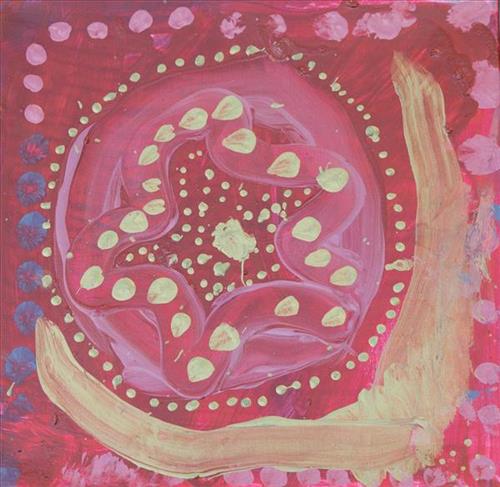
Biyulu (Yellow Ochre)

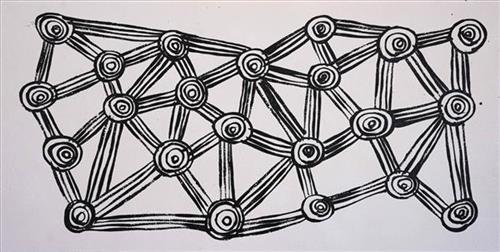
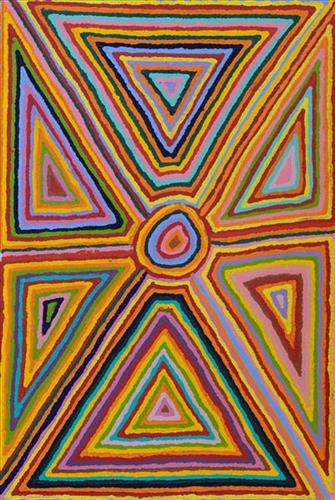
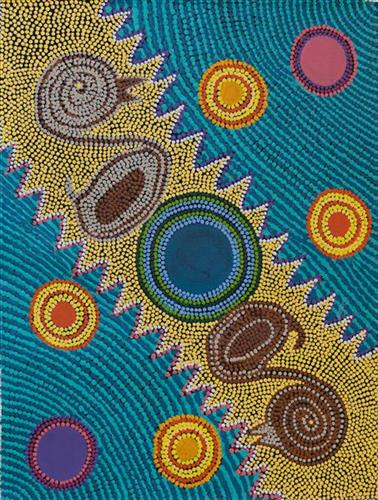
Biyulu (yellow ochre) is used during law ceremony. Every year during christmas season, familes from far and wide communities come and share that exciting moment where our young boys goes through the law and during that time family meet one another, catching up, being together and celebrating where our young boys through the birdarra law become men. They are no longer classed as teenagers.

116482368221


Emu Seed

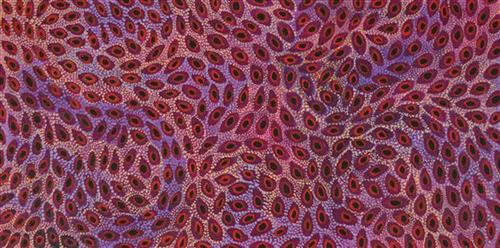
In this painting the artist has depicted the pods of a shrub which is common in the Pilbara area. It is a smallish bush which comes into seed in September, when the Emu is visible in the Milky Way. This is the time the emu chicks hatch and it is one of their main sources of food. When the pod opens the emu parents feed the little black seeds to their chicks. The seed pod, which is about the size and shape of a cockroach, turns from orange to yellow, so when all the bushes are in pod at different stages, there is a brilliant display of orange and yellow colours throughout the country. The official name of this annual shrub is Senna notabilis, but, due to the oblong, flat shape and the glossy golden brown colour of its pods, it is commonly known as Cockroach Bush. It has a little round fruit, a berry that starts off green and turns red when it is ripe, but it’s poisonous. The shrub starts off as a light green colour and then, as it matures, it gets darker. The flowers are a yellowy orange and they, too, get darker with a bit of black as they are fading away.

116482368217


Pilbara Creeks

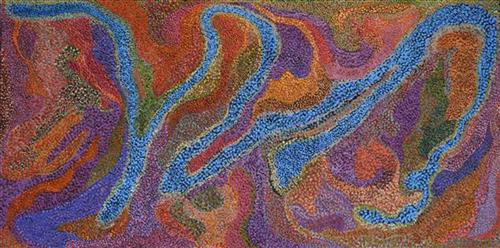
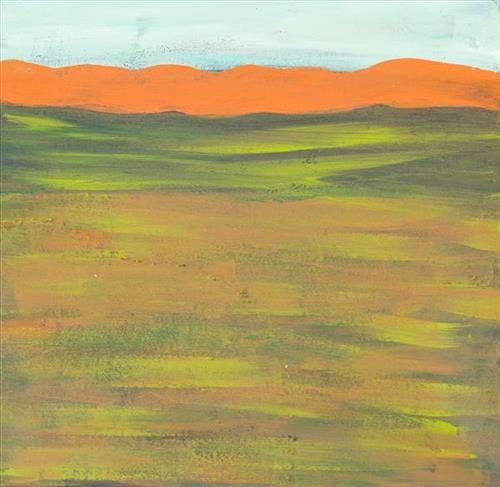
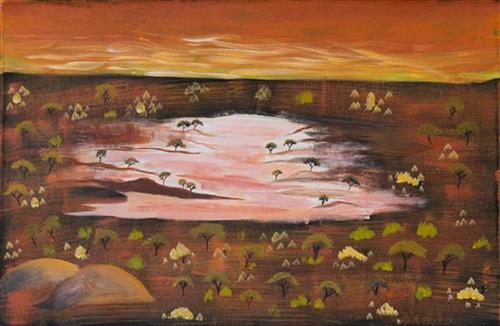
During the rainy season many creeks are hidden among the rocky hills of the Pilbara country. The locals from this area like fishing on the banks of the creeks, catching many different varieties of fish.

116482368211


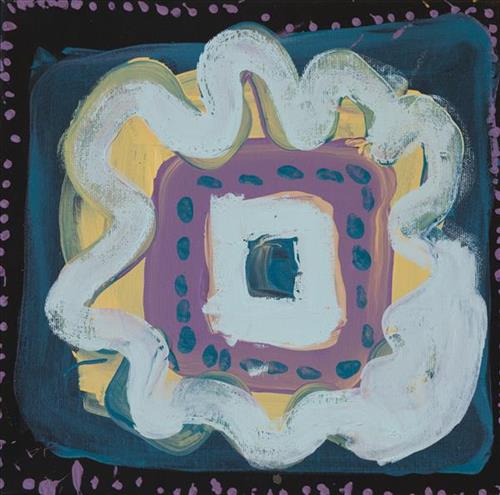
Family Connection

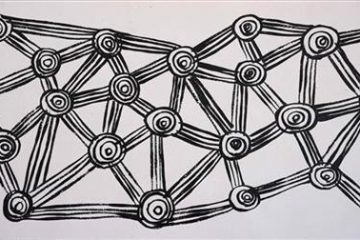
I am proud and blessed to have a family who are always supportive of me ad things I do. this painting represents the connection that we have.

111582368415


Punmu

“This area here is our Country. It’s our Country right here. We returned to our Country with a Toyota and a grader that made the road. A grader right up to here. Punmu is a good place. It’s a happy place to live. My spirit feels good living here. In pujiman (traditional, desert dwelling) time we lived in this area now. I’m happy with this life now, happy because I feel grounded by my Country. It’s important to hold onto the legacy of the ancestors. It’s up to the young people to carry it on now. For the ancestors past and present.”

– Minyawe Miller as translated by Kanyirninpa Jukurrpa


Punmu refers to a region and an Aboriginal community within its vicinity, located 670km North-East of Newman. Created during the return to Country movement of the 1980s, with the recognition of Martu land rights and native title, the community was named after a nearby Jukurrpa (Dreaming) story.

Punmu Aboriginal community sits on the edge of a large salt lake known as Nyayartakujarra, or Lake Dora. The lake runs south into Karlamilyi River (Rudall River). Surrounding Punmu are numerous fresh water soaks and the red tali (sandhills) typical of the area. The most frequently visited yinta (permanent springs) around Punmu include Wirlarra, Rawa, Yilyara, Jila-jila and Tuu-tuu.

The Country around Punmu features in several Jukurrpa stories. Of particular importance is the story of the Jila Kujarra (Two Snakes), one of the key Jukurrpa narratives for the Martu. Though the story belongs to Warnman people, it is shared across the Western Desert with several other language groups. The narrative centres on the travels of two snakes as they are pursued by the Niminjarra, spiritual ancestors of the Warnman people. 

Before transforming themselves into snakes, the Jila Kujarra were young brothers. As snakes, they began travelling home to their mother, but were intercepted by the Niminjarra, who tracked the Jila Kujarra to Paji, east of Nyayartakujarra (Lake Dora). Though the Jila Kujarra eluded their pursuers here by escaping under the lake at Paji, they were soon after speared and injured by two Pukurti (initiates with bundled hair) at Nyayartakujarra, who returned with the Niminjarra to cook the snakes at the site of Kumpupirntily (Kumpupintily, Lake Disappointment). As the Niminjarra cut down the length of the Jila Kujarra, the snake’s bladders were pierced, causing an explosion of scalding hot urine in which the Niminjarra all perished and became black rocks at the site. The spirits of the Jila Kujarra returned to their mother at Nyayartakujarra, where the mother and her sons entered the ground below Nyayartakujarra and remain to this day.

111582368414


Walytja (family): Martu kinship and family

In the heart of central Western Australia, the Martu people are the traditional owners of a vast landscape stretching from the Great Sandy Desert in the north to Wiluna in the south. Across this Country, their lives are bound by a common ancestral heritage, law, and culture. To one another, they are walytja (family).


Walytja

The Martu term for family, walytja, encapsulates a broader idea of relatedness that permeates every aspect of life. The Martu four-section kinship system determines a person as belonging to either the Purungu, Milangka, Panaka or Karrimarra skin group, and was created by the Jukurrpa (Dreaming) ancestors.

This system not only defines relationships, it also establishes a framework for expectations and obligations, and extends the importance of family far beyond mere blood or marriage ties. Family is not limited to blood connections; it encompasses all relationships within the entire community, forming a network of relationships that was crucial to survival during the pujiman (traditional, desert dwelling) era, and that remains fundamental to Martu life today. The kinship system allows everyone to know what expectations one person can have in relation to another, and means that familial terms and relationships are present between any two individuals, whether or not they are related by blood.


Walytja in relation to Country

Over thousands of years, Martu lived in small, kin-based bands that traversed their own territorial areas by foot according to seasonal changes and cultural obligations. Ngamaru Bidu describes this experience in the story for her work, ‘Wantili’; “My family and Jakayu’s family been walking round there together… Everywhere, we been walking everywhere.”  

Walytja groups had rights to their ngurra (home Country, camp) as inherited over generations. Also passed down over generations was the intimate knowledge of the physical and cultural properties of one’s Country, and the responsibility to care for and nurture one’s ngurra. The passing of rights and responsibilities through walytja in relation to specific lands continues today.


Walytja in Art

Many of the works by Martumili artists are representations of Country as defined by familial ties- artists paint “where their family is from and where they belong to” (Kuru Gladys Bidu). One’s Country encompasses their birthplace, and the Country they and their family lived on during the pujiman era. Collectively these works make clear the inseparable relationship between walytja and Country.

The significance of walytja is revealed in Martu art not only in its depiction of ngurra as delineated by ancestral inheritance, but also through the act of painting itself. Martumili artists begin to paint with their parents, grandparents and extended family, fostering an organic process of learning about painting techniques, along with knowledge of specific locations and their related Jukurrpa narratives. In this way, the passing down of cultural knowledge through art ensures the continuity of Martu heritage.
111582368413


Walytja (family): Martu kinship and family

In the heart of central Western Australia, the Martu people are the traditional owners of a vast landscape stretching from the Great Sandy Desert in the north to Wiluna in the south. Across this Country, their lives are bound by a common ancestral heritage, law, and culture. To one another, they are walytja (family).


Walytja

The Martu term for family, walytja, encapsulates a broader idea of relatedness that permeates every aspect of life. The Martu four-section kinship system determines a person as belonging to either the Purungu, Milangka, Panaka or Karrimarra skin group, and was created by the Jukurrpa (Dreaming) ancestors.

This system not only defines relationships, it also establishes a framework for expectations and obligations, and extends the importance of family far beyond mere blood or marriage ties. Family is not limited to blood connections; it encompasses all relationships within the entire community, forming a network of relationships that was crucial to survival during the pujiman (traditional, desert dwelling) era, and that remains fundamental to Martu life today. The kinship system allows everyone to know what expectations one person can have in relation to another, and means that familial terms and relationships are present between any two individuals, whether or not they are related by blood.


Walytja in relation to Country

Over thousands of years, Martu lived in small, kin-based bands that traversed their own territorial areas by foot according to seasonal changes and cultural obligations. Ngamaru Bidu describes this experience in the story for her work, ‘Wantili’; “My family and Jakayu’s family been walking round there together… Everywhere, we been walking everywhere.”  

Walytja groups had rights to their ngurra (home Country, camp) as inherited over generations. Also passed down over generations was the intimate knowledge of the physical and cultural properties of one’s Country, and the responsibility to care for and nurture one’s ngurra. The passing of rights and responsibilities through walytja in relation to specific lands continues today.


Walytja in Art

Many of the works by Martumili artists are representations of Country as defined by familial ties- artists paint “where their family is from and where they belong to” (Kuru Gladys Bidu). One’s Country encompasses their birthplace, and the Country they and their family lived on during the pujiman era. Collectively these works make clear the inseparable relationship between walytja and Country.

The significance of walytja is revealed in Martu art not only in its depiction of ngurra as delineated by ancestral inheritance, but also through the act of painting itself. Martumili artists begin to paint with their parents, grandparents and extended family, fostering an organic process of learning about painting techniques, along with knowledge of specific locations and their related Jukurrpa narratives. In this way, the passing down of cultural knowledge through art ensures the continuity of Martu heritage.
111582368411


Jartuti

“Jartuti water place east of Parnngurr. In pujiman (traditional, desert dwelling) days old people walked and hunted there, we went there recently with KJ (Kanyirninpa Jukurrpa) ranger mob, lovely place.” 

 – Beverley Rogers

Jartuti is a water source located close to Parnngurr Aboriginal Community (otherwise known as Cotton Creek), and is part of Beverley’s father’s ngurra (home Country, camp). The site is near to the home of the jangara (cannibal devil), spiritual beings from the Jukurrpa (Dreaming) era.

111582368410


Ngurra (home Country, camp)

“It’s their home for them, real ngurra (home Country, camp). Real ngurra is where they been born and grow up.”

– Corban Clause Williams

The Western Desert term ‘ngurra’ is hugely versatile in application. Broadly denoting birthplace and belonging, ngurra can refer to a body of water, a camp site, a large area of Country, or even a modern house. People identify with their ngurra in terms of specific rights and responsibilities, and the possession of intimate knowledge of the physical and cultural properties of one’s Country. This knowledge is traditionally passed intergenerationally through family connections. Country for Martu is full of memory; not just the memory of their own movement through it, but also of their family. As summarised by Ngalangka Nola Taylor, “painting the ngurra, they do it to remember their connections.” 

Painting ngurra, and in so doing sharing the Jukurrpa (Dreaming) stories and physical characteristics of that place, has today become an important means of cultural maintenance. Physical maintenance of one’s ngurra, like cultural maintenance, ensures a site’s wellbeing, and is a responsibility of the people belonging to that area.  

111582368409


Two little birds at Kunawarritji

Kunawarritji is an important site in the Great Sandy Desert where multiple stories and histories intersect. Originally a spring water and major Martu pujiman (traditional, desert dwelling) camping site, at the turn of the 20th century Kunawarritji was converted into a well along the Canning Stock Route. Each year throughout the 1930-50s, the well became a site of contact between the drovers, their cattle, and desert families. 

Long before colonial history entered this Country, however, other stories dominated the site. Primarily, Kunawarritji features in the Minyipuru (Jakulyukulyu, Seven Sisters) Jukurrpa (Dreaming). Minyipuru is a central Jukurrpa narrative for Martu, Ngaanyatjarra, Pitjantjatjara and Yankunytjatjara people that is associated with the seasonal Pleiades star constellation. Beginning in Roebourne on the west coast of Western Australia, the story morphs in its movement eastward across the land, following a group of women as they walk, dance, and even fly from waterhole to waterhole. As they travelled the women left markers in the landscape and create landforms that remain to this day. During the entirety of their journey the women are pursued by a lustful old man, Yurla, although interactions with other animals, groups of men, and spirit beings are also chronicled in the narrative.

The Minyipuru travelled to Kunawarritji from Nyipily (Nyipil, Nibil, Canning Stock Route Well 34), and transformed themselves into a distinctive group of trees that remain in the area between these two sites. From Kunawarritji Yurla followed the sisters to Pangkapirni, where he finally caught one of the women. 

Today, Kunawarritji is a site of return, a place where people came back to continue their life in the desert with the formation of Kunawarritji Aboriginal community in the early 1980s. The community’s cultural significance endures, with the population swelling up to 1000 during cultural business.