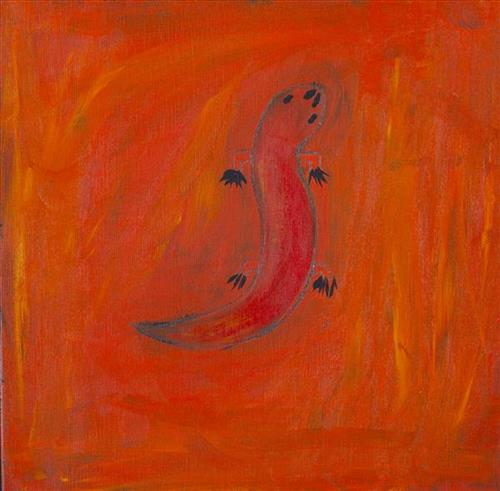
111582372835


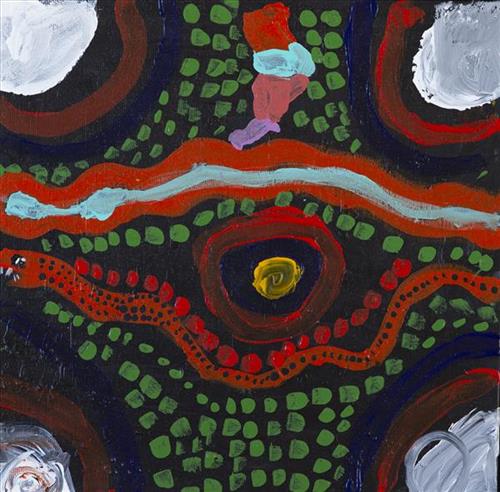
Carawine Gorge

“A big Carawine gorge that has a big snake. The water is green, and I went swimming there. I was swimming at the edge, on a trip with my family camping out. I did this painting as it was the only spot I remember, the old people tell me, everyone knew a big snake lives in the deep water there.” – Kenneth Biljabu

111582372834


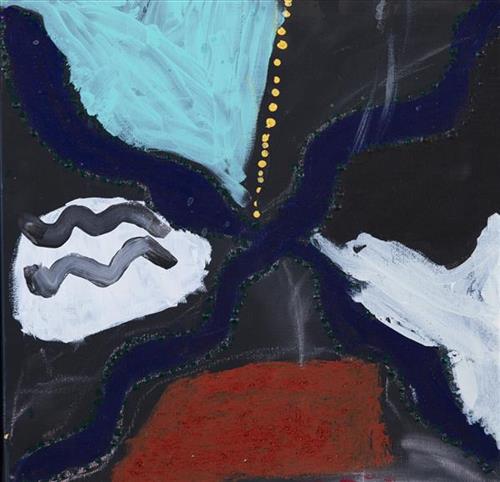
Creek

“The creek I made a painting of. When I was about 3 years old I had a swim in that creek. And I want to go back to that creek because I missed it a lot. And it was cool when I had swim but now when I’m older I still want to go back. Take back to my memories. And I had one sister with me I still have that memories in my head. That was like a home”

– Rowan Biljabu

111582372832


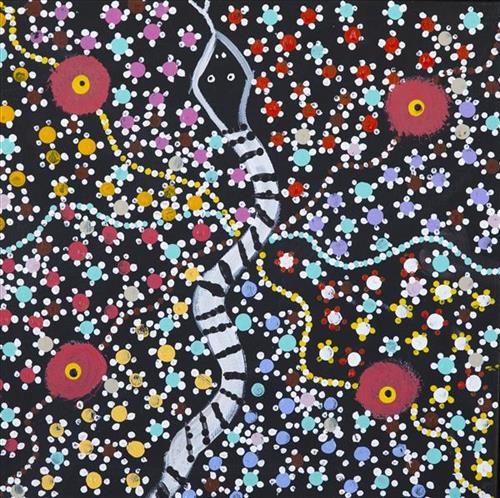
Rainbow Serpent

“Wild cat spring.
The snake was drinking water,
the leaf growed , wind blowed.
Seeds growed and rain came.
Rocks crumbled, and then water came up the salt ground,
and clouds started to come once the snake stop drinking.
The end”
– Racquel Butt

The Western Desert term jila is used interchangeably to describe springs considered to be ‘living’ waters and snakes, both of which play a central role in Martu culture and Jukurrpa (Dreaming).

During the pujiman (traditional, desert dwelling) period, knowledge of water sources was critical for survival, and today Martu Country is still defined in terms of the location of water sources. Of the many permanent springs in Martu Country, very few are ‘living waters’; waters inhabited by jila (powerful ancestral beings). Before they became snakes, these beings were men who made rain, formed the land and introduced cultural practices like ceremonies and ritual songs. Some of the men travelled the desert together, visiting one another, but they all ended their journeys at their chosen spring alone, transformed into a snake. These important springs are named after their jila inhabitant, guarding their waters. 

Some of the jila snakes are known by Martu as quiet and benevolent, others as dangerous and ‘cheeky’. Regardless of the nature of the inhabitant snake, jila sites must be entered respectfully; particular rituals are practiced, such as lighting fires, sweeping the ground with branches, approaching in single file, and calling out to the site’s jila to announce one’s arrival and introduce people who are new to the jila. Those who do not follow these guidelines are in danger of becoming sick, or even being killed.

111582372799


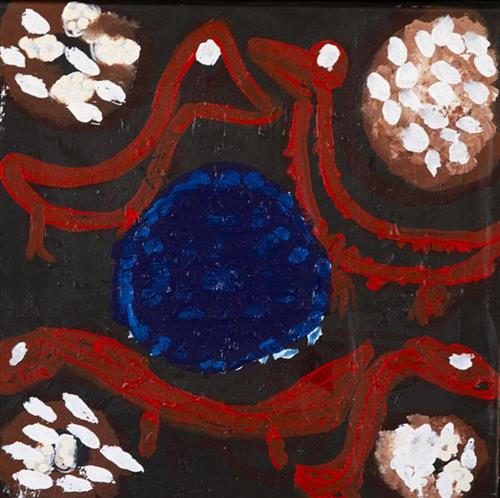
Snake

“This painting is about the two boys, they been walking across the Punmu lake and one became a snake.” – Arianna Williams

The Western Desert term jila is used interchangeably to describe springs considered to be ‘living’ waters and snakes, both of which play a central role in Martu culture and Jukurrpa (Dreaming).

During the pujiman (traditional, desert dwelling) period, knowledge of water sources was critical for survival, and today Martu Country is still defined in terms of the location of water sources. Of the many permanent springs in Martu Country, very few are ‘living waters’; waters inhabited by jila (powerful ancestral beings). Before they became snakes, these beings were men who made rain, formed the land and introduced cultural practices like ceremonies and ritual songs. Some of the men travelled the desert together, visiting one another, but they all ended their journeys at their chosen spring alone, transformed into a snake. These important springs are named after their jila inhabitant, guarding their waters. 

Some of the jila snakes are known by Martu as quiet and benevolent, others as dangerous and ‘cheeky’. Regardless of the nature of the inhabitant snake, jila sites must be entered respectfully; particular rituals are practiced, such as lighting fires, sweeping the ground with branches, approaching in single file, and calling out to the site’s jila to announce one’s arrival and introduce people who are new to the jila. Those who do not follow these guidelines are in danger of becoming sick, or even being killed.

111582372798


Rabbit Proof Fence

“This story is about the three girls going back home to Jigalong. They been walking to Jigalong to get back to their mum, this is the Rabbit Proof Fence story. My grandmother was walking through there, one of those girls.” – Arianna Williams

In 1931 sisters Molly Craig, Daisy Kadibil and Gracie Fields were taken from their families, like many other Aboriginal children at that time, and transported to Moore River Native Settlement, north of Perth. They were taken away in the belief that part-Aboriginal children should be trained as domestic servants. 

The three girls escaped the next day and, incredibly, walked 1600 kilometres home to Jigalong using the Rabbit-Proof Fence to navigate. The Rabbit Proof Fence remains the world’s longest fence, and was built in the early 1900s to separate rabbits from pasture. For nine weeks, the girls followed its length in order to be reunited with their family. They crossed a flooded river, sand dunes, heathlands, wheatbelts and plains, claypans and salt lakes. They slept in dug-out rabbit burrows, and caught and cooked rabbits, along with other plant based bush tucker. For the duration of their journey they were pursued by policeman and an Aboriginal police tracker.

The girls’ story has been immortalised in the novel “Follow the Rabbit-Proof Fence” by Doris Pilkington (Nugi Garimara, 1996), and was adapted into the film “Rabbit Proof Fence” (2002). This story retains special significance for the Martu, and in particular those inhabitants of Jigalong Aboriginal community. The three girls were Martu, and their children and grandchildren, including Noreena and her family, continue to live in the Martu homelands today.

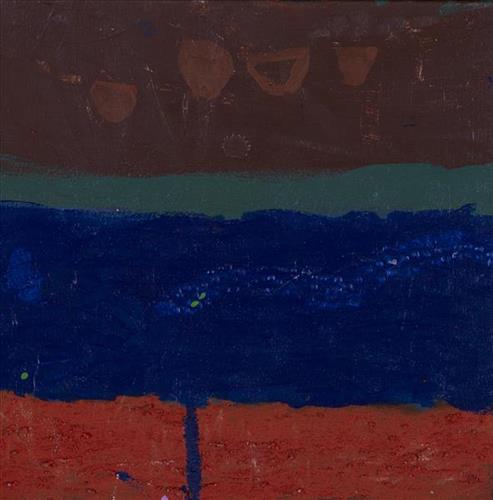
111582372797


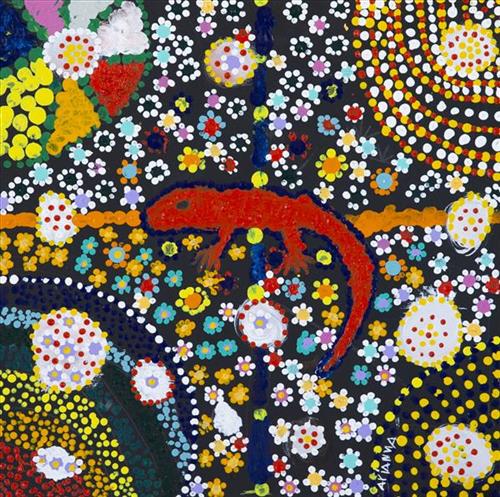
Mulyamiji (Great Desert Skink)

“This painting is about the Muyaminji, Great Desert Skink, I chose to paint this because it is the best animal.” – Arianna Williams

Arianna is painting a Mulyamiji (Great Desert Skink) while learning from Carol Williams about local endangered species.

“This painting is of the Mulyamiji and the big clayplan out there – those red, white and yellow dots are the flowers that grow next to the claypan.”

“They go inside, and when they poo they go outside, that’s how they keep their home clean. That’s how we find them when we go out looking for them.”– Carol Williams

111582372796


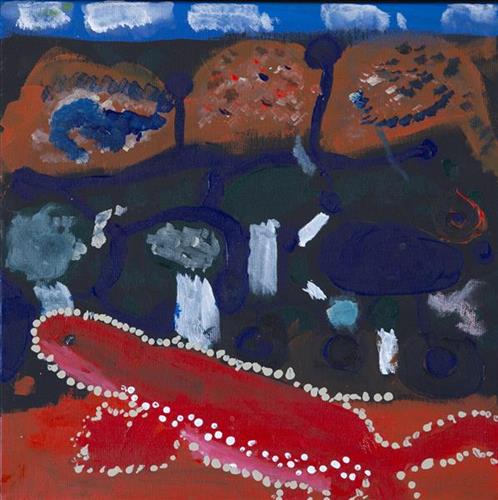
Mulyamiji (Great Desert Skink)

Rowan is painting a Mulyamiji (Great Desert Skink) while learning from Carol Williams about local endangered species.

“This painting is of the Mulyamiji and the big clayplan out there – those red, white and yellow dots are the flowers that grow next to the claypan.”

“They go inside, and when they poo they go outside, that’s how they keep their home clean. That’s how we find them when we go out looking for them.”– Carol Williams

111582372794


Mulyamiji (Great Desert Skink)

Keyarhn is painting a Mulyamiji (Great Desert Skink) while learning from Carol Williams about local endangered species.

“This painting is of the Mulyamiji and the big clayplan out there – those red, white and yellow dots are the flowers that grow next to the claypan.”

“They go inside, and when they poo they go outside, that’s how they keep their home clean. That’s how we find them when we go out looking for them.”– Carol Williams

111582372791


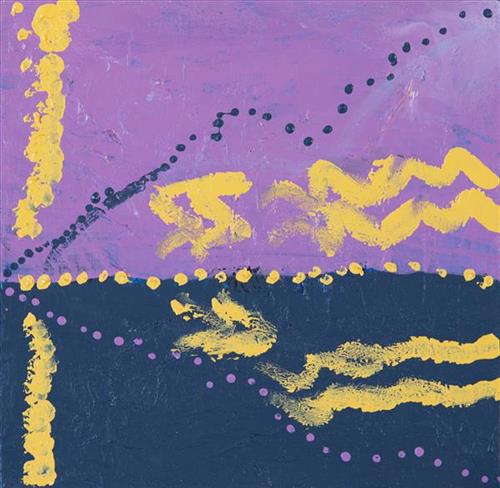
Snake

“Purple is the hill, purple one. Yellow, is all the snakes and black is the water. The snakes going to drink the water, painting is of Parnngurr East direction River.” – Uweisha Williams

The Western Desert term jila is used interchangeably to describe springs considered to be ‘living’ waters and snakes, both of which play a central role in Martu culture and Jukurrpa (Dreaming).

During the pujiman (traditional, desert dwelling) period, knowledge of water sources was critical for survival, and today Martu Country is still defined in terms of the location of water sources. Of the many permanent springs in Martu Country, very few are ‘living waters’; waters inhabited by jila (powerful ancestral beings). Before they became snakes, these beings were men who made rain, formed the land and introduced cultural practices like ceremonies and ritual songs. Some of the men travelled the desert together, visiting one another, but they all ended their journeys at their chosen spring alone, transformed into a snake. These important springs are named after their jila inhabitant, guarding their waters. 

Some of the jila snakes are known by Martu as quiet and benevolent, others as dangerous and ‘cheeky’. Regardless of the nature of the inhabitant snake, jila sites must be entered respectfully; particular rituals are practiced, such as lighting fires, sweeping the ground with branches, approaching in single file, and calling out to the site’s jila to announce one’s arrival and introduce people who are new to the jila. Those who do not follow these guidelines are in danger of becoming sick, or even being killed.

111582372789


Mulyamiji (Great Desert Skink)

Kaysten is painting a Mulyamiji (Great Desert Skink) while learning from Carol Williams about local endangered species.

“This painting is of the Mulyamiji and the big clayplan out there – those red, white and yellow dots are the flowers that grow next to the claypan.”

“They go inside, and when they poo they go outside, that’s how they keep their home clean. That’s how we find them when we go out looking for them.”– Carol Williams