114182349718
My Grandfather’s Country
This painting depicts Sharon’s Grandfather’s country. This place is in the Witura National Park on the Northern Territory and South Australia border just south of Finke. This area is a beautiful place with plenty of water. There are many trees, lakes and swimming holes.
221282351620
Jeffrey’s Birds
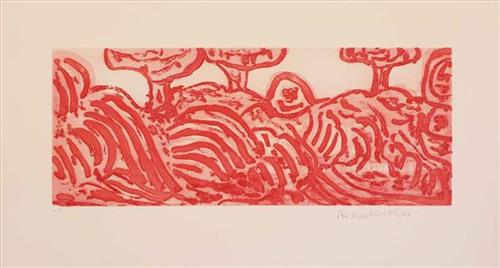
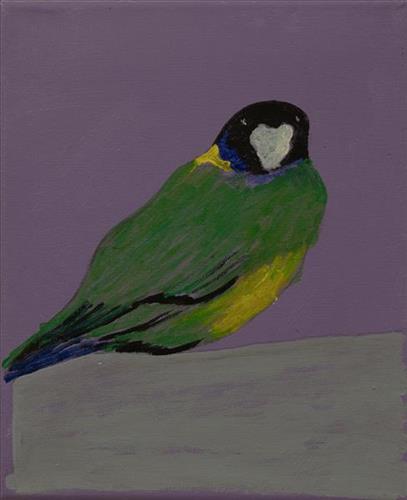
Jeffrey paints his favourite birds that live in the country around Ernabella. These include the kuparu (magpie), partilpa (Port Lincoln ringed neck parrot), kayarkiyarpa (galah), tjintir-tjintirpa (willy wag-tail), piil-piilpa (yellow throated minor) and kuurkuurpa (owls).
.
220982352045
Latoya Ngwarraye Petrick – Bushflowers
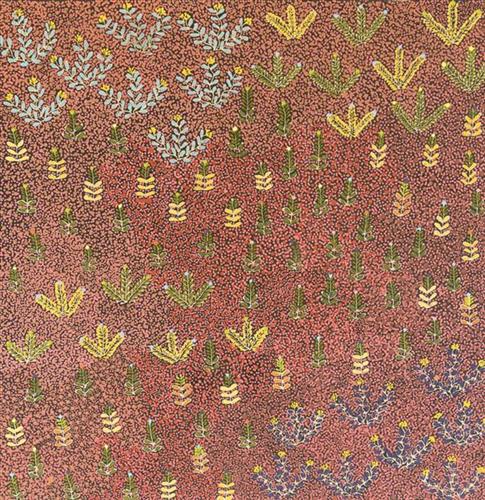
These bush flowers grow seasonally in Alyawarr country, some of which are also used in bush medicine remedies.
I have just started painting, my grandmother Elizabeth Ngwarraye Bonney has been teaching me, she tells me all about the bush flowers.
The community of Ampilatwatja made a conscious decision not to paint altyerr (dreaming stories). The artists paint their country where those stories sit.
220282356549
Tali at Kungkayunti
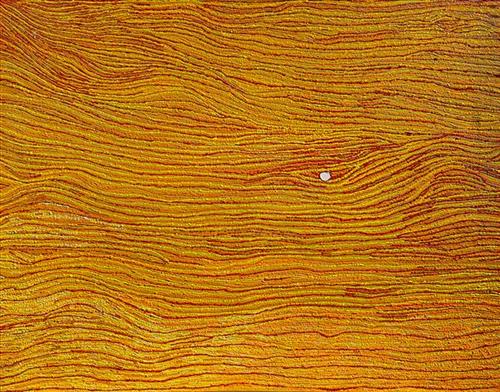
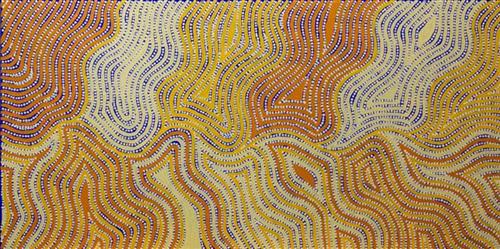
This painting shows the birds eye view of the tali tali (sandhills) at Kungkayunti (Brown’s Bore). This is the country of Joe Tjakamarra Multa, the father of Douglas Multa, Agnes Multa, Lisa Multa, Alison Multa, Rephina Multa, Benita Multa and Patricia Multa and the grandfather to their children. The tali tali are a short walk from where the family lived and the children of Joe grew up.
Lisa remembers walking up the tali tali with her sister, Agnes Multa, who was the same age as her. When Lisa got married she brought her partner to see those tali tali. From the tali tali, a 360-degree view can be seen of the surrounding country. The area is abundant with bush tucker, especially bush tomatoes and bush banana.
Kungkayunti is an important place for the travelling Tjukurrpa of the ancestral Arrernte women who travelled 600 kms from Ntaria (Hermannsburg) to Kintore, past Kulpitarra (Outstation) to attend to women’s business. Kungkayunti is the place where the women first camped. On their long journey, the women stopped at Kunkayunti (Brown’s Bore) to camp, rest, eat and dance. When the women reached their destination, they danced, shared their stories and renewed their law. Those women turned into stone and can be seen today. Annual events continue today to strengthen this Tjukurrpa.
220282356547
Women’s Ceremony at Lake Mackay
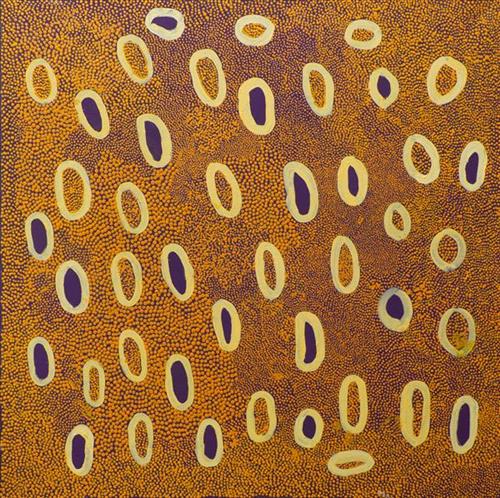
This painting shows Lake Mackay, Marilyn’s grandfather’s country and Dreaming. It shows many rockholes around which the painted up women dance for ceremony.
220282356544
Puli Puli – Rocks
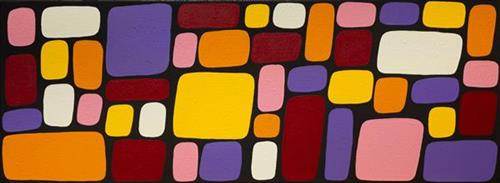
Keturah depicts the puli puli (rocks) at two different sites. She paints the landscapes at Haasts Bluff where she grew up and also at Karrkurrutintja (Lake Mcdonald in Pintupi), located west of Kintore along the Western Australia/Northern Territory border. Karrkurrutintja country is an important site of the Pilkati (snake) Tjukurrpa (dreaming) of Kaniya Kutjarra (two carpet snakes, two brothers, two Tjangalas). This story was passed town to her from her grandmother Narputta Nangala Jugadai, who was born there. Narputta was passed down this story from her father, Talaku Tjampitjinpa. Both Keturah’ss grandmother and mother, Molly Jugadai painted this same country. Narputta was one of the founding members of Ikuntji Artists, and has been painting since the beginning of the desert painting movement in the 1970’s. Keturah’s grandmother and mother have since passed away, with Keturah being the only remaining daughter in this lineage of artist to still be painting this story.
Keturah has been inspired by the painting legacy and tutorage from her grandmother and mother, though has developed a distinctive style over her practice. Keturah uses different colours and hues to depict the ways the puli puli change colours with the weather, especially at sunrise and sunset.
“The sand hills I paint are my mother’s story and the rocks I paint are my own story. My paintings are about my story and my mother’s… I like to paint; painting helps me forget my troubles. I paint every day. My Grandmother used to say to me when I was younger: “One day you will paint.”
220282356543
Puli Puli – Rocks
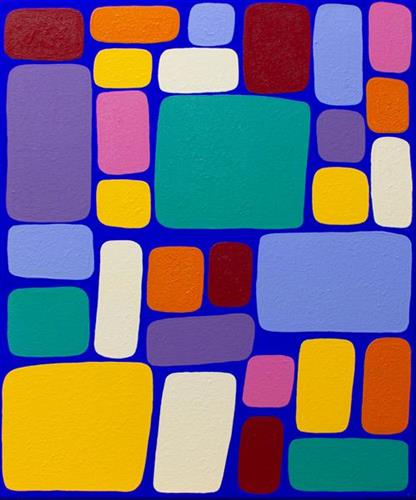
Keturah depicts the puli puli (rocks) at two different sites. She paints the landscapes at Haasts Bluff where she grew up and also at Karrkurrutintja (Lake Mcdonald in Pintupi), located west of Kintore along the Western Australia/Northern Territory border. Karrkurrutintja country is an important site of the Pilkati (snake) Tjukurrpa (dreaming) of Kaniya Kutjarra (two carpet snakes, two brothers, two Tjangalas). This story was passed town to her from her grandmother Narputta Nangala Jugadai, who was born there. Narputta was passed down this story from her father, Talaku Tjampitjinpa. Both Keturah’ss grandmother and mother, Molly Jugadai painted this same country. Narputta was one of the founding members of Ikuntji Artists, and has been painting since the beginning of the desert painting movement in the 1970’s. Keturah’s grandmother and mother have since passed away, with Keturah being the only remaining daughter in this lineage of artist to still be painting this story.
Keturah has been inspired by the painting legacy and tutorage from her grandmother and mother, though has developed a distinctive style over her practice. Keturah uses different colours and hues to depict the ways the puli puli change colours with the weather, especially at sunrise and sunset.
“The sand hills I paint are my mother’s story and the rocks I paint are my own story. My paintings are about my story and my mother’s… I like to paint; painting helps me forget my troubles. I paint every day. My Grandmother used to say to me when I was younger: “One day you will paint.”
220282356765
Puli Puli – Rocks
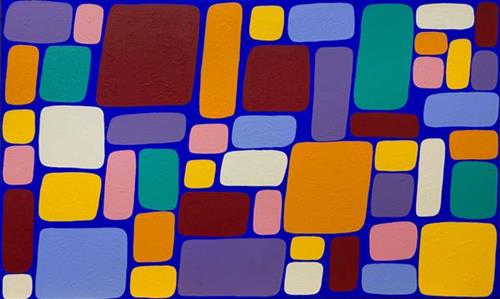
Keturah depicts the puli puli (rocks) at two different sites. She paints the landscapes at Haasts Bluff where she grew up and also at Karrkurrutintja (Lake Mcdonald in Pintupi), located west of Kintore along the Western Australia/Northern Territory border. Karrkurrutintja country is an important site of the Pilkati (snake) Tjukurrpa (dreaming) of Kaniya Kutjarra (two carpet snakes, two brothers, two Tjangalas). This story was passed town to her from her grandmother Narputta Nangala Jugadai, who was born there. Narputta was passed down this story from her father, Talaku Tjampitjinpa. Both Keturah’ss grandmother and mother, Molly Jugadai painted this same country. Narputta was one of the founding members of Ikuntji Artists, and has been painting since the beginning of the desert painting movement in the 1970’s. Keturah’s grandmother and mother have since passed away, with Keturah being the only remaining daughter in this lineage of artist to still be painting this story.
Keturah has been inspired by the painting legacy and tutorage from her grandmother and mother, though has developed a distinctive style over her practice. Keturah uses different colours and hues to depict the ways the puli puli change colours with the weather, especially at sunrise and sunset.
“The sand hills I paint are my mother’s story and the rocks I paint are my own story. My paintings are about my story and my mother’s… I like to paint; painting helps me forget my troubles. I paint every day. My Grandmother used to say to me when I was younger: “One day you will paint.”
220282359961
Yalka at Karrkurutinytja (Bush onion Dreaming at Lake Macdonald)
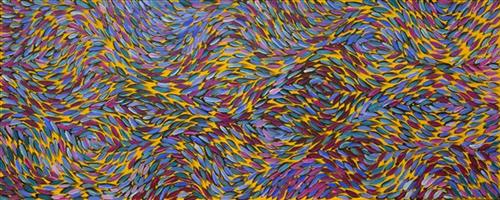
Daphne was passed down the right to paint the Yalka Tjukurrpa at Karrkurutinytja (Bush onion dreaming at Lake Macdonald) from her grandmother, Narputta Nangala Jugadai. Narputta, who was a founding member of Ikuntji art centre and a prolific painter, was born close to this sight.
Daphne says,
“My grandmother, Narputta used to make that painting. She told me that story. I used to work here (Ikuntji Women’s Centre) as a cook. I came to learn here. I saw my grandma painting. I learnt from her. She told me that story…Yalka…Bush food…For a long time those old ladies have been looking for Yalka, digging for Yalka, taking the fruit, cooking it in the fire. We cook them just a little bit, like Maku (witchetty grub). I have been looking for that Yalka with my grandmother.”
Yalka Tjukurrpa, as told by Narputta,
“Creek bed at Karrkurutinytja. Two old women, two Nungurrayi, came across from Pulpa and started Gathering bush onions, putting them into coolamons. They went on a journey west. They approached a group of men and watched them, whilst hiding in the bushed at Pimarrpa (Soakage near Kiwirrkura). There was another lady, Alkiljarra Nakamarra, who came along on their tracks. She saw them where they had gathered bush onions. She became upset that they’d gathered them all up and there were none left. The Nakamarra started walking and came across the creek, where she started collecing mungilpa (a staple seed food for the Pintupi people). She came across two Tjangalas (Mungilnga and Tiwilgna). Next to them was a rockhole and Atjakalya Nakamarra, who was making damper for them. Mungilnga had the smaller damper. The two Tjangalas ate their damper then she flew off and became a rock there at Kurultu.”