111982368040
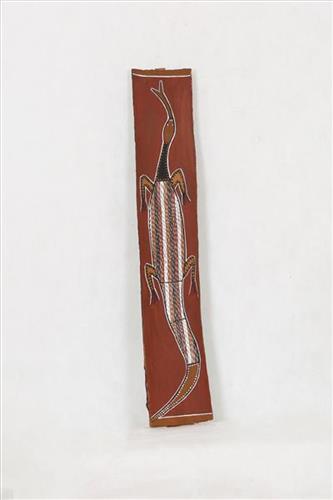
Burarr (Water goanna)
111982368038
Kalawan (Goanna)
This painting depicts a goanna embedded in an intricate depiction of kunkurra, the mini cyclones common during the wet season in Arnhem Land. Kunkurra also relates specifically to the Bilwoyinj site. At this site, two of the most important Kuninjku creation beings, a father and son, hunted and ate goanna. They left some goanna fat behind, which turned into the rock that still stands at the site today.
111982368037
Gnarr (spider)
111982368035
Morning Star
The ceremony known throughout Arnhem Land generically as Marradjiri is a ceremony of diplomacy given by one group to another to establish good relations and to strengthen kinship (for example by marriage) and economic ties (for example the sharing of clan estate resources).
The central object in the Marradjiri ceremony is a decorated polepainted with clan designs. The work on the pole is undertaken as part of the ceremony and is accompanied by the associated song series.
Often the ceremony commences when one group invites another and the people invited perform the Marradjiri. When a child finds their first bush food or object of value it is taken as a sign that the Marradjiri ceremony should be performed and an invitation is sent out sometimes in the form of a lock of hair from this child or in the form of some other token, sometimes encased in beeswax and wrapped in cloth. The token is delivered to the invited performers who then prepare to give the ceremony to their hosts at the residence of the host group.
Each evening before sunset the performance begins and continues for two or three hours. In the early stages of the ceremony the dancers perform with body clan designs which become progressively more elaborate as the time approaches the end of the ceremony. Usually this may take two or three weeks.
In the Marradjiri
, the pole is said to represent a mast of a Makassan prau. There exists many loan words (over three hundred in total) in North Australian Aboriginal languages and one of these is the Makassan word for mast of a ship ‘palayarrang’ which has changed in some Maningrida languages to ‘bulayarrang’ and a few other variations.
It is possible that the name of this ceremony has its origins in the Makassan word for mast. The Marradjiri ceremony is influenced heavily by Makassan themes.
On the final night of the ceremony the pole appears out of the darkness on the edge of the camp decorated with feathered tassles and long ropes which represent the rigging of the prau. Dancers hold these ropes and move the pole back and forth in the fashion of a prau rolling in rough sea as depicted. The dancers bring the pole down and dance with it until it is finally presented to the host group with great ritual and the pole is set into the ground to the accompaniment of the head song man chanting through a long list of clan names associated with the travels of creation ancestors.
When the dancers part with the pole they break into mourning as they may have done at the end of each Makassan trepanging season when their Makassan visitors returned to Sulawesi on the new early dry season winds. The pole is then kept by the host group, often being hung from the roof of a dwelling.
220982367844
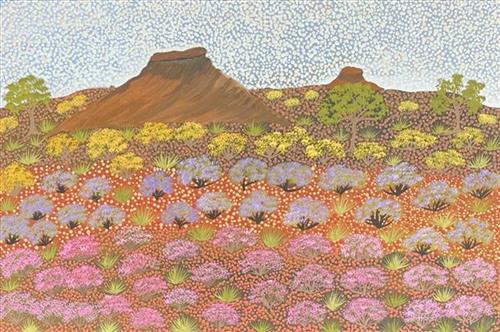
Kathleen Nanima Rambler – Mulangke Aherne (Beautiful Land)
My country. When I go hunting out bush, as we drive along the road towards the hill you can see the beautiful land and the flowers blooming on the side of the road, and near the hills, even the beautiful gum trees.
It makes me proud.

116482368065
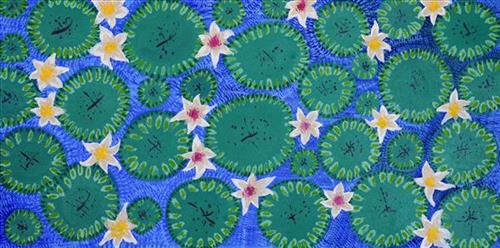
TBA

116482368046
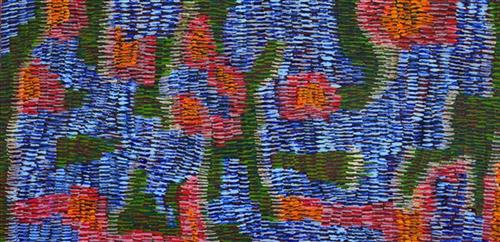
Wildflowers At The Riverbank

116482368018
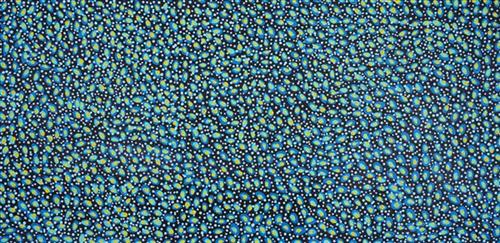
Blue Gum Tree (Ganyji )
Blue Gum Tree (Ganyji) The Blue Gum Tree, gets its name because of its bluish leaves. In Yindjibarndi language it is called Ganyji, in English, Kanji Bush (Acacia pyrifolia).This painting depicts elements of the bush – its blue leaves and yellow flowers against the red and green of the earth. When the rain comes, or when there has been a heavy dew, the Blue Gum Tree just shimmers in the light. In September, when we are looking for gum from the Blue Gum Tree, we walk through the spinifex country. We pick the gum when it is crystal coloured, and we eat it, or put it into hot water and leave it out in the sun to make it like a toffee. We call it sugar lolly.
116482367996
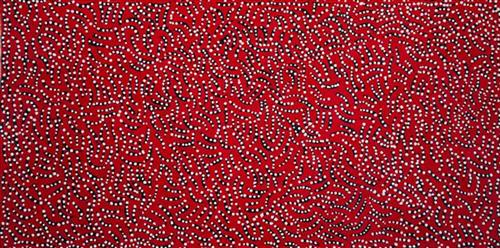
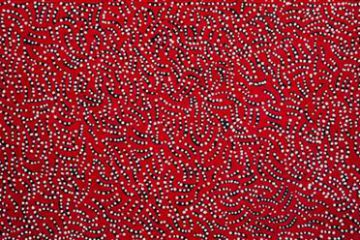
Sturt Pea
The Sturt Pea has a vibrant red flower.It has a succulent sweet juice that can be eaten.