111582386651


Mungili Waterholes and Rockholes

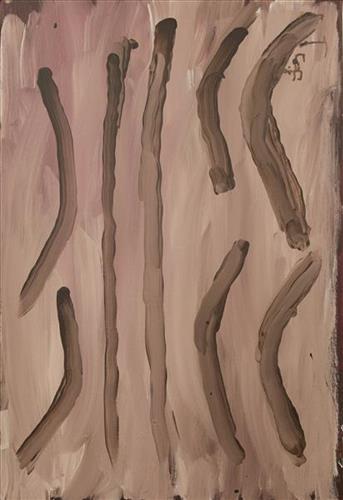
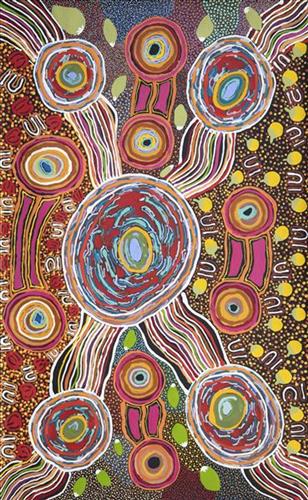
“No one goes there and sees that landscape. Only two, Mr and Mrs [refers to footsteps in painting]. They was walking to see if the water was in there. Walking on the creek sand, they see the colours and walk down to the water hole and dig where the waters been left. Dig the creek sand where there is still water. Little huts where they sit; move when it dries out. Leave remembrance behind. When the water fills up again; come back.

When the creek sand is still moist you can see the colours. You can see many colours – lovely colours come out. I do that in my mind [when painting], go and think about the rock colours there.

Different plants, water runs, and different plants are growing, different seeds. When it rains, all year round, when its overflowing. It’s all connected. The orange sand connects to one waterhole full of water, then flowing through the creek sand. This side down [pointing to one rock hole]; and it’s a bit up [pointing to another rock hole].

I was swimming there. Yeah, we go visit them a long time [ago]. We drink it, rainwater from the rain. Big waterhole. It’s a fresh water, when the rain comes, fills it up. One for swimming and another rock hole for drinking. 3 rock holes; another is special.”

– Marlene Anderson

In this work Marlene depicts a waterhole and rock hole located in Mungili, the small outstation community located just off the Eagle Highway in Western Australia, approximately 430 kilometres northeast of Wiluna and 250 kilometres north of Warburton. Marlene grew up in Mungili, and as such it forms a significant part of her ‘ngurra’ (home Country, camp). Typically Marlene depicts this site with a central large circular form that represents the main waterhole, surrounded by smaller circular forms representing satellite water bodies.

During the pujiman (traditional, desert dwelling) period, knowledge of water sources was critical for survival, and today Martu Country is still defined in terms of the location and type of water. Each of the hundreds of claypans, rockholes, waterholes, soaks and springs found in the Martu desert homelands is known through real life experience and the recounting of Jukurrpa (Dreaming) narratives by name, location, quality and seasonal availability. This encyclopedic knowledge extends even to the nature and movement of arterial waterways, and sustained Martu as they travelled across their Country, hunting and gathering, visiting family, and fulfilling ceremonial obligations. They would traverse very large distances annually, visiting specific areas in the dry and wet season depending on the availability of water and the corresponding cycles of plant and animal life on which hunting and gathering bush tucker was reliant.
22204008514


Status: Stock


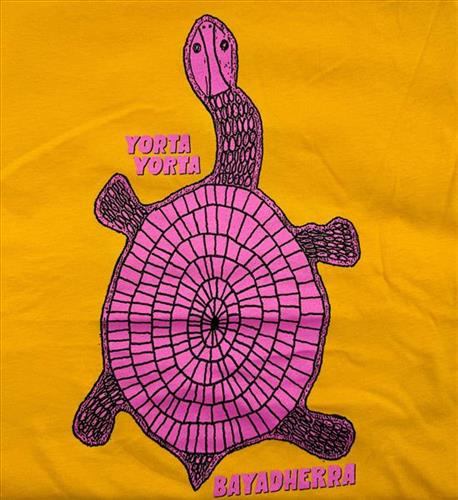
Kaiela x Gammin T-shirt Black

YO! My name is Tahnee Edwards, I’m a proud Yorta Yorta and Taungurung woman, designer and community worker. Gammin threads is my side hustle and creative outlet from my part-time job at Aboriginal family violence prevention service, Djirra. 

Gammin threads is a love letter to my culture and to blackfellas everywhere. It’s a staunch aunty label that likes good design and being cheeky. 

22204008512


Status: Stock


Kaiela x Gammin T-shirt Yellow

YO! My name is Tahnee Edwards, I’m a proud Yorta Yorta and Taungurung woman, designer and community worker. Gammin threads is my side hustle and creative outlet from my part-time job at Aboriginal family violence prevention service, Djirra. 

Gammin threads is a love letter to my culture and to blackfellas everywhere. It’s a staunch aunty label that likes good design and being cheeky. 

22024008286


Status: Stock


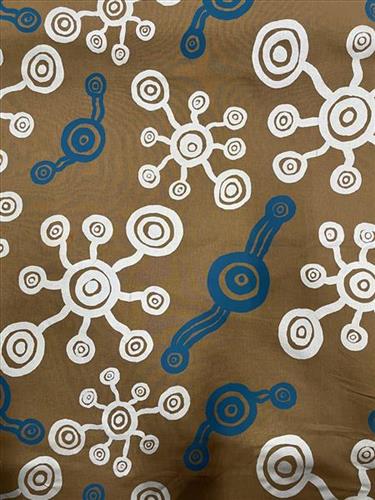
Dalhousie Hot Springs Fabric, birkinhead blue & NZ fern silver on mushroom cotton linen

This design is about the artist’s grandmother’s place. Her grandmother was born at Dalhousie Hot Springs, in the Witjirra NP, an oasis located at the edge of the Simpson Desert. It is south of Finke and West of Oodnadatta in South Australia.

The blue in the painting refers to the abundance of water at the site and reminds the artist of all her trips back to this oasis.

“We pass through this place every time we visit family and we stop and enjoy the beautiful water.”

About the printers:

Publisher Textiles & Papers is one of Australia’s leading print houses. Focused on producing original patterns through traditional hand-screen printing methods we create bold and colourful textiles, hand printed wallpaper, clothing and fabric.

Our fabric is printed in small batches and is available in pre-cut lengths on the website, which we update regularly. For larger quantities, please email us to discuss pre-orders.

Fabric details:

Width 132cm, 200gsm

This fabric is by continuous metreage going up in 50cm increments, priced at $110 per metre.

For 1m, please add 2 x 50cm to your cart and it will be cut as a continuous length ($110 for 1m).

For 2m, please add 4 x 50cm to your cart and it will be cut as a continuous length ($220 for 2m).

For 3m, please add 6 x 50cm to your cart and it will be cut as a continuous length ($330 for 3m).

A lovely cotton linen blend. Used for dresses, skirts and pants. Also used in patchwork quilts.
Weight (gsm): 200
Width (cm): 132
Finish: Standard

Care Instructions:

Hand wash, line dry, do not bleach, wash separately, warm iron, do not soak, dry cleanable (P). The ink has been heat set for longevity, however please take care when washing (wash garments inside out if possible).

22024008139


Status: Stock


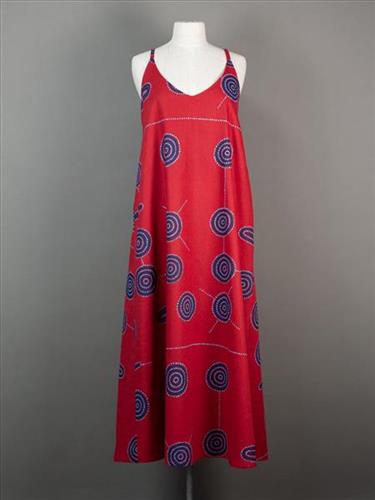
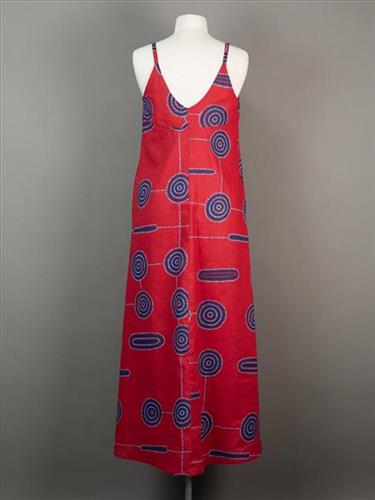
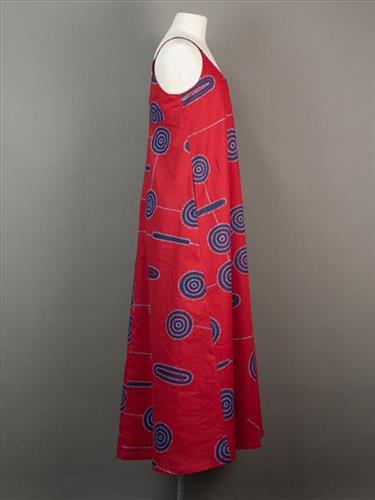
Anita Dress with Shield and Star Design, blue/white on red, cotton/linen blend

Named for Anita Pallenberg, noted 60s “it girl” and muse of The Rolling Stones, this 70s style oversized maxi is the kind of statement dress that’s perfect for a special occasion but also worth wearing as often as possible. Whether it’s dinner at a fancy restaurant, cocktails by the pool or an excuse to get dressed up and feel confident, this is your go-to dress that will deliver on all levels.

This gorgeous dress features the Walter Jugadai’s ‘Shield and Star Dreaming’ design. Of the design Walter says: “This is my secretive tradition men`s story which tells of events which happen at a place called Yarapilangu, near New Haven, North-west of Papunya. This is the dreaming of my grandfather, his traditional country is Yarripilangu. I got this story from him.”

Hand printed by Publisher Textiles & Papers in Leichhardt as a 2 colour print on red 60% linen 40% cotton. Being handmade there may be some print variations, making each garment unique.

Treat this handmade garment with love and it will love you back! Cold gentle machine wash, drip dry in shade, warm iron. Avoid the tumble dryer and dry cleaner.

22024006395


Status: Stock


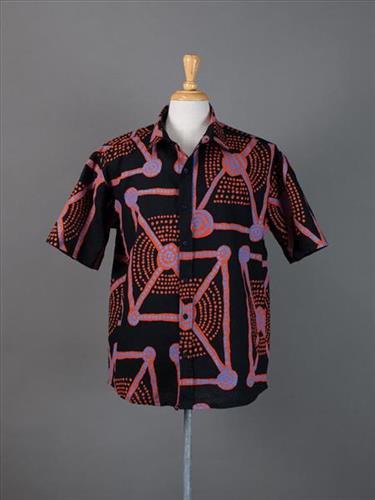
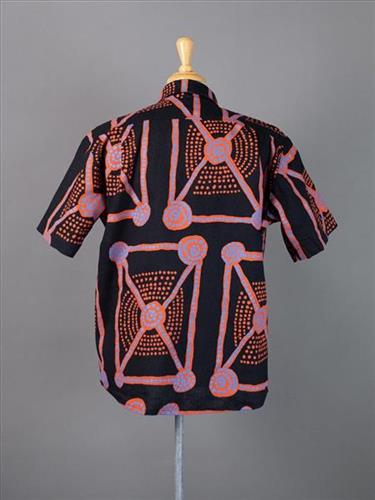
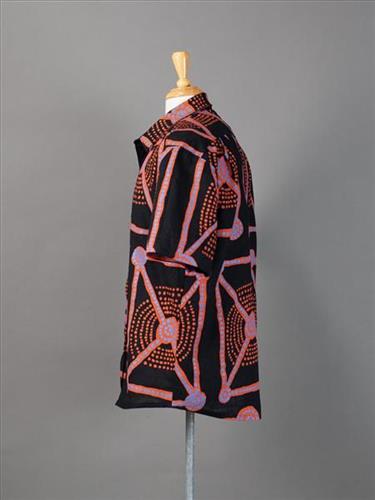
Lake Mackay Ronney shirt (publisher, Zakius Jack)

This design shows the artist’s father’s country, Lake Mackay. It tells the story about a large bushfire coming from the east turning the land into a lake. The circles in the paintings stand for water holes scattered around and the lines between are the tracks of animals looking for water.

Short sleeved button up shirts featuring bright colourful patterns were all the rage in the ’50s and ’60s, with Elvis being among the style’s biggest fans. Publisher’s take on this classic look takes its name from Elvis’ middle name Aaron.

Our version of the classic button up men’s shirt features short sleeves, a straight point collar and relaxed fit. Add a tie and team with dress pants or chinos for more formal look or skip the tie and match with jeans or shorts for a casual feel.

Print: Lake Mackay
By Zakius Jack
From Ikuntji Artists

Hand-printed at Publisher Textiles in Leichhardt as a 2-colour print on linen.
Being handmade there may be some print variations, making each garment unique.

Treat this handmade garment with love and it will love you back! Cold gentle machine wash, drip dry in shade, warm iron. Avoid the tumble dryer and dry cleaner.

221282375626


Kulata Tjuta – Kungkarangkalpa Freddy’s Story

Kungkarangkalpa means the Seven Sisters. This is an extensive creation story that relates to the Pleiades constellation in the southern hemisphere. The story traverses Australia taking on different forms, however Freddy’s part of the story is from his father’s country west of Atila (Mt Connor). For this part of the story a man called Nyiru is chasing the sisters as he wants to sleep with the oldest sister. All the younger sisters are deeply afraid of him. 

Nyiru makes kulata tjuta (many spears) and leaves them leaning up against a tree. When the sisters are travelling they find the spears resting there and realise that the wati kura (bad man) is nearby. They get frightened and run away. Eventually, to escape Nyiru, the sisters fly into the sky where they turn into stars and form the constellation.

221282375624


Kulata and Kali (Spear & Boomerang)

My father told me this story, it’s a dream he had. There was a man who was travelling for a long time. He was travelling with kulata (spear) and kali (boomerang) because someone was waiting there for fighting.

In the middle of the way someone came making problems and trouble. All the kulata gone, all the kali gone. That place is still there and the kangaroo and emu are still drinking there at that waterhole.

This is tjukurpa wiru – a good story. There are some stories I can’t tell you.

115682379054


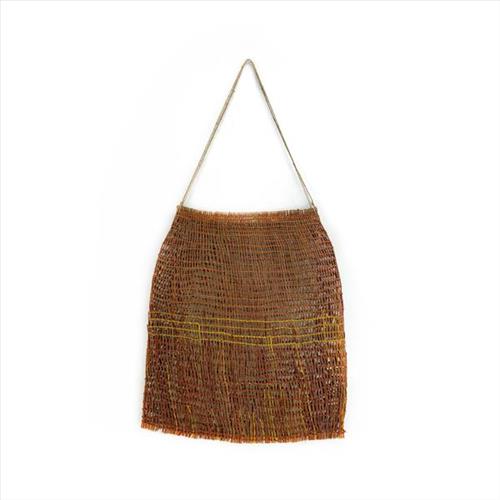
Bathi (Pandanus Basket)

Yolŋu weavers of Arnhem Land create utilitarian, ceremonial, and decorative pieces using naturally sourced materials. This Bathi (Pandanus Basket) is made from young Pandanus spiralis leaves, harvested with a wooden hook, stripped of prickles, and dried to create strong, resilient fibres. These fibres are then twisted, coiled, or woven using various techniques to produce both functional and decorative baskets.

Typically, Bathi are made using a coiling technique which was adapted from techniques used by Indigenous women throughout Southeast Australia. Introduced to Arnhem Land weavers in the 1930’s as Missionaries began commissioning pieces in this style.

Bula’bula weavers exclusively use natural dyes, derived from locally sourced roots, leaves and grasses. These pigments are extracted and infused into pandanus fibres by boiling over an open fire, producing the rich, vibrant colours characteristic of contemporary Yolŋu weavings.

377810582386084


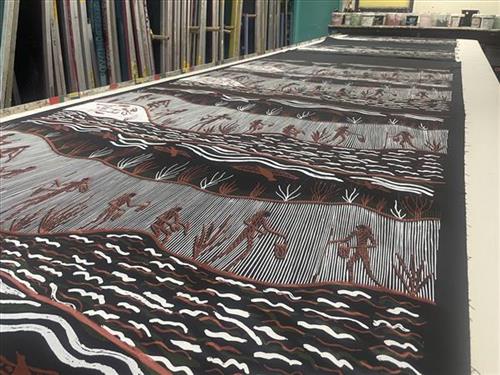
Namurre Boko (Two Brothers Fighting)

A two colour screen print design from 2022. Jay’s first large format design to join the Bábbarra Designs Collection.

‘This is my first one, I’m really happy, I’m proud. It’s just a songline for everybody. This story is from my great great grandfather on my fathers side. The songline was made by my second father. The mimihs tell the story. The painting took a long time, a few weeks to finish.’ Jay Jurrupula Rostron

‘Bini-murreko means two brothers – big brother and little brother.

Two brothers were really strong leaders and good hunters, sharing animals with different tribes.
With those different tribe there were jealousy going on.
Little brother went walkabout and heard the different tribe was talking about his tribe.
They said ngarribin manre djed-djedme bokko
Meaning: will make spear for them
Ngarrbin danj-bun, ngarrbinbun
Meaning: will spear them kill them
little brother turn around went back tell his brother
Namurre bokko kadi marne djed-djedme Karre wonens, kardi-djal danjbun
Meaning: they making spear for us, they gonna spear us
Couple of months they saw different tribe
They changed their attitude
They been bringing lots of animals to them and start asking for women
And that tribe realise that’s how those brothers died.
They kill them
This Why? They got jealous because two brothers was a good hunter.

This story written on the rock art and it stays forever.’