118782334589


Kungka Tjukurrpa at Ilpilli

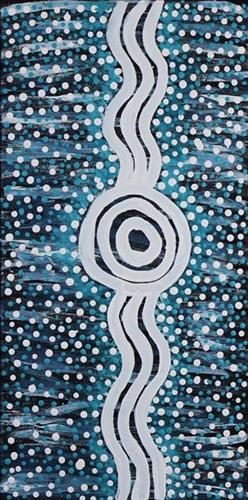
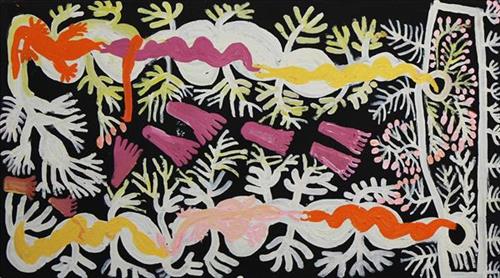
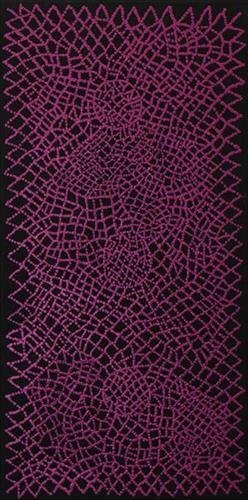
This painting represents the sacred site of Ilpilli, Napurrula’s country, which is located between Mt Liebig and Kintore.

Karen’s ancestors (The Napurrula women) were travelling across land searching for water and came upon this site. They discovered rockholes with water and a creek, which meant there was plenty of food around. This became a significant place and they remained there for a long time.

Eventually the missionaries came and took them to Haasts Bluff. 
118782335654


Kalipinypa

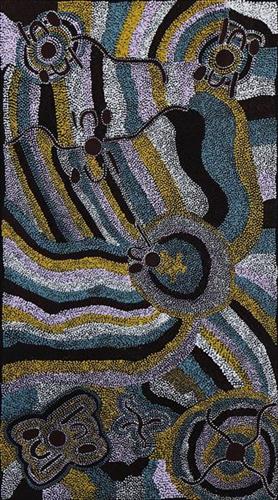
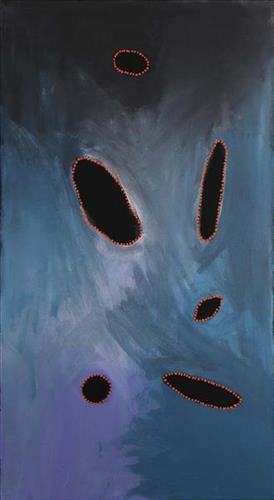
<p>This painting depicts the Kapi Tjukurrpa (Water Dreaming) at Kalipinypa, North-east of Kintore. The painting tells the story of the rain and hail making ceremony for the site of Kalipinypa. Ancestral forces are invoked to bring on a powerful storm with lightning, thunderclouds and rain sending a deluge to rejuvenate the earth, filling the rock holes, clay pans and creeks and creating new life and growth upon the land. Today the custodians of this important Water Dreaming site celebrate its stories in ceremonies.</p><p>

118782335593


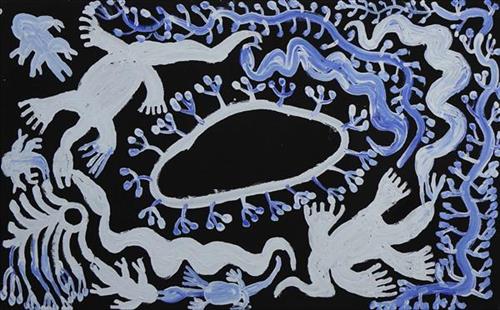
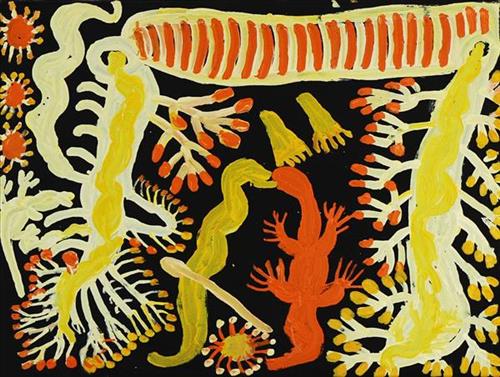
Pilkati anta rumiya (Snake and goanna)

Snake this one, eating, here, at the water. This mob over there are stabbing it with a spear. He’s trying to bite and eat that one over there. And that over there is coming to look at him, that one. This one, he’s watching, he is, ‘ooohhh!’, sneaking up intending to bite it. That one over there …
he bit him, that goanna yep, this one.
Coming to here, coming through the bush to the water, ‘ooohhh!’, they see it! ‘What happened here?’
Over there, a goanna is coming along. Going, going into the bush, across the water, sneaking up to try and bite it.
Yeah, this one, two men standing, over there is another, there watching all this the snake,
see? And see this line … he’s slowly sneaking along it.

After that, that one over there stabs him with a spear, with a spear he stabbed. Went and got that goanna and ate it, over there came and see all this mob.
Yeah, finished like that, that’s how I made this one by the water.

118782335585


Pilkati anta rumiya (Snake and goanna)

Snake this one, eating, here, at the water. This mob over there are stabbing it with a spear. He’s trying to bite and eat that one over there. And that over there is coming to look at him, that one. This one, he’s watching, he is, ‘ooohhh!’, sneaking up intending to bite it. That one over there …
he bit him, that goanna yep, this one.
Coming to here, coming through the bush to the water, ‘ooohhh!’, they see it! ‘What happened here?’
Over there, a goanna is coming along. Going, going into the bush, across the water, sneaking up to try and bite it.
Yeah, this one, two men standing, over there is another, there watching all this the snake,
see? And see this line … he’s slowly sneaking along it.

After that, that one over there stabs him with a spear, with a spear he stabbed. Went and got that goanna and ate it, over there came and see all this mob.


Yeah, finished like that, that’s how I made this one by the water.

118782335529


Kungka & Wati

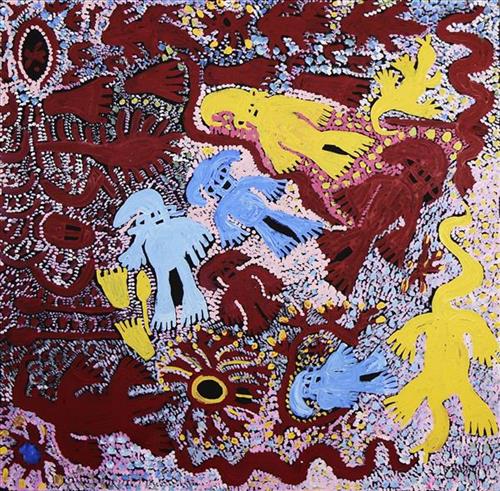
When Doris speaks about her Kungka & Wati (woman & man) paintings, she interweaves two separate stories; a memory of her family, and a story of spirits, both travelling over country. The painting depicts both of these subjects.

In Doris’s words:

He comes like a ghost, a spirit, and becomes a human being, dancing, all the kungkas come.

They travel around country, West to North. Travel around places to where the water is, looking for the waterhole. They travel to another country.

My memory of family travelling around. A story of spirits travelling over the country.

I was sleeping and woke up and saw someone dancing.

118782336366


Pilkati anta rumiya (Snake and goanna)


Snake this one, eating, here, at the water. This mob over there are stabbing it with a spear. He’s trying to bite and eat that one over there. And that over there is coming to look at him, that one. This one, he’s watching, he is, ‘ooohhh!’, sneaking up intending to bite it. That one over there …
he bit him, that goanna yep, this one.
Coming to here, coming through the bush to the water, ‘ooohhh!’, they see it! ‘What happened here?’
Over there, a goanna is coming along. Going, going into the bush, across the water, sneaking up to try and bite it.
Yeah, this one, two men standing, over there is another, there watching all this the snake,
see? And see this line … he’s slowly sneaking along it.

After that, that one over there stabs him with a spear, with a spear he stabbed. Went and got that goanna and ate it, over there came and see all this mob.


Yeah, finished like that, that’s how I made this one by the water.

118782337720


Four Dreamings

In this work Carbiene depicts four dreaming stories which he inherited from his father. These tjukurrpa are associated with a series of waterholes running between Docker River and Kata Tjuta. Specifically, it includes four important sites: Petermann Ranges, Docker River, Kalaya Murrpu (Blood’s Range) and Mulyayti near Kata Tjuta. 

As a young man, Carbiene returned to these places and retraced the footsteps of his father. These memories stay with him vividly today. 

118782337679


Kapi Tjukurrpa

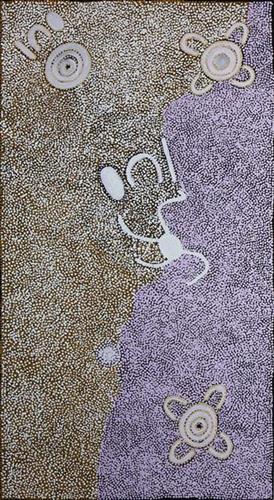
This painting tells one of many water dreamings from the Papunya area. The circles represent important water or rock hole sites. The background design symbolises the landscape after the rains when the earth has been replenished with new growth. The rock holes collect the water during the rains. Knowledge of where to find water is handed down from generation to generation to ensure survival in the desert. This work represents the elements of a storm – wind, rain, thunderclouds and lightning. It also tells the story of rain and water flowing from the waterholes and flooding the usually dry creek beds. If present, the U shapes are the women sitting around the rock holes. 

118782339099


Kapi Tjukurrpa

This painting tells one of many water dreamings from the Papunya area. The circles represent important water or rock hole sites. The background design symbolises the landscape after the rains when the earth has been replenished with new growth. The rock holes collect the water during the rains. Knowledge of where to find water is handed down from generation to generation to ensure survival in the desert. This work represents the elements of a storm – wind, rain, thunderclouds and lightning. It also tells the story of rain and water flowing from the waterholes and flooding the usually dry creek beds. If present, the U shapes are the women sitting around the rock holes. 

118782340525


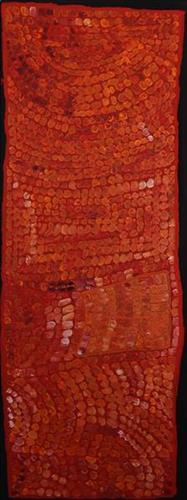
Kalipinypa Tjukurrpa

The painting depicts designs connected to Kapi Tjukurrpa (Water Dreaming) at Kalipinypa, a sacred site northwest of the Aboriginal Community of Kintore in the Central Western Desert of Australia. The Tjukurrpa tells of an important rain making ceremony to invoke the elements. It is a powerful storm bringing on the lightning, thunderclouds and rain sending its deluge to rejuvenate the earth, filling rock holes, clay pans and creeks. It has the power to create new life and growth upon the land. There is a lightning strike at this place.

In this Tjukurrpa the angular shapes represent the dryness of the Kapi Tjukitji (waterhole). Alice talks of having no spring water in this site. The arrow shapes represent the footprints of the white heron that frequent the site. The custodians for this tjukurrpa are Nakamarra, Tjakamarra, Naparula and Tjaparulla skin subsections.