118782325194


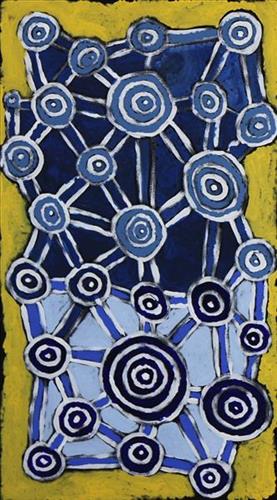
Tingari

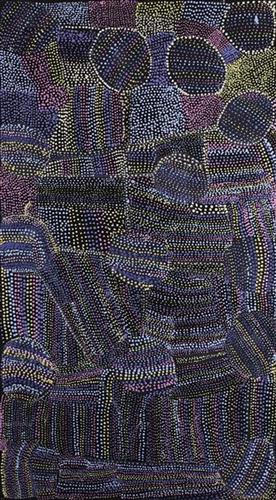
Simon’s paintings depict the dreaming stories and the travels of the Tingari, using the traditional concentric circle and line design.

Tingari refers to the Dreaming and its Laws for the Pintupi language group of the Central Western Desert. The Tingari is the Creation era when the Dreamtime Ancestors moved across the lands, creating the features of the landscape and all aspects of the natural world.
118782326093


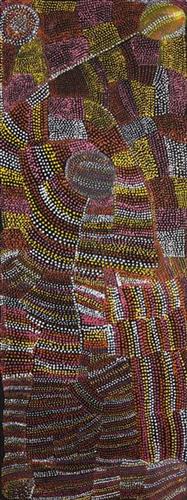
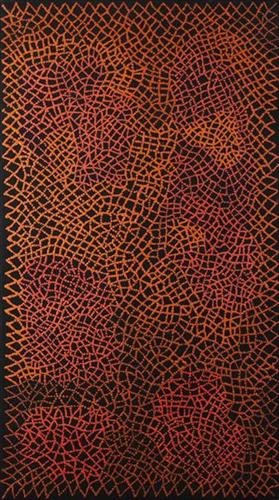
Kalipinypa Tjukurrpa

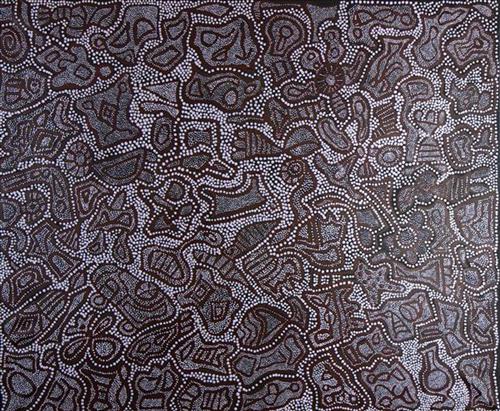
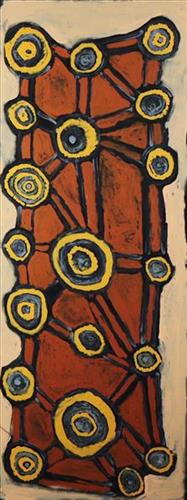
The painting depicts designs connected to Kapi Tjukurrpa (Water Dreaming) at Kalipinypa, a sacred site northwest of the Aboriginal Community of Kintore in the Central Western Desert of Australia. The Tjukurrpa tells of an important rain making ceremony to invoke the elements. It is a powerful storm bringing on the lightning, thunderclouds and rain sending its deluge to rejuvenate the earth, filling rock holes, clay pans and creeks. It has the power to create new life and growth upon the land. There is a lightning strike at this place.

In this Tjukurrpa the angular shapes represent the dryness of the Kapi Tjukitji (waterhole). Alice talks of having no spring water in this site. The arrow shapes represent the footprints of the white heron that frequent the site. The custodians for this tjukurrpa are Nakamarra, Tjakamarra, Naparula and Tjaparulla skin subsections.

118782327429


Tingari

Simon’s paintings depict the dreaming stories and the travels of the Tingari, using the traditional concentric circle and line design.

Tingari refers to the Dreaming and its Laws for the Pintupi language group of the Central Western Desert. The Tingari is the Creation era when the Dreamtime Ancestors moved across the lands, creating the features of the landscape and all aspects of the natural world.
118782327426


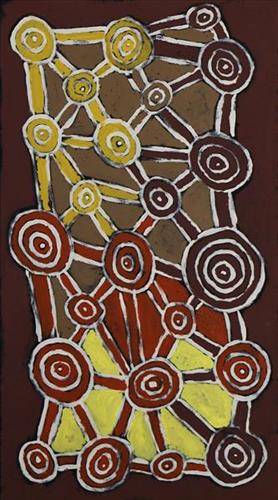
Tingari

Simon’s paintings depict the dreaming stories and the travels of the Tingari, using the traditional concentric circle and line design.

Tingari refers to the Dreaming and its Laws for the Pintupi language group of the Central Western Desert. The Tingari is the Creation era when the Dreamtime Ancestors moved across the lands, creating the features of the landscape and all aspects of the natural world.
118782329898


Papa Tjukurrpa – Nyumannu

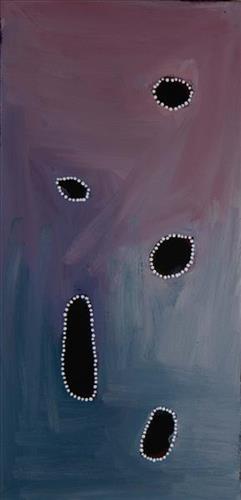
Nyunmanu is a Dingo Dreaming site just to the south east of the remote Aboriginal community of Kintore in the Northern Territory. Most of the dingoes and their pups from this place rose up into the sky and became stars. However, the ancestral mother Dingo and her pup had gone out hunting and were too tired to rise up, so they turned into a large rock that marks the place of this sacred Dreaming. 

It is said that if you sleep in this place you will dream of the ancestral dingo puppies. The story goes that if you remove one of the gleaming stones found at Nyunmanu, the puppies will haunt your dreams until you return it to the place where it belongs. The custodians of this Tjukurrpa are Nungarrayi, Tjungarrayi, Napaltjarri and Tjapaltjarri women and men.

The circles in this story often represent important waterholes. The roundels extending from the circles are the designs the women paint on their breasts during ceremony.

118782331469


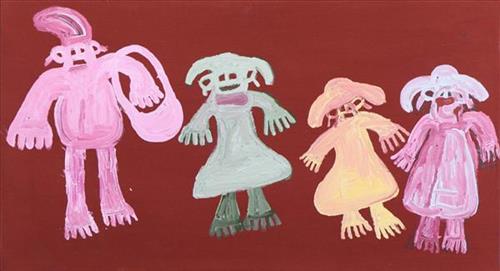
Kungka & Wati

When Doris speaks about her Kungka & Wati (woman & man) paintings, she interweaves two separate stories; a memory of her family, and a story of spirits, both travelling over country. The painting depicts both of these subjects.

In Doris’s words:

He comes like a ghost, a spirit, and becomes a human being, dancing, all the kungkas come.

They travel around country, West to North. Travel around places to where the water is, looking for the waterhole. They travel to another country.

My memory of family travelling around. A story of spirits travelling over the country.

I was sleeping and woke up and saw someone dancing.

118782332244


Karrinyarra

This painting depicts designs connected to the sacred site of Karrinyarra, to the north of Papunya. This is a Kapi Tjukurrpa (Water Dreaming) and Yalka Tjukurrpa (Bush Onion) place. This is a place where the women collect yalka. If present, concentric circles represent waterholes or yalka. Often women are depicted as U shapes, with their wana or digging stick and oval shaped coollamon by their side.Bush onions may be eaten raw or cooked after removing the hard casing. They are a small onion sedge with corms on shallow roots, the size of a small shallot. The women would perform a traditional ceremony in honour of the Bush Onion where they dance and paint their breast, chest and forearms in ceremonial body designs. They also decorate their bodies with feathers and dance with ceremonial objects such as nulla nullas (ceremonial dancing baton).

118782333372


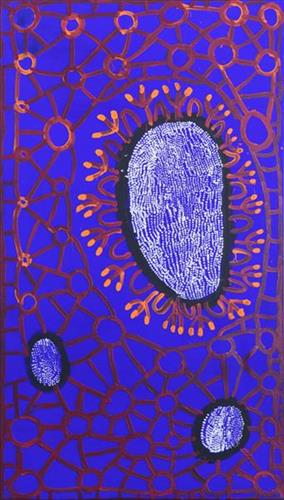
Kalinykalinypa Tjukurrpa

Beyula is telling the story of the Kalinykalinypa or desert grevillea flower, a favourite bush food for Anangu people and quite a delicacy. Kalinykalinypa grows in the sandy soils on the plains. The beautiful orange coloured flowers are picked early in the morning and placed in a billycan of water to create ‘honeywater’ (cordial) or sucked straight off the branch for their sweet honey dew. More often than not Anangu move from flower to flower, bending the flowers towards them so they can suck the nectar rather than picking it.

118782333359


Kungka Tjukurrpa at Ilpilli

This painting represents the sacred site of Ilpilli, Napurrula’s country, which is located between Mt Liebig and Kintore. Karen’s ancestors (The Napurrula women) were travelling across land searching for water and came upon this site. They discovered rockholes with water and a creek, which meant there was plenty of food around. This became a significant place and they remained there for a long time. Eventually the missionaries came and took them to Haasts Bluff.

118782334606


Karrinyarra

This painting depicts designs connected to the sacred site of Karrinyarra, to the north of Papunya. This is a Kapi Tjukurrpa (Water Dreaming) and Yalka Tjukurrpa (Bush Onion) place. This is a place where the women collect yalka. If present, concentric circles represent waterholes or yalka. Often women are depicted as U shapes, with their wana or digging stick and oval shaped coollamon by their side.Bush onions may be eaten raw or cooked after removing the hard casing. They are a small onion sedge with corms on shallow roots, the size of a small shallot. The women would perform a traditional ceremony in honour of the Bush Onion where they dance and paint their breast, chest and forearms in ceremonial body designs. They also decorate their bodies with feathers and dance with ceremonial objects such as nulla nullas (ceremonial dancing baton).