118782371746


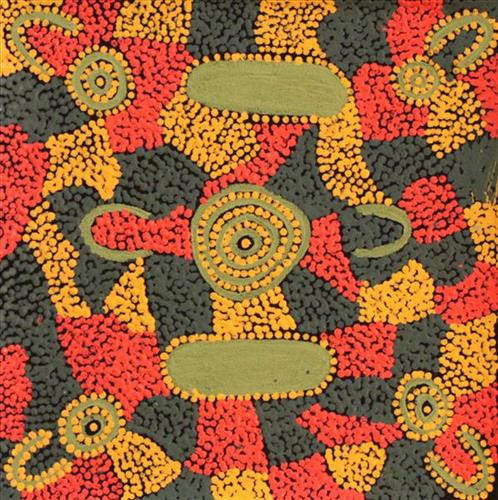
Doris Bush – Papa Tjukurrpa – Nyumannu Memory

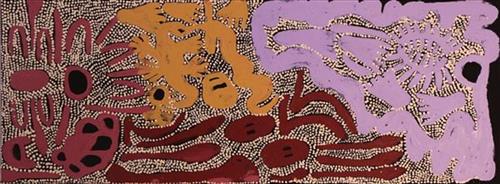
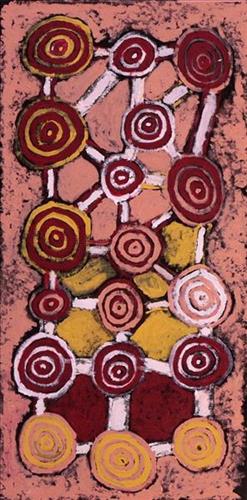
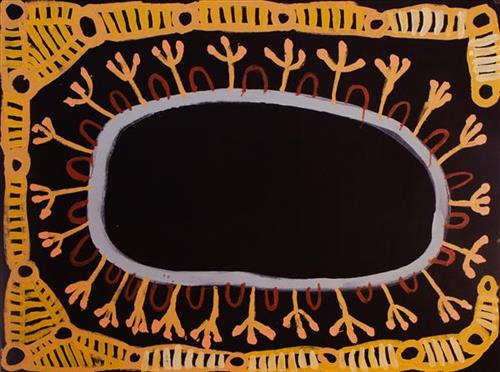
Nyunmanu is a Dingo Dreaming site just to the south east of the remote Aboriginal community of Kintore in the Northern Territory. Most of the dingoes and their pups from this place rose up into the sky and became stars. However, the ancestral mother Dingo and her pup had gone out hunting and were too tired to rise up, so they turned into a large rock that marks the place of this sacred Dreaming. 

 The custodians of this Tjukurrpa are Nungarrayi, Tjungarrayi, Napaltjarri and Tjapaltjarri women and men.

The circles in this story often represent important waterholes. The roundels extending from the circles are the designs the women paint on their breasts during ceremony.
 
In this painting Doris is remembering a day in her childhood where, as a little girl, she walked alone past the hill, the creek and the rock holes at Nyunmanu, which always had water. She saw dingos living in the caves and a Spiritual Woman dancing near one of the waterholes. This Spiritual Woman told Doris that this site was her home dreaming place. 
118782374266


Doris Bush – Pilkati

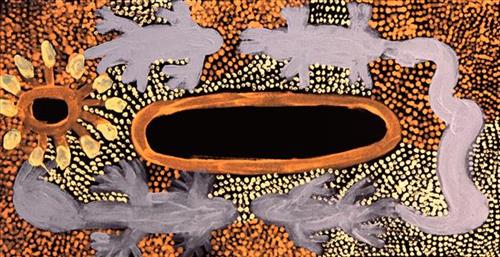
Doris Bush – Pilkati This is Doris’s Mothers Story. The custodians of this story are the Tjapaltjarri, Napaltjarri, Tjakamarra and Nakamarra skin groups. The kutuguro or policeman of this story are the Tjupurrula and Naparulla skin groups. There was a pregnant snake that travelled from Hassts Bluff looking for a place to give birth. It travelled through Karinyarra to Kalipinypa where it fought with an aggressive snake. It decided that Kalipinypa was not a good place to give birth because of that cheeky snake, so it travelled thorough Newmanu back to Hassts bluff. This is where the snake gave birth. This is the reason that Doris’s mother, when pregnant with Doris decided to come back to Hassts bluff to gave birth to her. The circles in the painting represent the Kapi Tjukutji (water holes) at Ikuntji (Hassts Bluff) where Doris grew up.

118782374147


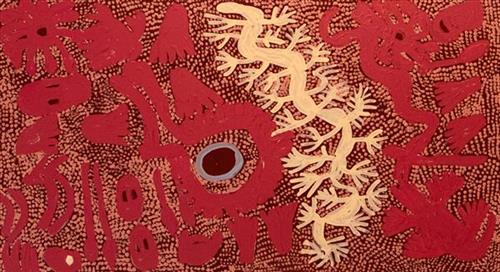
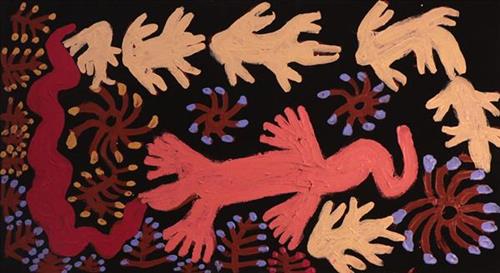
Doris Bush- Pilkati anta rumiya (Snake and goanna)


Snake this one, eating, here, at the water. This mob over there are stabbing it with a spear. He’s trying to bite and eat that one over there. And that over there is coming to look at him, that one. This one, he’s watching, he is, ‘ooohhh!’, sneaking up intending to bite it. That one over there …
he bit him, that goanna yep, this one.
Coming to here, coming through the bush to the water, ‘ooohhh!’, they see it! ‘What happened here?’
Over there, a goanna is coming along. Going, going into the bush, across the water, sneaking up to try and bite it.
Yeah, this one, two men standing, over there is another, there watching all this the snake,
see? And see this line … he’s slowly sneaking along it.

After that, that one over there stabs him with a spear, with a spear he stabbed. Went and got that goanna and ate it, over there came and see all this mob.


Yeah, finished like that, that’s how I made this one by the water.

118782374955


Glenda Kapi Tjukurrpa

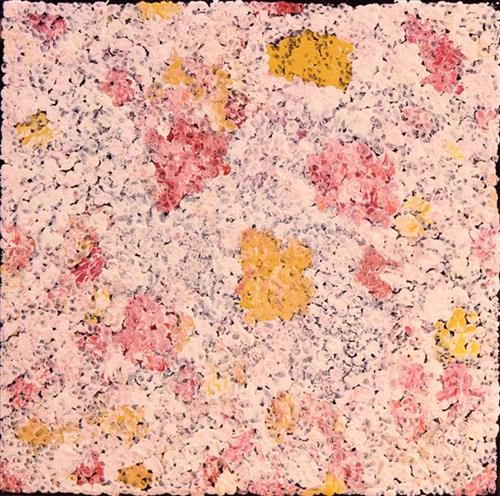
The painting depicts designs associated with Kapi Tjukurrpa (Water Dreaming) at Kalipinypa, a site northwest of Kintore. The Tjukurrpa tells of an important rain making ceremony to invoke the elements. It is a powerful storm bringing on the lightning, thunderclouds and rain sending its deluge to rejuvenate the earth, filling rock holes, clay pans and creeks. It has the power to create new life and growth upon the land.

In this painting Glenda has used the larger shapes to depict tali (sand hills) at the site of Kalipinypa. She has also used dots to represent Akatjurra (bush tomato) that have come to life after the rain. 

118782374954


Simon Yungut – Tingari

Simon’s paintings depict the dreaming stories and the travels of the Tingari, using the traditional concentric circle and line design.

Tingari refers to the Dreaming and its Laws for the Pintupi language group of the Central Western Desert. The Tingari is the Creation era when the Dreamtime Ancestors moved across the lands, creating the features of the landscape and all aspects of the natural world.

118782374769


Glenda Kapi Tjukurrpa

The painting depicts designs associated with Kapi Tjukurrpa (Water Dreaming) at Kalipinypa, a site northwest of Kintore. The Tjukurrpa tells of an important rain making ceremony to invoke the elements. It is a powerful storm bringing on the lightning, thunderclouds and rain sending its deluge to rejuvenate the earth, filling rock holes, clay pans and creeks. It has the power to create new life and growth upon the land.

In this painting Glenda has used the larger shapes to depict tali (sand hills) at the site of Kalipinypa. She has also used dots to represent Akatjurra (bush tomato) that have come to life after the rain. 

118782374768


Karen McDonald – Kungka Tjukurrpa at Ilpilli

This painting represents the sacred site of Ilpilli, Napurrula’s country, which is located between Mt Liebig and Kintore.

Karen’s ancestors (The Napurrula women) were travelling across land searching for water and came upon this site. They discovered rockholes with water and a creek, which meant there was plenty of food around. This became a significant place and they remained there for a long time.

Eventually the missionaries came and took them to Haasts Bluff. 

118782377240


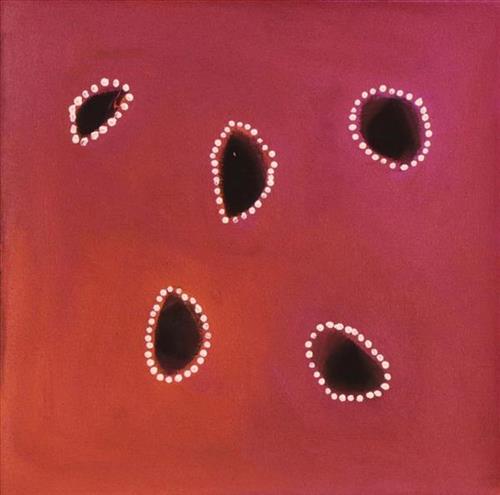
Flora Brown Mina Mina Tjukurrpa (Lake Mackay Dreaming)

Mina Mina is a salt lake place between Nyrrapi and Kunatjarryi. It is snake country. A place full of lightning and thunder. The language of the country is Yanama, and if you speak a different language the snakes will eat you. The white dot represents the dried salt.