111582384358


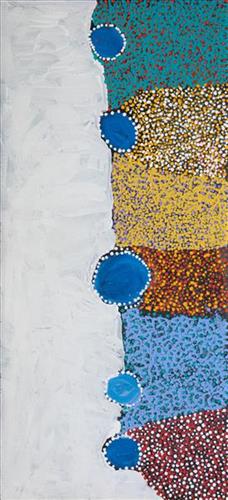
Wirlarra (Wilarra)

Wirlarra, the site depicted in this painting, lies on the eastern edge of a large salt lake, Nyayartakujarra (Lake Dora), near Punmu Aboriginal community. A distinctive group of small salt water pools are clustered together here. The water from these pools is known for its’ powerful healing properties, and the pools are still visited today by Martu to bathe cuts and sores. 

Wirlarra is also a term for ‘moon’ in Manyjilyjarra, and through the site’s Jukurrpa (Dreaming) narrative, the site is united with the moon in significance. It is said that at Wirlarra, the moon called to a family of dingoes; a mother, father and their large litter of dingo pups. The dingoes gathered at Wirlarra, where the moon cared for them and created a windbreak for the family to shelter. Here the dingoes scratched at the surface of the salt lake and created the cluster of salt water pools located there today. They lay down there. After a time, the dingoes continued travelling eastward toward the rising moon until they reached Kinyu (Well 35 on the Canning Stock Route), where they remained until all of the dingo pups had grown up. From Kinyu the family travelled further east with the moon.

111582384357


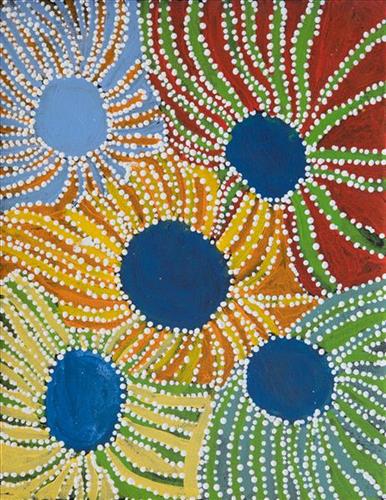
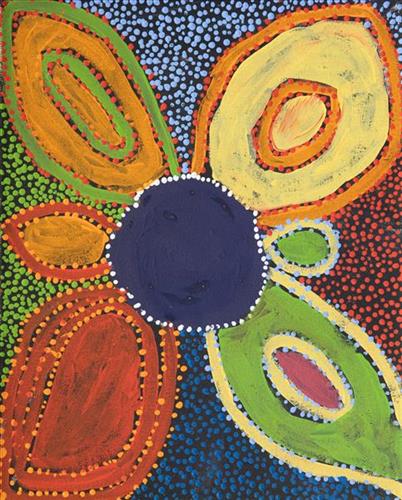
Flowers

This work depicts the remarkably diverse flora found through Martu Country. These plants are not only vital as significant food sources, but also celebrated for their aesthetic splendour. In the context of the often harsh and arid environments in which desert flowers bloom, their vibrancy, delicacy, and variation become even more spectacular. 

111582384356


Wirlarra (Wilarra)

Wirlarra, the site depicted in this painting, lies on the eastern edge of a large salt lake, Nyayartakujarra (Lake Dora), near Punmu Aboriginal community. A distinctive group of small salt water pools are clustered together here. The water from these pools is known for its’ powerful healing properties, and the pools are still visited today by Martu to bathe cuts and sores. 

Wirlarra is also a term for ‘moon’ in Manyjilyjarra, and through the site’s Jukurrpa (Dreaming) narrative, the site is united with the moon in significance. It is said that at Wirlarra, the moon called to a family of dingoes; a mother, father and their large litter of dingo pups. The dingoes gathered at Wirlarra, where the moon cared for them and created a windbreak for the family to shelter. Here the dingoes scratched at the surface of the salt lake and created the cluster of salt water pools located there today. They lay down there. After a time, the dingoes continued travelling eastward toward the rising moon until they reached Kinyu (Well 35 on the Canning Stock Route), where they remained until all of the dingo pups had grown up. From Kinyu the family travelled further east with the moon.

225182384341


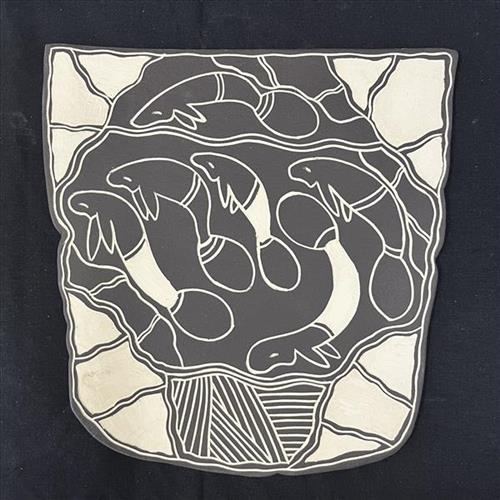
Kirbaji (Dugong)

Kirbaji (Dugong) is an Ancestral Spirit Being (Totem) that I inherited it from my mother’s side.  It is my Totem. The dugong was also an important food source for my ancestors. Only men were allowed to hunt them, and only men had the right to cook and distribute the meat to all the families. My uncles and cousins showed me how to hunt dugongs and they passed down to me the cultural knowledge about them.

My ancestors used to wrap the dugong meat in ginger leaves for flavour, close the wraps with a vine and cook them in the ground oven. Dugongs were only hunted on special occasions such as births, weddings and funerals to provide food for large family gatherings.Dugong fat was also melted to make oil which was used as a medicine for skin and hair ailments or as ointment to treat an upset stomach.

37781064008605


Status: Stock


Crab Bandhini – Cecelia Tigan

This garment is a collaboration between the artists at Nagula Jarndu Designs and the Saheli Women in Rajasthan, India. A social enterprise centered on traditional craft and textiles practices in Jodhpur founded to create opportunities and financial independence for women. Collaborating with Saheli meant that we have more transparency in the production our garments, in ways that are both environmentally sustainable and ethically sound. It also supports jarndunil (women) like us! Designs by seven Nagula Jarndu artists were developed into either wood blocks or interpreted into an embroidery pattern by the makers in Jodhpur.

The Bhandini Dyed Cotton dress features an embroidered crab design. This design was created by artist Cecelia Tigan.

 Description:

  • relaxed fit
  • Ruched elasticated waist band with lots of give
  • Hem finishes at ankle
  • Ample side seam pockets

*Please note that the pattern placement will vary slightly on each garment. these are also hand printed with natural dyes. You might notice slight flecks of colour on the garment which are not a flaw but part of the hand woodblock printing process

Size and fit guide:

These garments run true to size and are designed to be both generous and comfortable. 

Measurements: waist / waist stretched to max/ length waistband to ankle hem

S: 72cm / 92cm / 97cm 
M: 78cm / 96cm / 99cm 
L: 86cm / 112cm / 100cm 

Care and washing guide:

Handwashing your garment in cold water and ironing from the inside-out, will ensure that it is a part of your wardrobe for years to come.

11414008597


Status: Stock


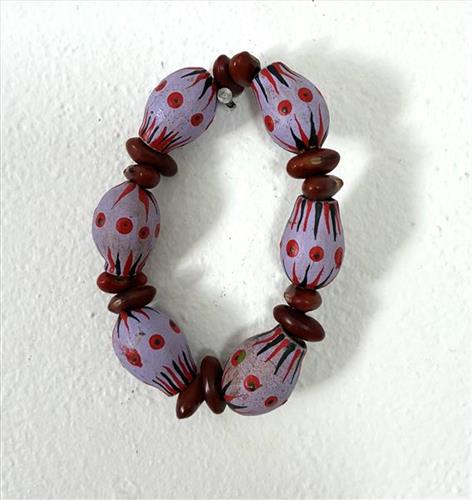
Locally collected painted tatu/gumnut, ininti seed or quondong seed, pieced with a hot poker.

37781064008596


Status: Stock


Scrunchies

This garment is a collaboration between the artists at Nagula Jarndu Designs and the Saheli Women in Rajasthan, India. A social enterprise centered on traditional craft and textiles practices in Jodhpur founded to create opportunities and financial independence for women. Collaborating with Saheli meant that we have more transparency in the production our garments, in ways that are both environmentally sustainable and ethically sound. It also supports jarndunil (women) like us! Designs by seven Nagula Jarndu artists were developed into either wood blocks or interpreted into an embroidery pattern by the makers in Jodhpur.

The soft pastel colours of this collection are the result of choosing natural dyes to create the repeat prints.

There are five (5) designs

  • Bandhini – Saheli Women – Natural Dyed cotton
  • Fan Coral by Rowena Morgan – 100% Egyptian Cotton
  • Mala (Trumpet Shell) by Lorraine Hunter – 100% Egyptian Cotton
  • Pale Pink – Saheli Women – Natural Dyed Cotton
  • Wattle by Mareeya Pigram – 100% Egyptian Cotton

 Description:

  • relaxed fit
  • Ruched elasticated band with lots of give

*Please note that some fabrics are hand printed with natural dyes. You might notice slight flecks of colour on the garment which are not a flaw but part of the hand woodblock printing process

37781064008595


Status: Stock


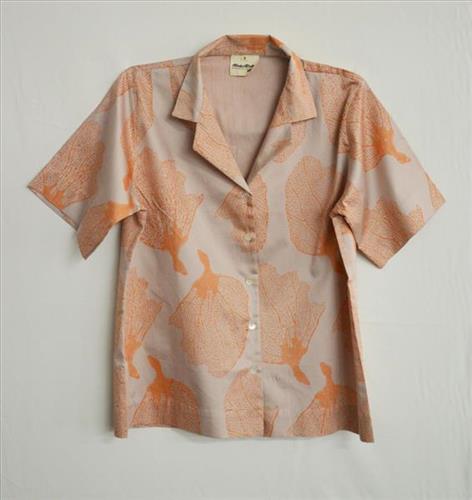
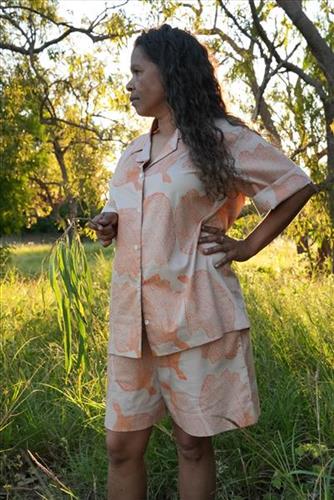
Fan Coral – Rowena Morgan

This garment is a collaboration between the artists at Nagula Jarndu Designs and the Saheli Women in Rajasthan, India. A social enterprise centered on traditional craft and textiles practices in Jodhpur founded to create opportunities and financial independence for women. Collaborating with Saheli meant that we have more transparency in the production our garments, in ways that are both environmentally sustainable and ethically sound. It also supports jarndunil (women) like us! Designs by seven Nagula Jarndu artists were developed into either wood blocks or interpreted into an embroidery pattern by the makers in Jodhpur.

The soft pastel colours of this collection are the result of choosing natural dyes to create the repeat prints.

This design was created by artist Rowena Morgan, called Fan Coral , printed on 100% Egyptian cotton

 Description:

  • relaxed fit
  • very soft, natural dyed cotton

You might notice slight variation in the colour on the garment which is not a flaw but part of the hand dye process

Size and fit guide:

These garments run true to size and are designed to have a relaxed fit

Measurements: shoulder to hem, bust, horizontal shoulder

S: 69cm / 112cm / 45cm 
M: 72cm / 124cm / 49cm 
L: 75cm / 132cm / 53cm 

Care and washing guide:

Handwashing your garment in cold water and ironing from the inside-out, will ensure that it is a part of your wardrobe for years to come.

37781064008594


Status: Stock


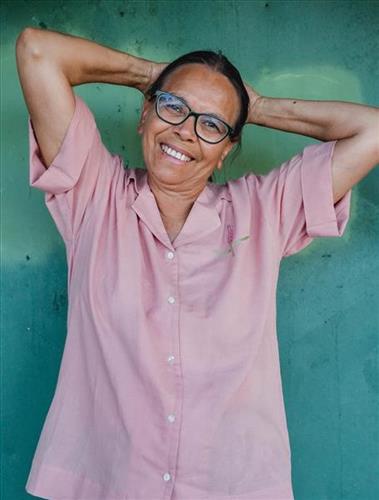
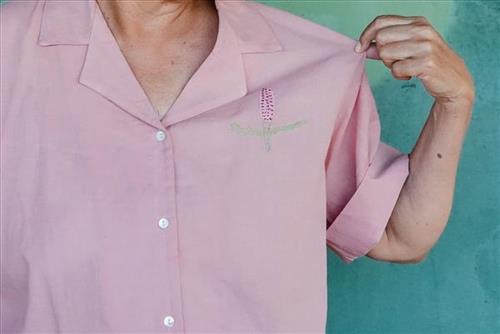
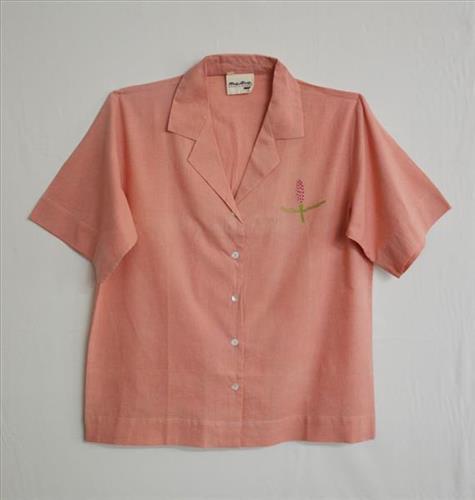
Banksia Embroidered Shirt – Dena Gower

This garment is a collaboration between the artists at Nagula Jarndu Designs and the Saheli Women in Rajasthan, India. A social enterprise centered on traditional craft and textiles practices in Jodhpur founded to create opportunities and financial independence for women. Collaborating with Saheli meant that we have more transparency in the production our garments, in ways that are both environmentally sustainable and ethically sound. It also supports jarndunil (women) like us! Designs by seven Nagula Jarndu artists were developed into either wood blocks or interpreted into an embroidery pattern by the makers in Jodhpur.

The soft pastel colours of this collection are the result of choosing natural dyes to create the repeat prints.

This design was created by artist Dena Gower, Banksia, embroidered on 100% Egyptian cotton

 Description:

  • relaxed fit
  • very soft, natural dyed cotton

You might notice slight variation in the colour on the garment which is not a flaw but part of the hand dye process

Size and fit guide:

These garments run true to size and are designed to have a relaxed fit

Measurements: shoulder to hem, bust, horizontal shoulder

S: 69cm / 112cm / 45cm 
M: 72cm / 124cm / 49cm 
L: 75cm / 132cm / 53cm 

Care and washing guide:

Handwashing your garment in cold water and ironing from the inside-out, will ensure that it is a part of your wardrobe for years to come.