
111582384011
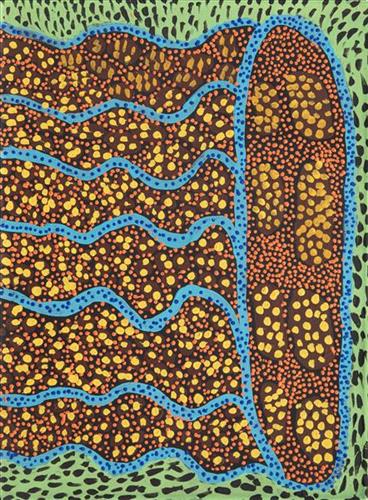
Punmu Yabu
“Punmu hill, that’s all the little rocks. That’s the wood, big ones. We camped there, eagle’s nest in Punmu, dreamtime story”
– Elizabeth Toby
In Martu the word Yabu translates to rock or hill. Punmu Yabu is the site of a large rocky hill near the community of Punmu. Elizabeth visited this Jukurrpa site on a camp with the local school.
The term Jukurrpa is often translated in English as the ‘dreaming’, or ‘dreamtime’. It refers generally to the period in which the world was created by ancestral beings, who assumed both human and nonhuman forms. These beings shaped what had been a formless landscape; creating waters, plants, animals, and people. At the same time they provided cultural protocols for the people they created, as well as rules for interacting with the natural environment. At their journey’s end, the ancestral beings transformed themselves into important waters, hills, rocks, and even constellations.

111582384007
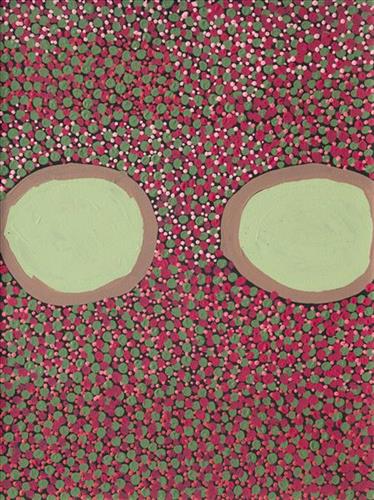
Nyinpingka
Nyinpingka, know as native fuchsia in English, is a small to medium shrub that produces pink flowers. Usually after good rains Nyinpingka prolifically produces bright pink flowers that you can pull off the bush and suck honey from. The leaves can also be boiled to make a drinking medicine or a rubbing tonic. Traditional Martu knowledge of plant properties was encyclopedic, and saw plants used for purposes as diverse as food resources, carving implements, tobacco, firewood, shelter construction, and bush medicines.
During the pujiman (traditional, desert dwelling) period, Martu would traverse very large distances annually in small family groups, moving seasonally from water source to water source, and hunting and gathering bush tucker as they went. Whilst desert life has moved away from mobile hunter-gatherer subsistence throughout the course of the twentieth century, bush tucker continues to be a significant component of the modern Martu diet. Hunting and gathering bush tucker remains equally valuable as an important cultural practice that is passed on intergenerationally. Though hunting and gathering implements have been modernised, methods of harvesting, tracking and the use of fire burning to drive animals from their retreats are still commonly practiced today.

111582383999
Pilbara Communities
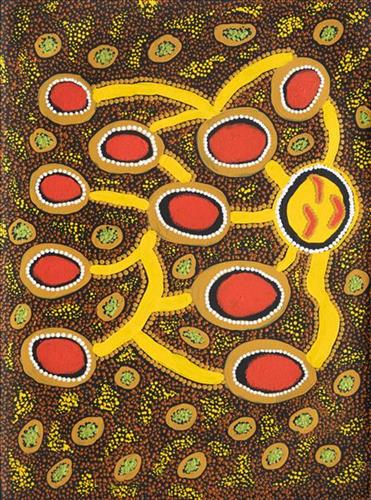
The traditional lands of the Martu people encompass the Great Sandy Desert and Rudall River regions of Western Australia, and include speakers of Manyjilyjarra, Warnman, Kartujarra, Putijarra and Martu Wangka languages. Since the 1980’s Return to Country movement, many Martu have chosen to live in remote Aboriginal Communities, including Punmu, Parnngurr, Kunawarritji, Jigalong, Irrungadji (Nullagine), and Warralong. Here, Martu are able to live a life where connections to Country can be best maintained.
Sites for modern day Aboriginal communities were designated for their close proximity to good spring water, their significance as historical and cultural sites, and for their relevance to particular family groups. Most communities contain an office, community store, school, health clinic, art shed, mechanics workshop, sports field, and areas for gathering during ceremonial events. Kuulkaja (community schools) were in many instances one of the first spaces to be established when the communities were formed. They are recognised as being at the heart of each community, and play an important role in keeping culture, Country and language strong.
Life in community is unique; the distance between communities and major centres means few outside visitors pass through, travel between communities and towns is via long 4WD journeys or on the mail plane, fresh fruits and vegetables are relatively scarce, and up until recently telephone communication was limited to a few fixed landlines and community phone booths. Whilst these communities are continually being modernised, Country remains central to community life, both physically and culturally.

111582383993
Willy Willy
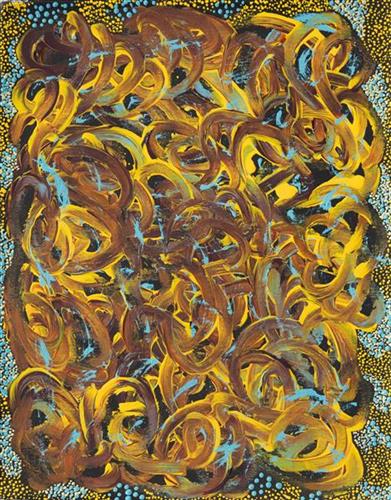
The term willy willy describes small whirlwinds or dust devils, and is believed to have come from an Aboriginal language in Western Australia.
During the pujiman period, Martu would traverse very large distances annually in small family groups, moving seasonally from water source to water source, and hunting and gathering bush tucker as they went. At this time, one’s survival depended on their intimate knowledge of the location of resources; thus physical elements of Country, such as sources of kapi (water), tali (sandhills), different varieties of warta (trees, vegetation), ngarrini (camps), and jina (tracks) are typically recorded with the use of a use of a system of iconographic forms universally shared across the desert.

114182384120
Kakalala and Kangka (White Cockatoo and Black Crow)
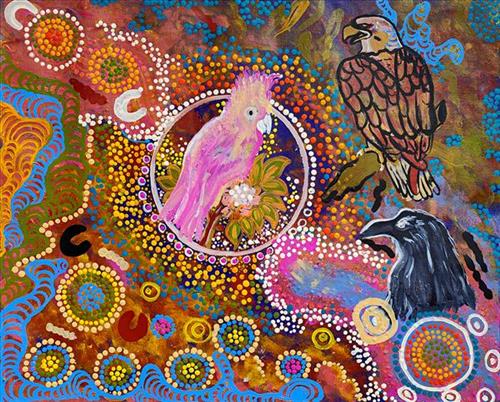
This is a dreamtime story about Kakalala (White Cockatoo) and Kangka (Black Crow). Cockatoo and Crow were the wives of Eagle. One day the wives went off to collect food. Crow was jealous of Cockatoo and she attacked her and broke her legs. Crow left her out bush and went back to Eagle. Crow said that Cockatoo was in the bush as she was expecting a baby. But after three days when Cockatoo did not return home, Eagle went out looking for her. He followed her tracks but could not find her. He decided that Crow had been lying and he punished her by burying her in a hole.

114182384119
Kungkarrangkalpa (Seven Sisters) – Angilyiya Mitchell
‘Kungkarrangkalpa’ (The Seven Sisters or Pleaides) is significant Tjukurrpa (dreamtime). Its origins you may be familiar with in astronomy and its connection to ‘Wati Nyiru’ (Magic Man or Orion). The roots of this dreaming stems across indigenous groups around the world. The Australian Aboriginal songline is one part to the whole dreaming which can be traced all around the world. The ladies of the Ngaanyatjarra Lands depict their significant chapter and understanding of the journey of the sisters. The different versions of this story depend on where you live and the significance’s of local Tjukurrpa places.
Nyiru fell in love with the sisters but he was of the wrong skin group to marry, but he still pursued them on their journey. The sisters travel across the land to escape Nyiru’s unwanted attentions, but he is persistent and always finds them. There are significant land forms which can be sited today that evidence this dreaming. As Nyiru is chasing the sisters he tries to catch them by using magic to turn into the most tempting kampurarrpa (bush tomato) and the most beautiful Yirli (wild fig tree), for them to eat and camp under. However, the sisters are knowledgeable of his magic and too clever for Nyiru who they outwit again and again. They go hungry and run through the night rather than be caught by him. As the journey continues, Nyiru gets so frustrated at the wit of the sisters that he uses his magic to make the oldest sister sick to try and get closer to her. The other sisters rescue the big sister and nurse her back to health. It is said he also captures the youngest sister, but with the help of the oldest sister, she escapes back to her sisters who are waiting for her. Eventually, the sisters fly into the sky to escape Nyiru, forming the constellation. Nyiru felt lonely, longing for the sisters who were so far away. Nyiru used his magic to go to the sky, forever in pursuit.
This painting maps the site of ‘Kuru Ala’ (two-eyes), a sacred place for women in Angilyiya’s mother’s country south of Papulankutja (Blackstone). Wati Nyiru was following them, disguising himself as a Quandong tree, a Yirli (wild fig tree), and then a carpet snake, spying on them as they made camp and dug for food.
“This is the story about my Grandmother’s country, south of Papulankutja. You can see today the circles at the site in the cave from that Dreamtime story. It’s the young girls turning into young women. The bigger circles are those already women. They have been travelling for food and they saw that man had already taken the big sister. So they are taking her to the second cave for resting and getting better. You can see that man sitting; the rock hole down the bottom “Kuru Ala”, they drank that water in the early days. We still drink this water today”.

114182384117
Kampurarrpa Piti
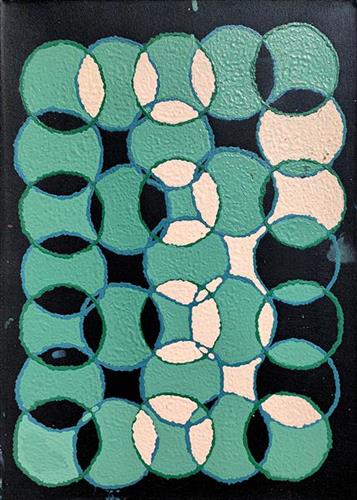
Kampurarrpa Piti is the name of a rock hole where water can be found. Kampurarrpa means bush tomato or raisin while piti is the word for hole. The rock hole was given this name because it is where Kampurarrpa grows.
Traditionally the people would go there for the Kampurarrpa and water. They used to tap on the many round rocks to scare off the birds that were eating the Kampurarrpa.

114182384116
Kakalala and Kangka (White Cockatoo and Black Crow)
This is a dreamtime story about Kakalala (White Cockatoo) and Kangka (Black Crow). Cockatoo and Crow were the wives of Eagle. One day the wives went off to collect food. Crow was jealous of Cockatoo and she attacked her and broke her legs. Crow left her out bush and went back to Eagle. Crow said that Cockatoo was in the bush as she was expecting a baby. But after three days when Cockatoo did not return home, Eagle went out looking for her. He followed her tracks but could not find her. He decided that Crow had been lying and he punished her by burying her in a hole.

114182384115
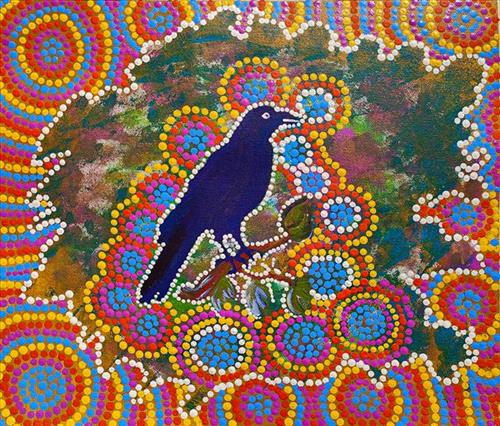
Eagle, Crow and Cockatoo
This story is from Wanan. It refers to a rock that is white and black, the white symbolises the cockatoo while the black symbolises the crow.
The Eagle man wants to marry the cockatoo woman, however the crow lady is jealous. She tells the cockatoo woman that he’s not going to marry her, he’s going to marry me! While the Eagle man is secretly watching from behind bushes the woman start to fight. The crow woman hit the cockatoo woman on the head with her wana (large digging stick), splitting her head open. The cockatoo woman is angry and says I don’t want to marry him, you can! As a result no one gets married.