22024001710


Status: Stock


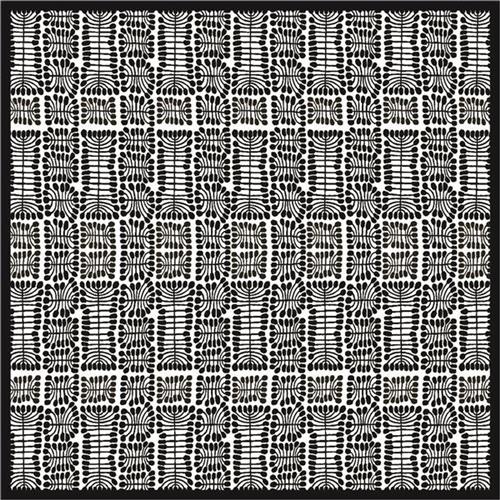
Watiya Tjuta Square Tablecloth (Black on White)

Watiya (tree) Tjuta (many) is the artist’s iconic rendering of her late father’s Tjukurrpa (Dreaming). In this design, the artist depicts the ceremonial spear straightening in Uwalkari country (Gibson desert region). The spear straightening is part of restricted men’s business. Mitjilli was given the right to depict the source of the spears by her father, however, the ceremony cannot be revealed in her works. Uwalkari is abundant with Watiya Tjuta and other plants that grow in a landscape dominated by sandhills. Mitjilli came from an acclaimed family of artists and the imagery of Watiya Tjuta is a recurring motif in her artwork. 

22013972653


Status: Stock


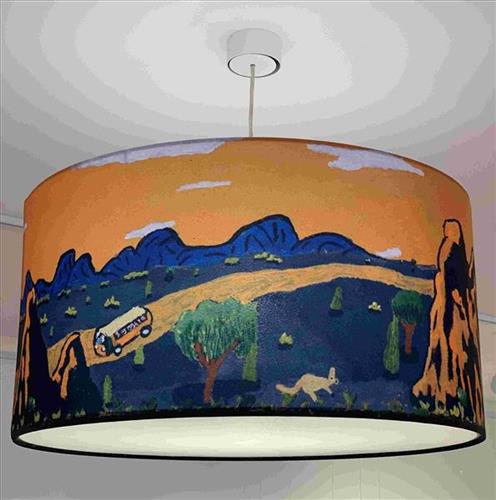
Billy Tjampijinpa Kenda Pendant Light Shade

Goin’ to take Photos of the Wallabies Near West of Jay Creek.

‘I think about memories and I paint my Countryside”

Comes as both a pendant and floor Shade:

Pendant Shade 610 W x 300 H mm – $680
Floor Stand Shade 610 W x 300 H mm – $580

Pendant shades come with a diffuser and electrics.
Floor Shades are sold shade only.

22013972652


Status: Stock


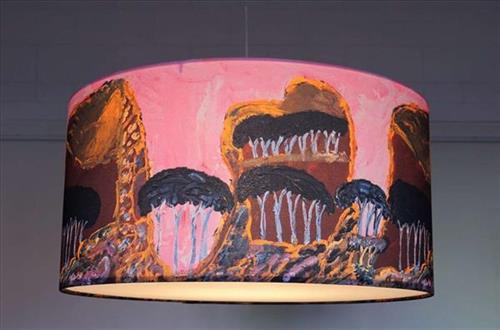
Adrian Jangala Robertson Pendant Light Shade

Yalpirakinu

Comes as both a pendant and floor shade:

Pendant Shade 610 W x 300 H mm – $680
Floor Stand Shade 610 W x 300 H mm – $580

Pendant shades come with a diffuser and electrics.
Floor Shades are sold shade only.

221282378925


Ngayuku Walka / My Design

Walka means design or pattern. Artists use this title to describe artworks that are pattern based rather than descriptive or telling a story.

221282379100


Ngayuku Walka / My Design

Walka means design or pattern. Artists use this title to describe artworks that are pattern based rather than descriptive or telling a story.

220982379343


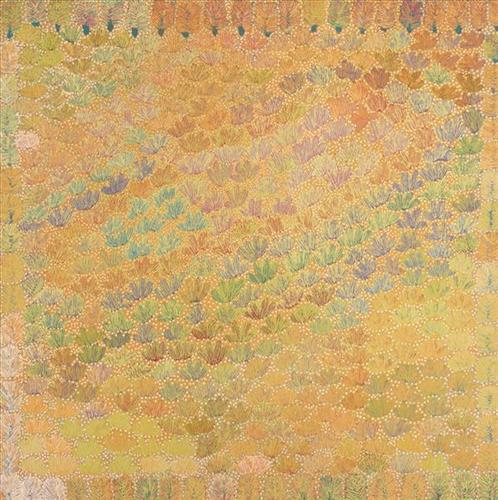
Diane Kemarre Ross – My Country

This is my country, it’s the country around Irrultja. This is where we like to go after big rain. After big rain there, we can go swimming. There is always good hunting on my country. It is good for me to paint my country and it makes me feel good.

The artists of Ampilatwatja made a conscious decision not to paint altyerr (dreaming stories). The artists paint their country where those stories sit.
114182380540


Kungkarrangkalpa (Seven Sisters)

‘Kungkarrangkalpa’ (The Seven Sisters or Pleaides) is significant Tjukurrpa (dreamtime). Its origins you may be familiar with in astronomy and its connection to ‘Wati Nyiru’ (Magic Man or Orion).  The roots of this dreaming stems across indigenous groups around the world. The Australian Aboriginal songline is one part to the whole dreaming which can be traced all around the world. The ladies of the Ngaanyatjarra Lands depict their significant chapter and understanding of the journey of the sisters. The different versions of this story depend on where you live and the significance’s of local Tjukurrpa places.

Nyiru fell in love with the sisters but he was of the wrong skin group to marry, but he still pursued them on their journey. The sisters travel across the land to escape Nyiru’s unwanted attentions, but he is persistent and always finds them. There are significant land forms which can be sited today that evidence this dreaming. As Nyiru is chasing the sisters he tries to catch them by using magic to turn into the most tempting kampurarrpa (bush tomato) and the most beautiful Yirli (wild fig tree), for them to eat and camp under. However, the sisters are knowledgeable of his magic and too clever for Nyiru who they outwit again and again. They go hungry and run through the night rather than be caught by him. As the journey continues, Nyiru gets so frustrated at the wit of the sisters that he uses his magic to make the oldest sister sick to try and get closer to her. The other sisters rescue the big sister and nurse her back to health. It is said he also captures the youngest sister, but with the help of the oldest sister, she escapes back to her sisters who are waiting for her. Eventually, the sisters fly into the sky to escape Nyiru, forming the constellation. Nyiru felt lonely, longing for the sisters who were so far away. Nyiru used his magic to go to the sky, forever in pursuit.

220982381064


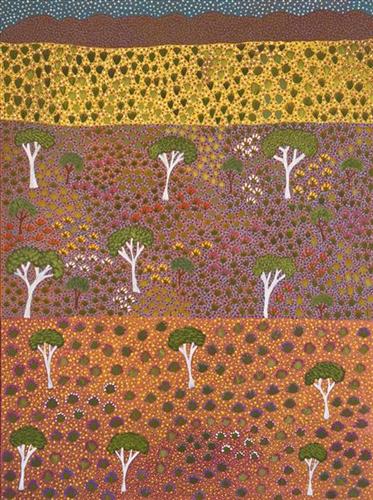
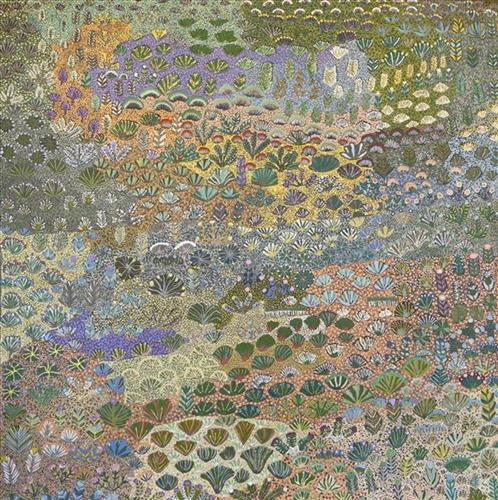
Betty Pula Morton – My Country and Bush Medicine

I paint my country where I find bush tucker and bush medicine. I am very happy when out bush hunting and gathering, it is where I feel connected to country and culture. My inspiration is from being out on the land, especially from the hunting and gathering trips where I see the different seasonal plants, bush foods and medicines, that are producing at that time and observes the ever-changing layered landscapes, it is always changing, with the light of day and the seasons of the year.

I enjoy and understand the importance of painting bush medicine plants. They help in the healing of my people and it keeps the tradition and knowledge strong. These particular plants are very plentiful after rain and can be used for numerous conditions, such as skin irritations, flu, coughs and infections.

Bush medicine plants are used for healing on the body and for drinking. We make this by smashing the plants with a rock, we use the juice and the fibre of the plant. We collect bush medicine plants when we are out hunting, different kinds of plants grow during different seasons.

There are lots of different medicines, we know what their stories are as we learnt them from our parents and we teach these stories to our children.

The artists of Ampilatwatja made a conscious decision not to paint altyerr (dreaming stories). The artists paint their country where those stories sit.
220982382734


Julieanne Ngwarraye Morton – My Country, My Bush Medicine

My Mother, Lilly Kemarre, taught me to paint. She likes to paint her Mother’s and Father’s country from the old days, when they used to live off of the land.

The landscape changes during the different seasons in the year. I paint the dried flowers and bushes from last season as well as the new plants that come after the rain. These plants have special meanings and uses for us. I have been taught how to read the country, and now I teach my children these skills.

Julieanne’s painting’s are inspired by her Mother’s stories of the old days, walking and living on their land, and also of her own experience of life out here in Alyawarr country.