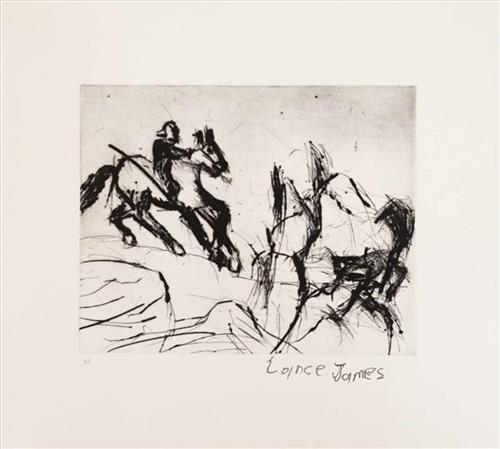
The Hunt
Artist Proof
Artist Proof

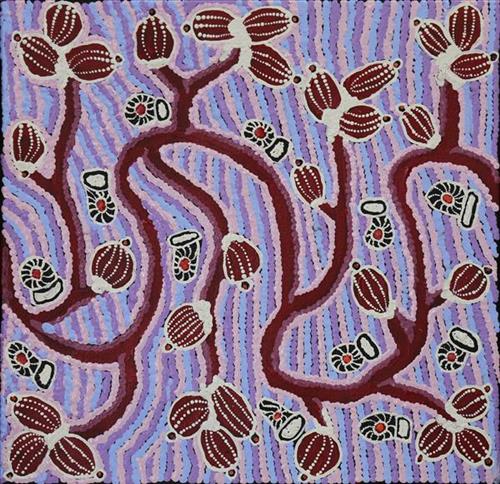
Two things – tree roots used for bush medicine with flowers in the background. Mangarri is a kind of Bush Medicine. The plant roots are gathered, ground up and boiled in water. This is used on the skin. You don’t eat this one. Also, the painting has seeds used to make a necklace. The seeds are decorated with a hot wire from the fire. Women make necklaces for decoration and ceremony.


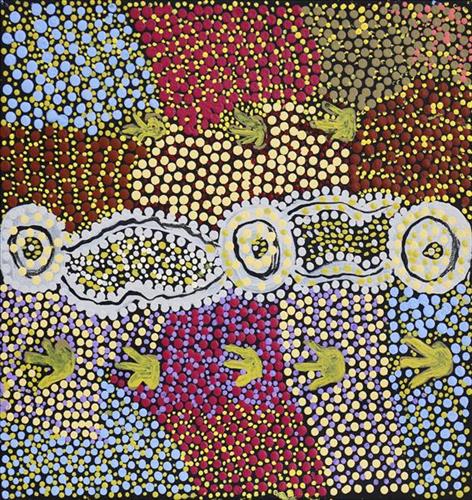
Emu looking around for water. This is a Dreaming story from my father’s country, other side of Yuendumu. Past Mandarin Station, through there and other side. Emu looking round for water, they are three waterholes. I’ve painted the country side after big rain, flowers everywhere. The emu is looking for yellow fruit to eat, with seed. The snake is in the waterholes.

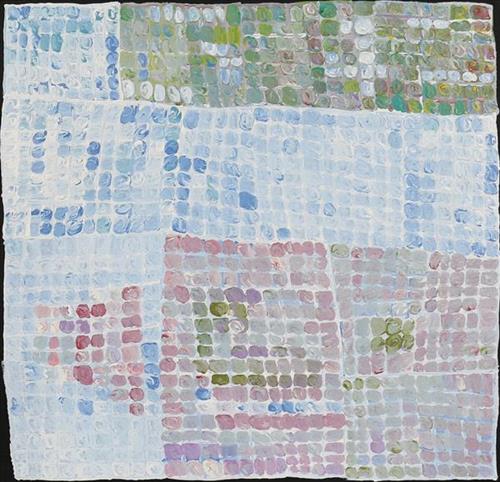
‘This is Petermann Range near Kaltukatjara – that’s Docker River [Community]. Puta Puta, Tjunti, Muliati. This is my father’s Country’.
Carbiene’s father was Snowy McDonald. He, like many other Pintupi-Pitjantjatjara people eventually moved east and north to refuges such as the Lutheran Mission at Ernabella, and Areyonga, during difficult drought times about 60-70 years ago. Some even ended up in Papunya once it opened as a Government Reserve in the early 1960s, as was the case of Carbiene’s father.
The shapes Carbiene paints represent an abstracted form of a series of important waterholes through the Petermann Ranges. Some of these sacred places now also have small Family Outstations or Homelands established nearby. For example, Tjunti is the name of a family outstation named for a soakage where the Hull River cuts through the Petermann Ranges. This is where Lasseter took refuge during his ill-fated expedition in search of gold. The cave he was found in near Tjunti is called Kuḻpi Tjuntinya (now commonly called Lasseter’s Cave in English).
The Petermann Ranges have now been designated an area of Conservation significance and the government work closely with local families in managing the area.
Carbiene is a Papunya Tjupi artist, having joined Papunya Tjupi Art Centre in 2018 and launching his career along with a cohort of emerging young male artists. Papunya is 250km West of Alice Springs, and when Carbiene visits Alice Springs he paints with Tangentyere Artists. Tangentyere Artists and Papunya Tjupi have a good working relationship, with several artists from each art centre coming from the same families. Tangentyere Artists’ figurative painter Betty Conway is Carbiene’s Aunty and Carbiene stops at Betty’s when in town.

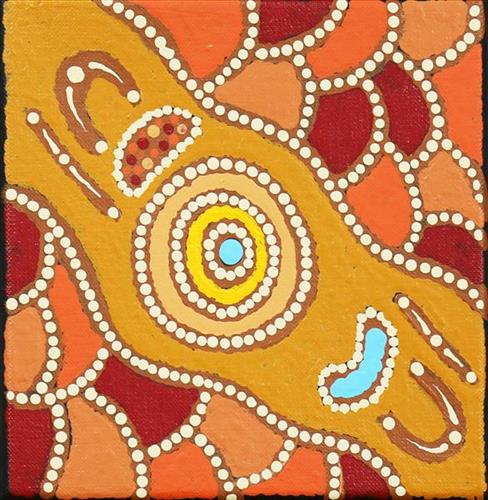
Women dancing, and the skirts they are wearing, made from their woven hair. The patterning that feature in this painting represents the swirling hair-string skirts worn by the Dancing Women Ancestors during ceremonies when women reaffirm their connections to the each of the Women’s Tjukurrpa through dance and song. The hair-string skirts are woven by the women from their own hair or that of their family using a simple spindle made of two sticks and are shown as a complex pattern of lines. The works are neat and well ordered, but free flowing, filling the canvas with the energetic forms of the women dancing in their skirts. The impact of the work mesmerises, just as the ceremonial performance works its magic. The artwork reveals both bodies moving and the inner or spiritual power, the essence of cultural identity.
Aboriginal women gathering at ceremonial or meeting places. All the women are painting and gathering together with food to prepare for ceremony. Songs and dances are exchanged often at large ceremonial gatherings when many people gather together and when trade goods are also exchanged. These gatherings often occur at the time and place when there is plenty of food. Ceremony is the underlying basis of Aboriginal song, music, dance and visual arts. Ceremony contains many significant elements some of which are specifically related to the movements and activities of Ancestral Tjukurrpa Women.

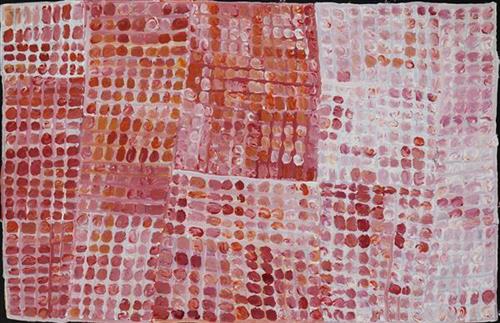
‘This is Petermann Range near Kaltukatjara – that’s Docker River [Community]. Puta Puta, Tjunti, Muliati. This is my father’s Country’.
Carbiene’s father was Snowy McDonald. He, like many other Pintupi-Pitjantjatjara people eventually moved east and north to refuges such as the Lutheran Mission at Ernabella, and Areyonga, during difficult drought times about 60-70 years ago. Some even ended up in Papunya once it opened as a Government Reserve in the early 1960s, as was the case of Carbiene’s father.
The shapes Carbiene paints represent an abstracted form of a series of important waterholes through the Petermann Ranges. Some of these sacred places now also have small Family Outstations or Homelands established nearby. For example, Tjunti is the name of a family outstation named for a soakage where the Hull River cuts through the Petermann Ranges. This is where Lasseter took refuge during his ill-fated expedition in search of gold. The cave he was found in near Tjunti is called Kuḻpi Tjuntinya (now commonly called Lasseter’s Cave in English).
The Petermann Ranges have now been designated an area of Conservation significance and the government work closely with local families in managing the area.
Carbiene is a Papunya Tjupi artist, having joined Papunya Tjupi Art Centre in 2018 and launching his career along with a cohort of emerging young male artists. Papunya is 250km West of Alice Springs, and when Carbiene visits Alice Springs he paints with Tangentyere Artists. Tangentyere Artists and Papunya Tjupi have a good working relationship, with several artists from each art centre coming from the same families. Tangentyere Artists’ figurative painter Betty Conway is Carbiene’s Aunty and Carbiene stops at Betty’s when in town.

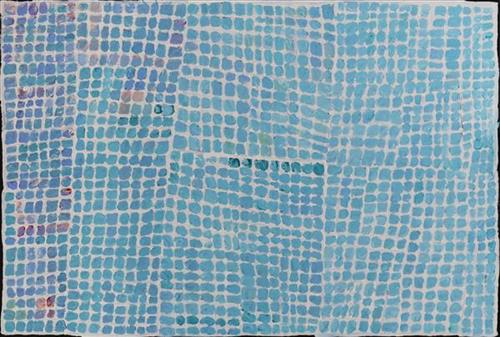
‘This is Petermann Range near Kaltukatjara – that’s Docker River [Community]. Puta Puta, Tjunti, Muliati. This is my father’s Country’.
Carbiene’s father was Snowy McDonald. He, like many other Pintupi-Pitjantjatjara people eventually moved east and north to refuges such as the Lutheran Mission at Ernabella, and Areyonga, during difficult drought times about 60-70 years ago. Some even ended up in Papunya once it opened as a Government Reserve in the early 1960s, as was the case of Carbiene’s father.
The shapes Carbiene paints represent an abstracted form of a series of important waterholes through the Petermann Ranges. Some of these sacred places now also have small Family Outstations or Homelands established nearby. For example, Tjunti is the name of a family outstation named for a soakage where the Hull River cuts through the Petermann Ranges. This is where Lasseter took refuge during his ill-fated expedition in search of gold. The cave he was found in near Tjunti is called Kuḻpi Tjuntinya (now commonly called Lasseter’s Cave in English).
The Petermann Ranges have now been designated an area of Conservation significance and the government work closely with local families in managing the area.
Carbiene is a Papunya Tjupi artist, having joined Papunya Tjupi Art Centre in 2018 and launching his career along with a cohort of emerging young male artists. Papunya is 250km West of Alice Springs, and when Carbiene visits Alice Springs he paints with Tangentyere Artists. Tangentyere Artists and Papunya Tjupi have a good working relationship, with several artists from each art centre coming from the same families. Tangentyere Artists’ figurative painter Betty Conway is Carbiene’s Aunty and Carbiene stops at Betty’s when in town.

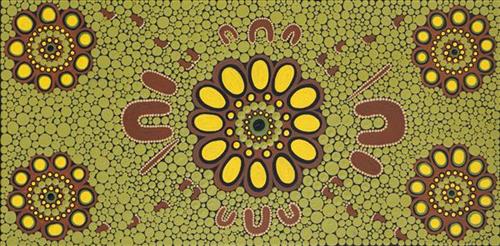
Women planning their dig for Honey Ants. Honey Ants hang from the ceiling of chambers their family dig out of the earth. The tunnels into the chambers are long and complex. That means the Honey Ants have to be tracked, and then the women use informed guesswork based on experience to decide where to dig. The process can take hours of very hard work, but the ladies are always completely rewarded when they find those delicious ants whose abdomens are full of sweet honey.