111582392245


Puntawarri

“All around is sandhills and lakes on every side. You can see the grass, but the lakes are all dry. In the middle is Puntawarri waterhole. That’s the jila (snake) place, two jila. They nyupa (spouses), they darlings, man and woman. They sleeping near to Puntawarri. It’s a hole in the ground- that jila will come out of the ground and all the dust will go everywhere. All the dust going everywhere, the dust that flies up when the jila flies up out of its hole. The jila isn’t in that place anymore. It’s gone now but that jila used to stop there.” 

 – Helen Dale Samson

Puntawarri is an important cultural area located on the middle stretches of the Canning Stock Route and east of the Jigalong Mission (now Jigalong Aboriginal community). It is also the site of an abandoned community, a waterhole, creek and lake. Puntawarri’s close proximity to Jigalong Mission made it a popular site for Martu to visit during the ‘mission days’. Dale was born at Jigalong Mission, and continues to live in the community now located there today. Though she grew up in the dormitory at Jigalong, she spent her weekends and holidays in the bush, camping at sites such as Puntawarri with her extended family. Once married, she lived around Puntawarri, walking and hunting in the surrounding Country.

For many Martu, like Dale’s family, Jigalong Mission was the site where their pujiman (traditional, desert dwelling) lifestyle came to an end from the late 1940s as they transitioned to a life as stockmen and women working in cattle stations in the Pilbara region and beyond. In the wake of the extreme and prolonged drought of the 1960s, the last of the remaining pujimanpa (desert dwellers) were forced to move to missions like Jigalong, where a supply of food and water was assured. There, many Martu were reunited with family members that had already moved in from the desert.

The waterhole at Puntawarri is said to be populated by several kinds of ancestral jila, as referred to by Dale in her account. However the site is best known for its association with the Ngayurnangalku, fearsome ancestral cannibal beings. During the Jukurrpa (Dreaming) the Ngayurnangalku came together from all over the desert, first stopping near Puntawarri on their travels to Kumpupirntily (Kumpupintily, Lake Disappointment). At Kumpupirntily, they had a big meeting to debate whether or not they would continue to live as cannibals, and eventually came to the decision to stop eating people. That night, a female baby cannibal was born to the eastern Ngayurnangalku on the red sandhills at Puntawarri, where she continues to live today as the ‘big mummy’ Ngayurnangalku. Following protocol, the baby also had to be consulted by the group. She determined that the Ngayurnangalku should continue to eat people. Her decision divided the group, and from this point the group from the east continued to live as ‘bad’ cannibals at Kumpupirntily, while the group from the west became ‘good’, thereafter consuming only animals.
111582392244


Untitled

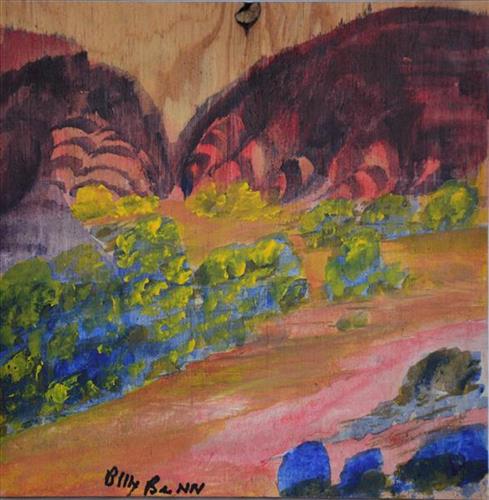
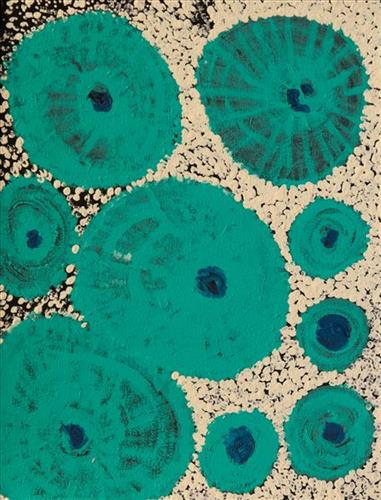
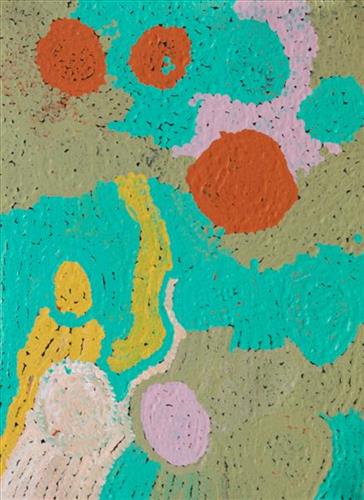
This is Ngamaru’s Country- her ‘ngurra’ (home Country, camp). People identify with their ngurra in terms of specific rights and responsibilities, and the possession of intimate knowledge of the physical and cultural properties of one’s Country. Painting ngurra, and in so doing sharing the Jukurrpa (Dreaming) stories and physical characteristics of that place, has today become an important means of cultural maintenance. 

Ngamaru’s ngurra encompasses the Country that she and her family walked in the pujiman (traditional, desert dwelling) era. At this time Ngamaru travelled nomadically with her own and other family groups, most notably the Biljabu and Whyoulter families. 

Ngamaru was born at Martilirri (Canning Stock Route Well 22). She grew up, walked and hunted primarily around Wikiri, Rarrki (Canning Stock Route Well 27), Wantili (Warntili, Canning Stock Route Well 25), Pitu, Nyilangkurr and Nyinyari. She continued to live nomadically before eventually deciding to move to Jigalong Mission along with many other relatives following an extreme and prolonged drought in the 1960s. 

Portrayed in this work are features of Ngamaru’s ngurra, such as the striking salt lakes, dominant permanent red tali (sandhills), warta (trees, vegetation), and the individually named water sources Ngamaru and her family camped at. These include Julyjarru, Juntiwa, Jaturti, Karanyal (Canning Stock Route Well 20), Martilirri (Canning Stock Route Well 22), Kaalpa (Canning Stock Route Well 23), Kartarru (Blue Hills Station, Canning Stock Route Well 24), Wantili (Canning Stock Route Well 25, Tiwa (Canning Stock Route Well 26), Rarrki (Canning Stock Route Well 27), Warla-warla (Canning Stock Route Well 31), Kulilu, Kunapila, Nyilangkurr, Parnngurr, Pitu, Purn, Wangkakalu, Wikiri, Yiranang, and Yulpu. Rock holes, waterholes, soaks and springs were all extremely important sites for Martu people during the pujiman period, and are generally depicted with circular forms. 

The encyclopaedic knowledge of the location, quality and seasonal availability of the hundreds of water bodies found in one’s Country sustained Martu as they travelled across their Country, hunting and gathering, visiting family, and fulfilling ceremonial obligations. They would traverse very large distances annually, visiting specific areas in the dry and wet season depending on the availability of water and the corresponding cycles of plant and animal life on which hunting and gathering bush tucker was reliant. As they travelled and hunted they would also burn areas of Country, generating a greater diversity of plant and animal life.

377810582392110


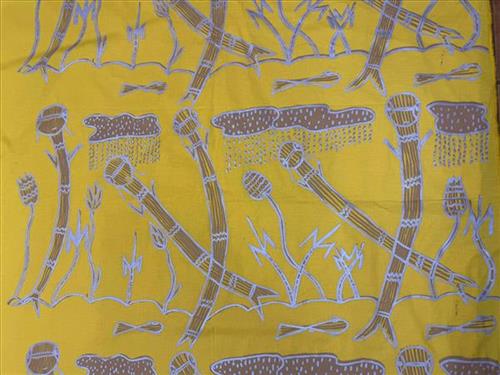
Yawkyawk la Kunronj (freshwater mermaid) 2005

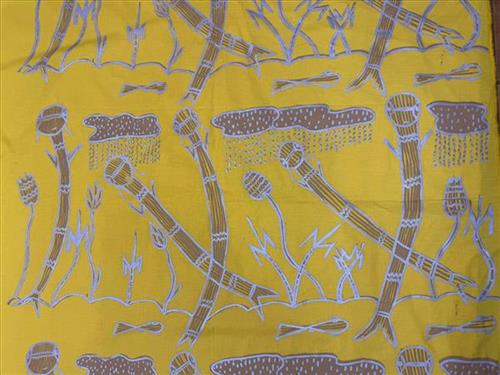
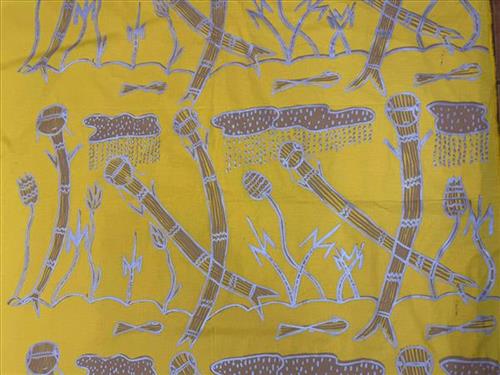
This screen print was created by the young Jennifer Wurrkidj, one of the most prolific artists at Bábbarra Women’s Centre. This design was re exposed onto screen after Kamanj passed away. Her sister Deborah Wurrkidj talks about this design.


At that time the children were all going to homelands school. The design shows too many yawkyawk in the billabong at Barridjowkeng a very sacred Yirridjidja site for Kuninjku people.

The design shows  kundayarr (pandanus) and wayuk (waterlily) around the billabong.

Our grandfather on our mothers side used to live at this site and they used to drink the water from this billabong. There is now an Outstation located at this site. 

This scene shows wet season as we can see by the mandjewk – (heavy rainclouds). The yawkyawk love the sound of the rain. 

Yawkyawk are young girls but they are spirits from kunred (country) that have fish tails. 

377810582392109


Yawkyawk la Kunronj (freshwater mermaid) 2005

This screen print was created by the young Jennifer Wurrkidj, one of the most prolific artists at Bábbarra Women’s Centre. This design was re exposed onto screen after Kamanj passed away. Her sister Deborah Wurrkidj talks about this design.


At that time the children were all going to homelands school. The design shows too many yawkyawk in the billabong at Barridjowkeng a very sacred Yirridjidja site for Kuninjku people.

The design shows  kundayarr (pandanus) and wayuk (waterlily) around the billabong.

Our grandfather on our mothers side used to live at this site and they used to drink the water from this billabong. There is now an Outstation located at this site. 

This scene shows wet season as we can see by the mandjewk – (heavy rainclouds). The yawkyawk love the sound of the rain. 

Yawkyawk are young girls but they are spirits from kunred (country) that have fish tails. 

377810582392103


Yawkyawk la Kunronj (freshwater mermaid) 2005

This screen print was created by the young Jennifer Wurrkidj, one of the most prolific artists at Bábbarra Women’s Centre. This design was re exposed onto screen after Kamanj passed away. Her sister Deborah Wurrkidj talks about this design.


At that time the children were all going to homelands school. The design shows too many yawkyawk in the billabong at Barridjowkeng a very sacred Yirridjidja site for Kuninjku people.

The design shows  kundayarr (pandanus) and wayuk (waterlily) around the billabong.

Our grandfather on our mothers side used to live at this site and they used to drink the water from this billabong. There is now an Outstation located at this site. 

This scene shows wet season as we can see by the mandjewk – (heavy rainclouds). The yawkyawk love the sound of the rain. 

Yawkyawk are young girls but they are spirits from kunred (country) that have fish tails. 

377810582392102


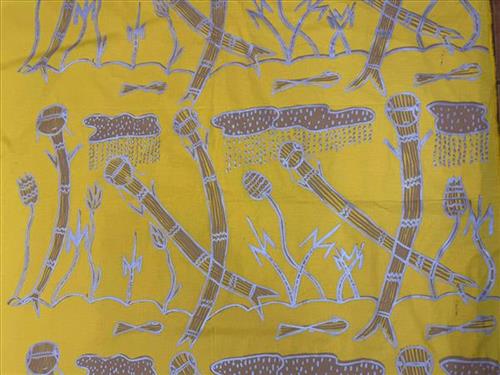
Yawkyawk la Kunronj (freshwater mermaid) 2005

This screen print was created by the young Jennifer Wurrkidj, one of the most prolific artists at Bábbarra Women’s Centre. This design was re exposed onto screen after Kamanj passed away. Her sister Deborah Wurrkidj talks about this design.


At that time the children were all going to homelands school. The design shows too many yawkyawk in the billabong at Barridjowkeng a very sacred Yirridjidja site for Kuninjku people.

The design shows  kundayarr (pandanus) and wayuk (waterlily) around the billabong.

Our grandfather on our mothers side used to live at this site and they used to drink the water from this billabong. There is now an Outstation located at this site. 

This scene shows wet season as we can see by the mandjewk – (heavy rainclouds). The yawkyawk love the sound of the rain. 

Yawkyawk are young girls but they are spirits from kunred (country) that have fish tails.