116182380857


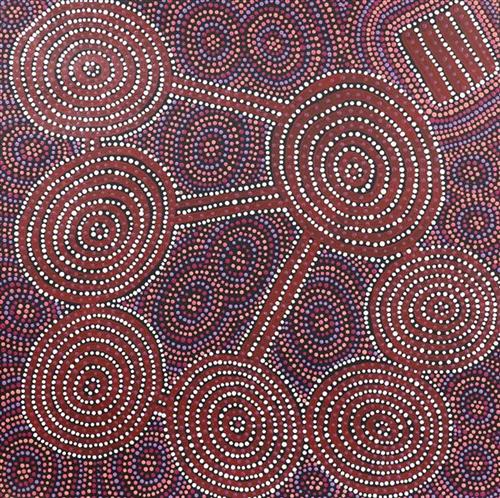
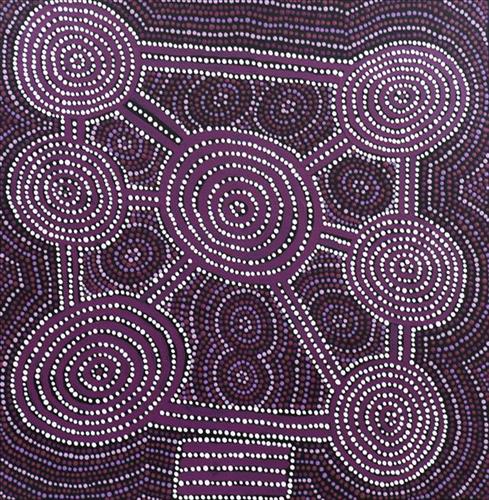
Wardapi Jukurrpa

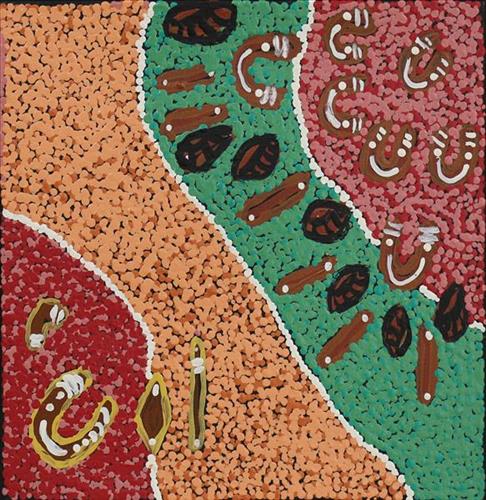
‘This painting is about the way women hunt Wardapi – that sand goanna. He digs holes in the dunes, makes his nest deep inside. Many of the holes all join up. Women hunt Wardapi in the dunes by digging out the holes. Sometimes cover one, and Wardapi runs out other one. Need to hunt him together. Find all the holes. Dig them at the same time. Someone going to get him that way.’

The Wardapi Jukurrpa [Varanus Gouldii Goanna] belongs to the Spencer Sisters. It comes from Yarripilangku [aka Yinyiripalangu], south-west of Yuendumu. A group of Warlpiri Karnta [women] are sitting down in a circle when a Japangardi Wati [man] from Puturlu [Mt Theo], called Wamaru came upon them. He wants to take one of them, named Yurlkurinyi, of Nungarrayi skin, which is the wrong skin for him. He takes the Nungarrayi woman up a hill, where they make love. In response, the earth on top of the hill turns to Ngunjungunju [white ochre], and yellow and red ochre. The yellow is for Karnta and the red for Wati. The ochre is used by Warlpiri people for love magic and ceremonial decoration. The Wati turns all the Karnta and himself into Wardapi, aka Varanus Gouldii goannas. This Jukurrpa belongs to the Napaljarri/Japaljarri and Nungarrayi /Jungarrayi subsections, and the Japanangka/Napanangka, Japangardi/Napangardi subsections of Puturlu. The women are often represented by ‘U’ shapes. Concentric circles may illustrate Wardapi holes, or their droppings left behind them, and Wardapi tracks are usually represented by ‘W’ shapes and wavy lines.

116182380836


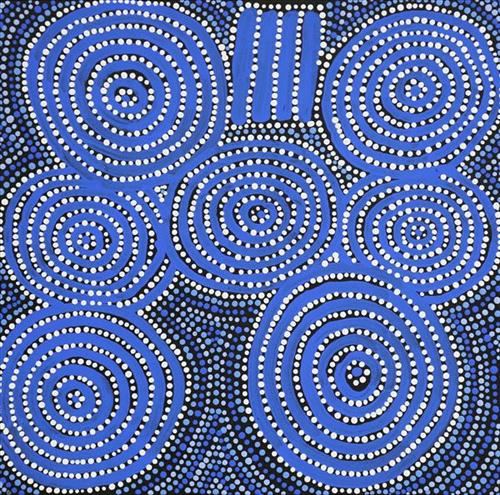
Wardapi Jukurrpa

‘This painting is about the way women hunt Wardapi – that sand goanna. He digs holes in the dunes, makes his nest deep inside. Many of the holes all join up. Women hunt Wardapi in the dunes by digging out the holes. Sometimes cover one, and Wardapi runs out other one. Need to hunt him together. Find all the holes. Dig them at the same time. Someone going to get him that way.’

The Wardapi Jukurrpa [Varanus Gouldii Goanna] belongs to the Spencer Sisters. It comes from Yarripilangku [aka Yinyiripalangu], south-west of Yuendumu. A group of Warlpiri Karnta [women] are sitting down in a circle when a Japangardi Wati [man] from Puturlu [Mt Theo], called Wamaru came upon them. He wants to take one of them, named Yurlkurinyi, of Nungarrayi skin, which is the wrong skin for him. He takes the Nungarrayi woman up a hill, where they make love. In response, the earth on top of the hill turns to Ngunjungunju [white ochre], and yellow and red ochre. The yellow is for Karnta and the red for Wati. The ochre is used by Warlpiri people for love magic and ceremonial decoration. The Wati turns all the Karnta and himself into Wardapi, aka Varanus Gouldii goannas. This Jukurrpa belongs to the Napaljarri/Japaljarri and Nungarrayi /Jungarrayi subsections, and the Japanangka/Napanangka, Japangardi/Napangardi subsections of Puturlu. The women are often represented by ‘U’ shapes. Concentric circles may illustrate Wardapi holes, or their droppings left behind them, and Wardapi tracks are usually represented by ‘W’ shapes and wavy lines.

116182381128


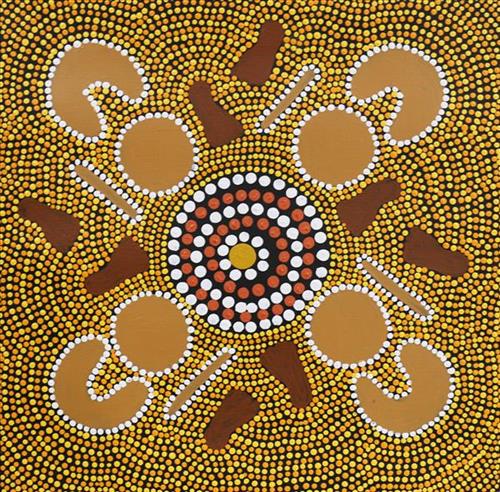
Docker River

Great Great grandfather went to Docker River. He sat down and saw a fire coming, bushfire, willy willy came, he go inside the water. Wanampi, the rainbow serpent, lives at the bottom. This is a story I heard. 

224982382212


Nyungawarra Patjarr

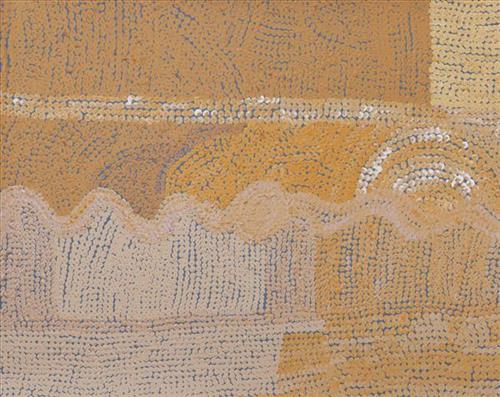
I am painting Yankuntjuntju. It is my grandmother’s country, close to Patjarr. There’s a rockhole close. I like to paint my story, my grandfather’s, my grandmother’s. My father’s mother passed away at that rockhole, that is why I’m painting. My grandmother had two sons, two daughters. [She] passed away right there, rockhole side. I also paint Karrku, that’s my nyal-ku Tjukurrpa, (my dreaming) Porcupine dreaming in that place. I think about these stories and my family when I am painting. Proper story. Painting keeps my family, and these stories close to me.

116182382197


Kungkarangkalpa

Seven Sisters’ travels of Central Australia. Wati Nyiru is a lust-filled shape shifting man who seeks to seduce the Seven Sisters and take them as his wives. But he is an untrustworthy tricky man and all the sisters are deeply afraid of him. They travel across the country locked in a battle of wits. Wati Nyiru is smart, but so is the eldest Sister. They each have their stories, their songs, and their dances. Each knows how to read the country they move through, their bush tucker, their Law.  The Sisters flee with Wati Nyiru in perpetual pursuit. Wati Nyiru is a master of disguise and uses magic to try to trick the sisters, transforming into highly valued food: the most tempting Bush tomatoes, and the most beautiful Ili (Wild Fig) tree and delicious Wayanu (Quandong tree). The sisters pluck the fruit, but when they taste it they realise that it Nyiru tricking them again. They forever travel through sand hill country hoping they have left him behind. However, Wati Nyiru uses his shape shifting so he is ahead of them, anticipating his next opportunity to seduce and steal one of the younger sisters away.

Eventually, so desperate to escape him, the Sisters transform into fire and flee into the Milky Way, where they are the Constellation Pleiades, now safely watching over all the women on earth. Wati-Nyiru follows them north, the lone star Orion, still pursuing, but unable to harm the Kungkarrakalpa. You will find them in the night sky, a small cluster of seven stars next to the Milky Way and Nyiru is the Morning Star that gets up early each morning to look for them. The Kungkarrakalpa Tjukurrpa creates links between all Australian women’s secret knowledge and Law about sacred places, knowledge about hunting and bush tucker species, and about creating and using various Punu [wooden artefacts]. The Minyma [mature women] often sing and dance the section of the Inma cycle specific to the Tjukurrpa of the place where they camp. When they meet other women at ceremony they paint ritualised patterns on their bodies with ochres and perform the epic Inma cycles [ceremonial song and dance] associated with these Tjukurrpa, each group holding a different section of the long and complex narrative.

116182382169


Wardapi Jukurrpa

‘This painting is about the way women hunt Wardapi – that sand goanna. He digs holes in the dunes, makes his nest deep inside. Many of the holes all join up. Women hunt Wardapi in the dunes by digging out the holes. Sometimes cover one, and Wardapi runs out other one. Need to hunt him together. Find all the holes. Dig them at the same time. Someone going to get him that way.’

The Wardapi Jukurrpa [Varanus Gouldii Goanna] belongs to the Spencer Sisters. It comes from Yarripilangku [aka Yinyiripalangu], south-west of Yuendumu. A group of Warlpiri Karnta [women] are sitting down in a circle when a Japangardi Wati [man] from Puturlu [Mt Theo], called Wamaru came upon them. He wants to take one of them, named Yurlkurinyi, of Nungarrayi skin, which is the wrong skin for him. He takes the Nungarrayi woman up a hill, where they make love. In response, the earth on top of the hill turns to Ngunjungunju [white ochre], and yellow and red ochre. The yellow is for Karnta and the red for Wati. The ochre is used by Warlpiri people for love magic and ceremonial decoration. The Wati turns all the Karnta and himself into Wardapi, aka Varanus Gouldii goannas. This Jukurrpa belongs to the Napaljarri/Japaljarri and Nungarrayi /Jungarrayi subsections, and the Japanangka/Napanangka, Japangardi/Napangardi subsections of Puturlu. The women are often represented by ‘U’ shapes. Concentric circles may illustrate Wardapi holes, or their droppings left behind them, and Wardapi tracks are usually represented by ‘W’ shapes and wavy lines.
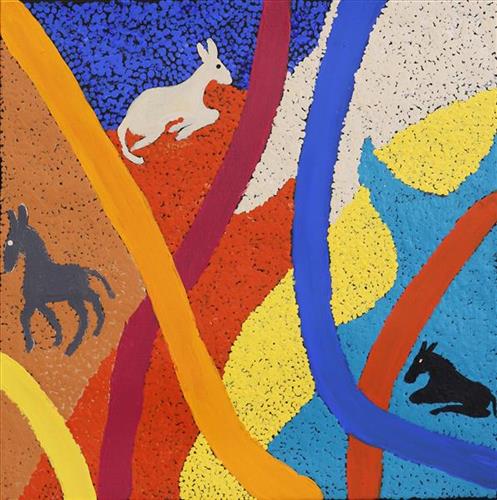
116182382060


Women Collecting Bush Food

Women talking about collecting bush food – where the best places are and the best times, whether seasonal or dependent on rain events – All the women sit with their digging sticks and piti’s [coolamons] around the hearth to talk about these aspects of collecting bush food.

220982383654


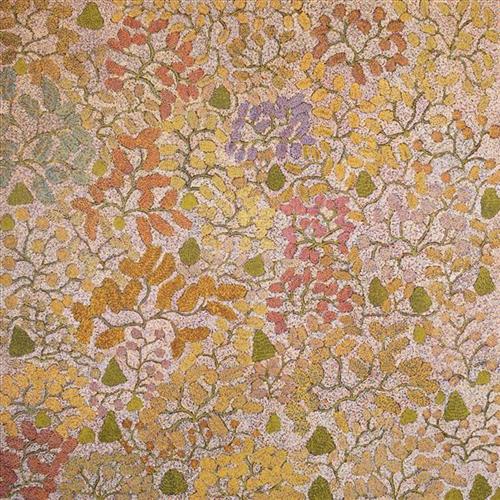
Joyrene Ngwarraye Holmes – Wildflowers

When I go hunting for aker arlkerl (echidna) around the sandhills of Ampilatwatja I always spot the wild flowers and honey flowers.  We tap the Bankias against our hand and get the honey, it is sweet to taste.

 After the rain and bushfires all the new flowers pop up around me. My favourite time of the year is winter when it is cooler to walk and hunt. 

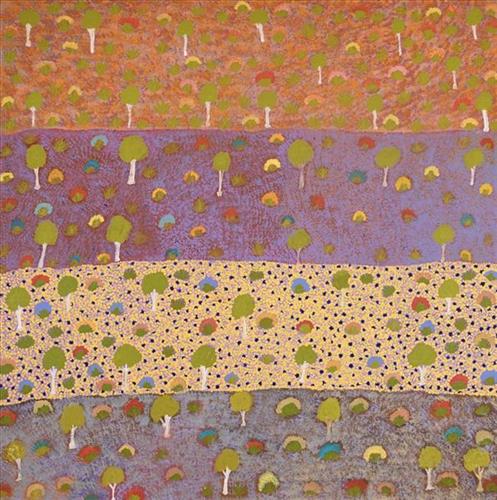
The community of Ampilatwatja made a conscious decision not to paint altyerr (dreaming stories). The artists paint their country where those stories sit.


220982383936


Rita Pitjara Beasley – My Father’s Country

“This is my Father’s country.

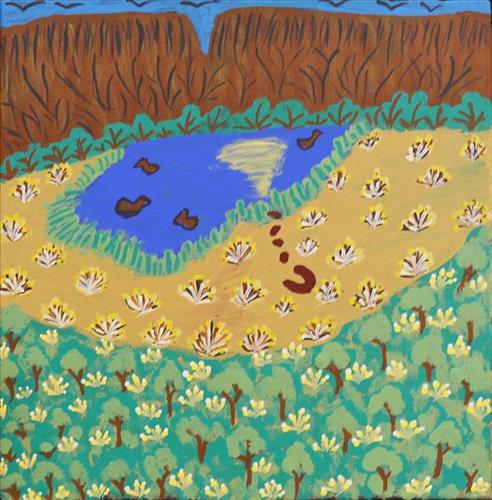
This place is our hunting place. I always go with my daughters and their children, I show them this place and teach them about the swampy country. We hunt for goannas, bush potato, bush tomato and after the big rain the bush medicine is picked and the roots are dug up to be used.

It is important as my mother taught me this and now I teach my family.”

The community of Ampilatwatja made a conscious decision not to paint altyerr (dreaming stories). The artists paint their country where those stories sit.