115682396993


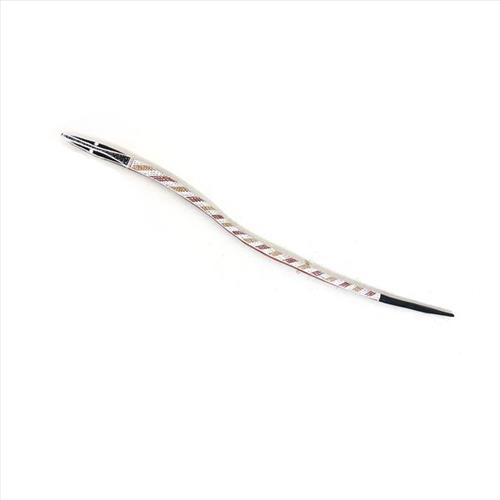
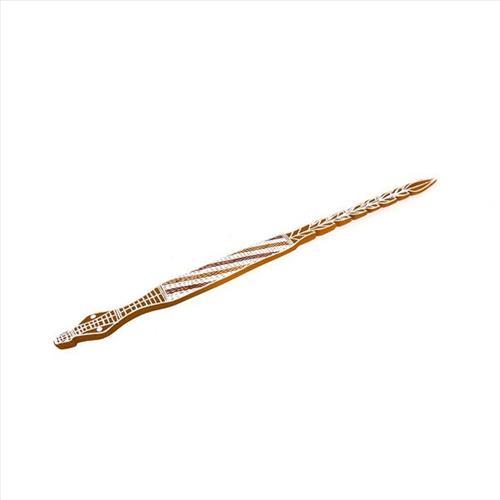
Bapi (snake)

Aboriginal art in Ramingining, Central Arnhem Land is commonly illustrated through designs and images of animals, plants, and landscape. These motifs commonly reflect the artists ancestral inheritance and their dreamings and are referred to as totems. 

This snake has been sculpted by Barnabus Smith. 


115682396992


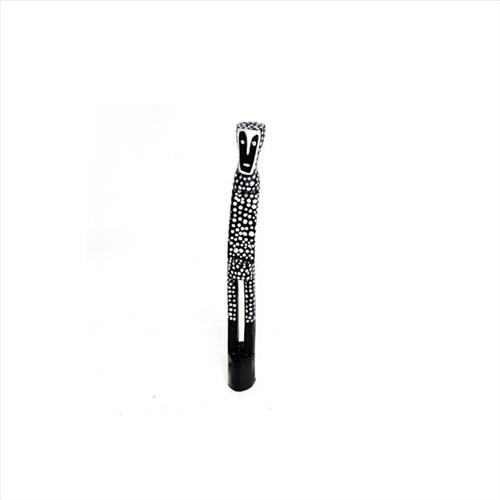
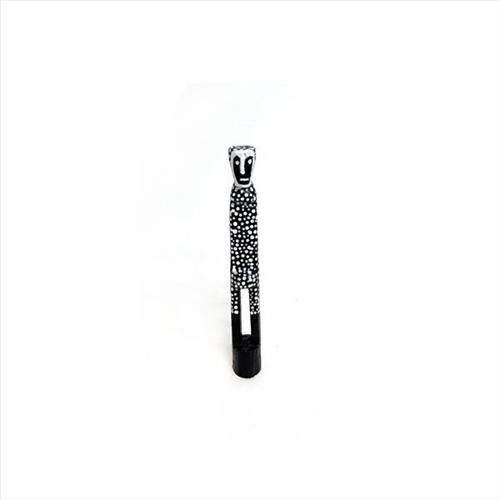
Warraburnburn (spirit)

Like people, warraburnburn live in family groups. Though they cannot be seen, they can sometimes be heard calling out to one another as they move across the country to hunt. They also have the ability to communicate internally with people, warning them when strangers enter their land. Warraburnburn know the country intimately and can be both protective and dangerous. Some may mislead people, turning the land over to make it confusing and unfamiliar, while others guide people to safety.

115682396991


Warraburnburn (spirit)

Like people, warraburnburn live in family groups. Though they cannot be seen, they can sometimes be heard calling out to one another as they move across the country to hunt. They also have the ability to communicate internally with people, warning them when strangers enter their land. Warraburnburn know the country intimately and can be both protective and dangerous. Some may mislead people, turning the land over to make it confusing and unfamiliar, while others guide people to safety.

115682396977


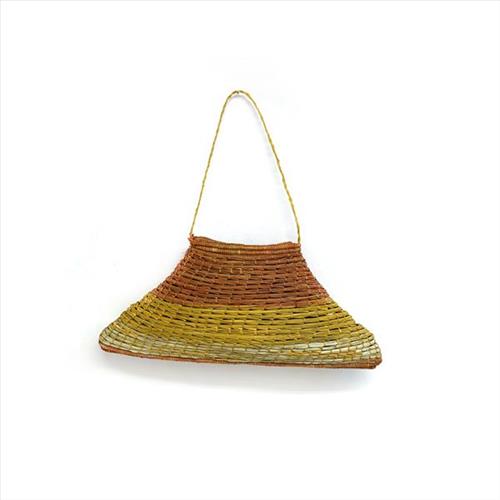
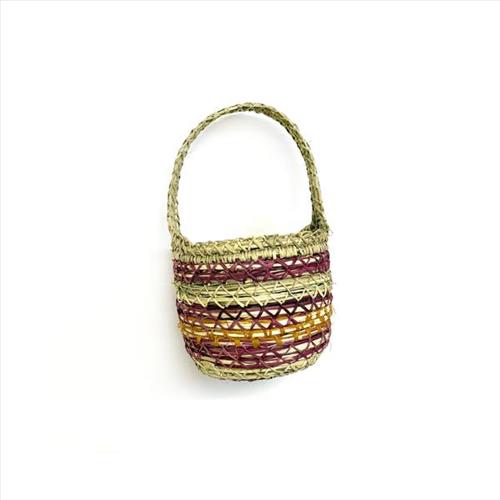
Bathi (Pandanus Basket)

Yolŋu weavers of Arnhem Land create utilitarian, ceremonial, and decorative pieces using naturally sourced materials. This Bathi (Pandanus Basket) is made from young Pandanus spiralis leaves, harvested with a wooden hook, stripped of prickles, and dried to create strong, resilient fibres. These fibres are then twisted, coiled, or woven using various techniques to produce both functional and decorative baskets.

Typically, Bathi are made using a coiling technique which was adapted from techniques used by Indigenous women throughout Southeast Australia. Introduced to Arnhem Land weavers in the 1930’s as Missionaries began commissioning pieces in this style.

Bula’bula weavers exclusively use natural dyes, derived from locally sourced roots, leaves and grasses. These pigments are extracted and infused into pandanus fibres by boiling over an open fire, producing the rich, vibrant colours characteristic of contemporary Yolŋu weavings.

115682396964


Bathi (Pandanus Basket)

Yolŋu weavers of Arnhem Land create utilitarian, ceremonial, and decorative pieces using naturally sourced materials. This Bathi (Pandanus Basket) is made from young Pandanus spiralis leaves, harvested with a wooden hook, stripped of prickles, and dried to create strong, resilient fibres. These fibres are then twisted, coiled, or woven using various techniques to produce both functional and decorative baskets.

Typically, Bathi are made using a coiling technique which was adapted from techniques used by Indigenous women throughout Southeast Australia. Introduced to Arnhem Land weavers in the 1930’s as Missionaries began commissioning pieces in this style.

Bula’bula weavers exclusively use natural dyes, derived from locally sourced roots, leaves and grasses. These pigments are extracted and infused into pandanus fibres by boiling over an open fire, producing the rich, vibrant colours characteristic of contemporary Yolŋu weavings.

220982397182


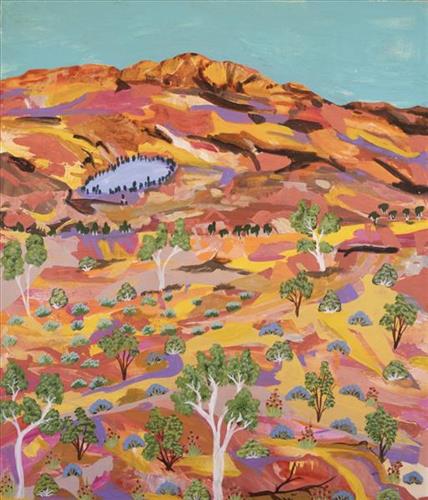
Elizabeth Ngwarraye Bonney – My Grandmothers Country

I still hunt my Grand Mothers country for goanna, bush medicine and yams.

I hunt all year round, hunting and walking through the country makes me happy.  When I look at the distant hills I can feel my grandmother.  Bush flowers are everywhere.

Painting and printing my grandmother’s country reminds about those times.

220982397181


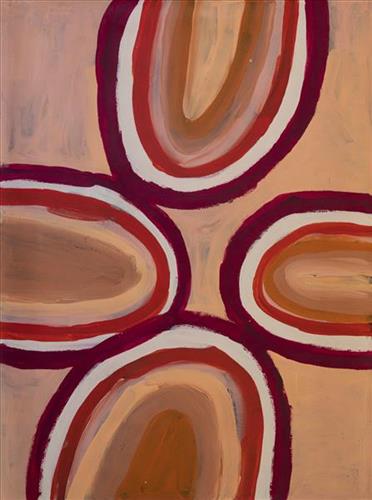
Maisie Petyarre Bundey – Anhelengkw (Emu) Dreaming

Anhelengkw (emu) dreaming is the breast body painting depicting the story of the mother emu who runs away and leaves the father emu to look after the eggs until they hatch, he then raises the chicks.

This story is passed down through Maisie’s family and celebrated in dance.

111582397187


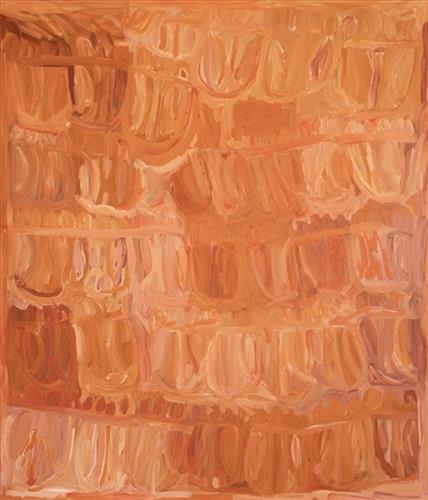
Tuwa (sandhills) in Puntawarri

“I do tuwa (sandhill) in my own style because that’s our Country. That’s a sandhill, that’s the Dreaming- the Jukurrpa. That’s our culture.

They stay there and we go through the sandhills at Puntawarri in the car. We go first tuwa, then the second tuwa, looking for the waterholes. Go up, up, up- ‘nother tuwa, ‘nother tuwa.

Long time [ago] in Puntawarri, when I was a little girl [with] my Nana and Pop [Dadda Samson (dec.) and Yanjimi Peter Rowlands (dec.)] we went climbing up the sandhill. And when I went up my Nana and Pop were at the bottom under a tree and I came down running then rolling, rolling right down to the ground! But I was ok- he right!”

– Judith Anya Samson

Puntawarri is an important cultural area located on the middle stretches of the Canning Stock Route and east of the Jigalong Mission (now Jigalong Aboriginal community), where Anya grew up with her grandmother and renowned Martumili Artist, Dadda Samson (dec.). Puntawarri is also the site of an abandoned community, a waterhole, creek and lake. Puntawarri’s close proximity to Jigalong Mission made it a popular site for Martu to visit during the ‘mission days’. While growing up at Jigalong Mission in the 1960’s, Dadda would return to Puntawarri every weekend to hunt and camp. 

For many Martu, like Anya’s family, Jigalong Mission was the site where their pujiman (traditional, desert dwelling) lifestyle came to an end from the late 1940s as they transitioned to a life as stockmen and women working in cattle stations in the Pilbara region and beyond. In the wake of the extreme and prolonged drought of the 1960s, the last of the remaining pujimanpa (desert dwellers) were forced to move to missions like Jigalong, where a supply of food and water was assured. There, many Martu were reunited with family members that had already moved in from the desert.

The traditional lands of the Martu people encompass the Great Sandy Desert and Rudall River regions of Western Australia, an enormous tract dominated by distinctive red tali, or tuwa (sandhills). These sandhills present an unforgiving landscape; sparse vegetation covers a seemingly never ending expanse of dunes, and yet these lands and the location of resources within them was known intimately by its pujiman inhabitants.
 

220982397563


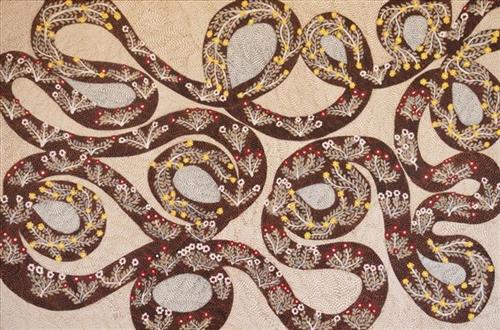
Kathleen Nanima Rambler – Brown Snake Creek

When you fly over my country you see when the water starts to dry up in the creeks. Looking down you can see the drying river beds running like brown snakes slithering through the land

115682397775


Baru Dhawu (Crocodile Story)

Baru (the crocodile man), was from the Gumatj clan. People usually call him Gurdu Gurdu or Baru which means crocodile. He lived his life at a place called Yirrkala. Living near him were other people, and when Baru didn’t have enough to eat he began to kill and eat these other people. After a while others noticed that some people were missing. When Baru went to the toilet, the people could smell this strong smell, so they knew that he ate the other people. Some men went to get help and they took message sticks to the other tribes. Some were sending smoke signals. When they came to Baru’s camp they started to spear him in the left side of his ribs. He dropped into the fire and burnt his left hand and maybe his right hand. He then ran into the bush and yelled to his countrymen – the animals, birds and fish that live on the land and in the sea. He stopped and he named the tribes and clans and also the places until he came to a place called Gamarru/Guyurru. There he took a rest and said to himself “This is where I stop and call this place Gamarru/Guyurru”. Baru, still in pain from the fire, then jumped into the water and turned himself into a crocodile. The fire left scars on his back. Baru paintings belong to Gumatj and Warrawarra and also the Marpi clan. This painting is used at death ceremonies or initiations and it normally is painted on the belly, which means the person the design is painted on is part of Gurdu Gurdu (the crocodile people).