220982408523


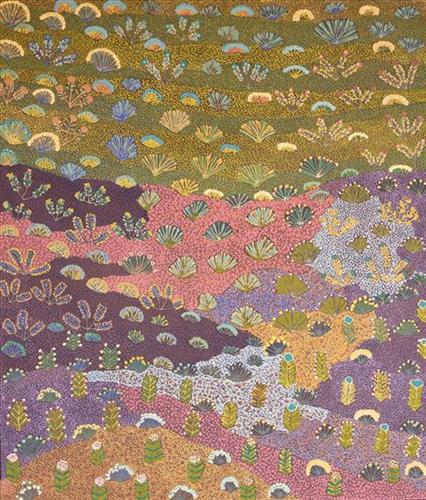
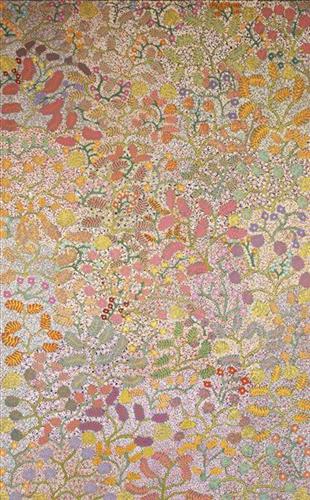
Joyrene Ngwarraye Holmes – Wildflowers

When I go hunting for aker arlkerl (echidna) around the sandhills of Ampilatwatja I always spot the wild flowers and honey flowers.  We tap the Bankias against our hand and get the honey, it is sweet to taste.

 After the rain and bushfires all the new flowers pop up around me. My favourite time of the year is winter when it is cooler to walk and hunt. 

The community of Ampilatwatja made a conscious decision not to paint altyerr (dreaming stories). The artists paint their country where those stories sit.


220982409823


Julieanne Ngwarraye Morton – My Country, My Bush Medicine

My Mother, Lilly Kemarre, taught me to paint. She likes to paint her Mother’s and Father’s country from the old days, when they used to live off of the land.

The landscape changes during the different seasons in the year. I paint the dried flowers and bushes from last season as well as the new plants that come after the rain. These plants have special meanings and uses for us. I have been taught how to read the country, and now I teach my children these skills.

Julieanne’s painting’s are inspired by her Mother’s stories of the old days, walking and living on their land, and also of her own experience of life out here in Alyawarr country.

115682409663


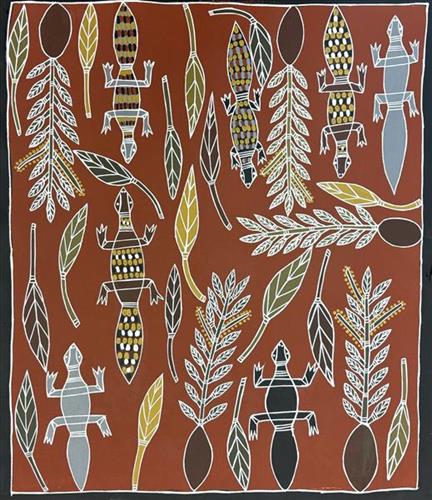
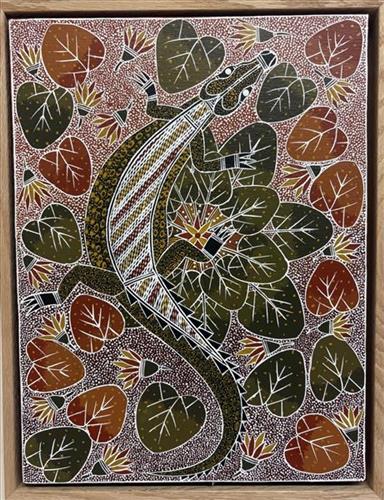
Northern Marbled Velvet Gecko (Oedura marmorata)

Aboriginal art in Ramingining, Central Arnhem Land is commonly illustrated through designs and images of animals, plants, and landscape. These motifs commonly reflect the artists ancestral inheritance and their dreamings and are referred to as totems.

For this painting, the artist has painted Northern Marbled Velvet Gecko (Oedura marmorata)

115682410117


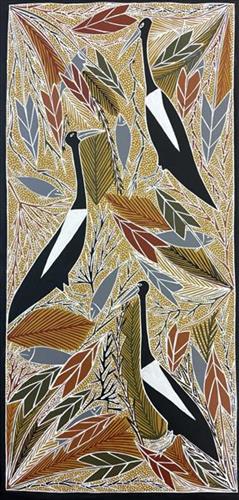
Gumang (Magpie Geese)

The Yolngu people of Arnhem Land originate from a spiritual source, fixed in a particular place in their land or the sea. These ‘Spiritual Reservoirs’ are often in the form of special waterholes made by Wangarr (Creative Beings) long ago close to the beginning of time.

The creator beings moved across the country side, shaping the land and implanting in each tract of country, the spiritual life force for the people who were to own it. These Creative Spirits took many forms. When they gave the land to each group they also gave songs, dances, ceremony, the associated laws and language. The Creation story for Ganalbingu people took place near the middle section of the Glyde River where it becomes the Goyder River. Their land, Ngaliyindi, sits astride the Arafura Swamp in Central Arnhem Land.

In this painting, the artist has depicted Gumang (magpie geese), which are sacred to the Ganalbingu people. To the east of the Arafura Swamp is a freshwater billabong which is said to have been made by the Goose Spirit and is in the shape of a goose nest. As a result, geese, their eggs and their nests are sacred.

115682410992


Bäru Dhäwu (Crocodile Story)

Bäru (the crocodile man), was from the Gumatj clan. People usually call him Gurdu Gurdu or Bäru which means crocodile. He lived his life at a place called Yirrkala. Living near him were other people, and when Bäru didn’t have enough to eat he began to kill and eat these other people. After a while others noticed that some people were missing. When Bäru went to the toilet, the people could smell this strong smell, so they knew that he ate the other people. Some men went to get help and they took message sticks to the other tribes. Some were sending smoke signals. When they came to Bäru’s camp they started to spear him in the left side of his ribs. He dropped into the fire and burnt his left hand and maybe his right hand. He then ran into the bush and yelled to his countrymen – the animals, birds and fish that live on the land and in the sea. He stopped and he named the tribes and clans and also the places until he came to a place called Gamarru/Guyurru. There he took a rest and said to himself “This is where I stop and call this place Gamarru/Guyurru”. Bäru, still in pain from the fire, then jumped into the water and turned himself into a crocodile. The fire left scars on his back. Bäru paintings belong to Gumatj and Warrawarra and also the Marpi clan. This painting is used at death ceremonies or initiations and it normally is painted on the belly, which means the person the design is painted on is part of Gurdu Gurdu (the crocodile people).

377816082414227


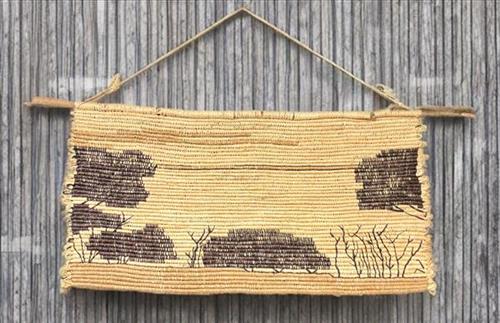
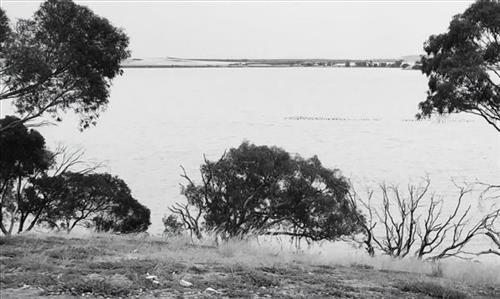
Lake Burrumbeet, Woven Memory

Lake Burrumbeet is a place many people return to — to camp, to gather, to rest beside the water. For generations, it has held stories of movement, pause, and connection. This woven work reflects those shared memories, translating a familiar landscape into fibre and line. It honours Lake Burrumbeet as a place of meeting, where water holds both personal moments and deeper histories within Country.

377810582414359


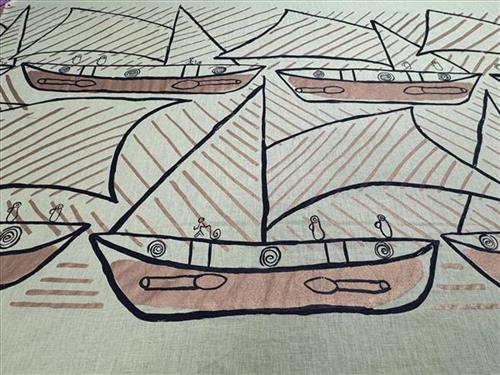
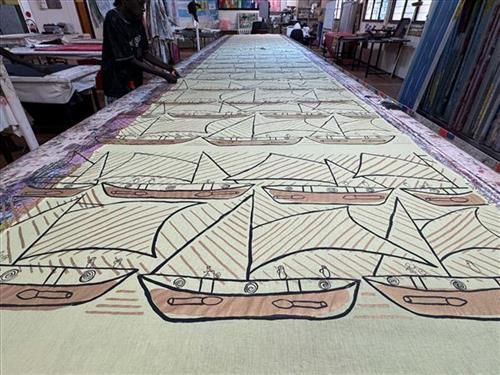
Makassan Boat with Bottles and Rope

“Wubbunj is our traditional canoe. This design is the old history story of how people came to live in this place we call Maningrida. Two old people were staying on the other side of the saltwater, in Narlarrambarr area. The old people slept in a paper bark shelter and hunted on the water using their canoe. A long time ago our people carved these canoes from the big paperbark trees. They had paddles with one person at the front, one at back, and other kids and passengers in the middle. Kunkot (paper bark) was used to make the sails which they would stand up and catch the wind.

One day these old people saw a new boat in their waters, which belonged to the Makassans (Indonesians). Those two old men saw the big Makassan boat coming in, and decided to paddle their canoe from Narlarrambarr to the other side (modern day Maningrida). We were scared of the Makassans, they gave us tobacco and tea, but they took many of our women.

In this design I have painted the Makassan’s rope, smoking pipe and the pottery vessels they bought with them on a boat. Our people had never seen these things before they bought them across from Indonesia.

When those two old people tasted that water at Maningrida from the Djomi spring, it was sweet freshwater and they decided to stay here. People here had no clothes in those time, we were just wearing string morkoi (loin cloths). Seven tribes were here then, but now in Maningrida there are lots more languages.” – Raylene Bonson
377810582414352


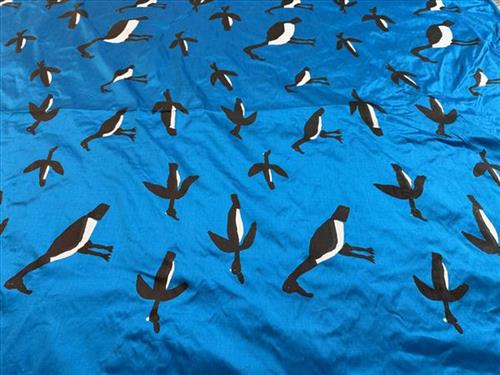
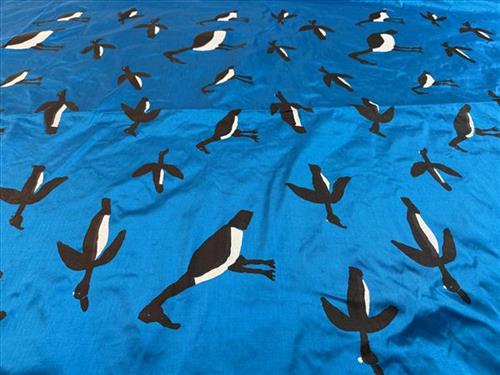
Murnubbarr Karrolkan (Flying Magpie Geese)

Murnubbarr (magpie geese) are a waterbird found in abundance in the wetland areas of Kakadu and western Arnhem Land. Murnubbarr are a sustainably hunted and enjoyed manme (bush food). They are known to fly long distances, particularly in the wet season.

115682414212


Mindirr (Pandanus Bag)

Miṉḏirr (dilly bags) are made from gunga (Pandanus spiralis), baḻgurr (kurrajong) and natural bush dyes. The body of the miṉḏirr is made from gunga, and the handles from baḻgurr. Once the gunga fronds and baḻgurr bark have been collected, they are stripped and prepared then boiled with the dyes.

Miṉḏirr were used traditionally for every day utilitarian purposes, particularly collecting bush foods such as bäḻtji (yam). Traditionally, the baḻgurr handles were worn across the forehead while the body of the miṉḏirr sat at the back, between the shoulder blades making it easily accessible when collecting ŋatha (food).

115682414211


Mindirr (Pandanus Bag)

Miṉḏirr (dilly bags) are made from gunga (Pandanus spiralis), baḻgurr (kurrajong) and natural bush dyes. The body of the miṉḏirr is made from gunga, and the handles from baḻgurr. Once the gunga fronds and baḻgurr bark have been collected, they are stripped and prepared then boiled with the dyes.

Miṉḏirr were used traditionally for every day utilitarian purposes, particularly collecting bush foods such as bäḻtji (yam). Traditionally, the baḻgurr handles were worn across the forehead while the body of the miṉḏirr sat at the back, between the shoulder blades making it easily accessible when collecting ŋatha (food).