220982394011


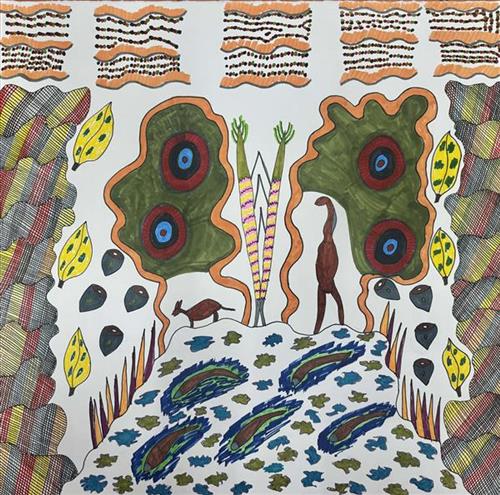
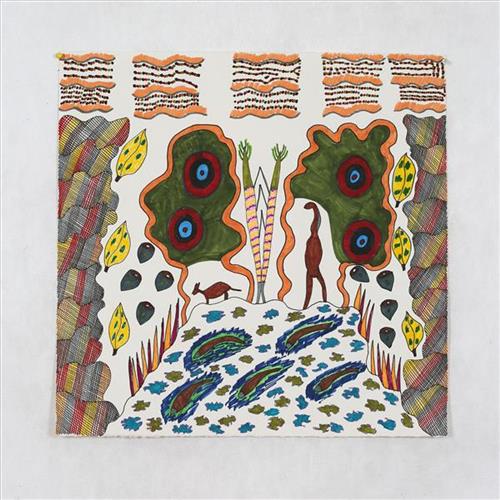
Susan Ngwarraye Philomac – Spring Creek

Kwetyaylp (donkeys) and nantew (horses) would come and drink from the water at Spring Creek on my father’s country.  We would put a bucket in the sand we would filter the water so we could drink it. 

When I was young girl we would go to Canteen Creek following the track along the hills, we would hunt turkey, emus and kangaroo and we would cut the bark and collect the sap from the sugar bag trees. `

220982394161


View Of Country

This shows the layered landscape of Alyawarr, Central Australia. Knowing your country is an important part of living in a remote community like Ampilatwatja.

Knowing when and where to go hunting and gathering, knowing where there is ‘soakage’ (where you can dig for water), travelling with family for ceremonies, and maintaining a connection with the land.

“This is my country, my view of country.”

The community of Ampilatwatja made a conscious decision not to paint altyerr (dreaming stories). The artists paint their country where those stories sit.


220982396022


Rosie Kemarre Morton – My Father’s Country and Bush Medicine

Rosie has painted her Father’s country, where she can always find bush tucker and bush medicine. She is very happy when out bush hunting and gathering, as it brings back memories of her childhood when she used to live traditionally off of the land with her family.


Rosie uses these hunting trips as her inspiration for her artworks, each one reflecting the layered landscape and various colours as she has seen them. They are always changing, with the light of day and the seasons of the year.


Rosie enjoys and understands the importance of painting bush medicine plants. They help in the healing of her people and it keeps the tradition and knowledge strong. These particular plants are very plentiful after rain and can be used for numerous conditions, such as skin irritations, flu, coughs and infections.


Rosie’s dreaming is the Araluta or kangaroo plant. This bush is a rich source of food for the kangaroos and keeps them fat and healthy and good for hunting.

The community of Ampilatwatja made a conscious decision not to paint altyerr (dreaming stories). The artists paint their country where those stories sit.

116482397122


Wild Tomato Plant

The Wild Tomato is one of the bush foods. It is eaten when its colour changes from green to yellow. It is also a common prickly bush.

377810582397474


Djarnbokkorn and kulabbarl (sacred dog and billabong) – Work 4

Work 4 of 9 drawings in series Ngaldjorlhbo (Mother of Everything)

Artist short statement:

(And the old lady Ngaldjorlhbo says:) ‘then I made this’

She was carrying her own dillybag and was walking slowly and she kept looking at Country. She made the rocks, the rivers. In the same way she made the fish and she also made the animals and the butterflies. She kept on creating all this while walking.

She made the water spirit mermaids from the sea so she kept on walking while creating all the things. She also made the mimih spirits – the spirit of the rocks. She also created Djarnbokkorn, the  sacred dog. And then she created Ngalng, the yabby. Then she made the Namorrorddo – the shooting star spirit, who lives inside the hill. Then she made the freshwater mermaids and she kept on going and she made Ngalyod (rainbow serpent). Then she named those two humans, Kodjok and Kamanj. So she made all the humans and those two put themselves there.That is the right order, it is the order in which the old woman spirit created everything.

BKRLCC_ translations, transcriptions and spell check by Claudia Cialone and Jill Nganjmirra,Bàbbarra_narrating voice – Janet Marawarr, recorded by Jessica Rosalie Stalenberg.

377810582397473


Ngaldjorlhbo (Mother of Everything)

Ngaldjorlhbo is a powerful woman who created the spiritual and tangible world for the Aboriginal people in Western Arnhem Land. In creating the land and environment, she endowed Kuninjku people with the ability to create art, and with their culture, to share with future generations. Ngaldjorlhbo gives women the cultural knowledge and deep links to country, identity and ancestor spirits. 

Ngaldjorlhbo created daluk (women) When she started walking she started talking and telling stories. She create, came together as one. She was walking, thinking and writing with her hand creating all the animals and trees.  Creating mountains and rivers. Came together and made a beautiful flowing wind and river to the coming of the land. From fresh water to the salt water river, all the fish, all kinds of fish she created .From little bird, big bird she created. She came all the way from east, west, north and south. She knows all the places from this land. She was speaking, she was telling, she was creating the country, this world. She was carrying kunmadj and digging stick and she created yawkyawk. So that’s the story about Ngaldjorlhbo.’ JM 2022

(And the old lady Ngaldjorlhbo says:) ‘then I made this’

She was carrying her own dillybag and was walking slowly and she kept looking at Country. She made the rocks, the rivers. In the same way she made the fish and she also made the animals and the butterflies. She kept on creating all this while walking.

She made the water spirit mermaids from the sea so she kept on walking while creating all the things. She also made the mimih spirits – the spirit of the rocks. She also created Djarnbokkorn, the  sacred dog. And then she created Ngalng, the yabby. Then she made the Namorrorddo – the shooting star spirit, who lives inside the hill. Then she made the freshwater mermaids and she kept on going and she made Ngalyod (rainbow serpent). Then she named those two humans, Kodjok and Kamanj. So she made all the humans. JM 2026


220982401620


Susan Ngwarraye Philomac – Spring Creek

Kwetyaylp (donkeys) and nantew (horses) would come and drink from the water at Spring Creek on my father’s country.  We would put a bucket in the sand we would filter the water so we could drink it. 

When I was young girl we would go to Canteen Creek following the track along the hills, we would hunt turkey, emus and kangaroo and we would cut the bark and collect the sap from the sugar bag trees. `

111982405386


Warraburnburn

In Burarra and Gun-nartpa languages the figure represented in this artwork is generally known as a wangarra ‘ghost spirit’. For the Warrawarra clan ghost spirits have their own particular characteristics and their own name – Warraburnburn.

The Warraburnburn and the closely related Galabarrbarr spirit (owned by the Balkarranga clan) are also manikay song topics.  The spirits are related to each other as maternal grandparent and grandchild, just as the people of Warrawarra and Balkarranga are. The dancing of the two ghost spirit figures forms the finale performance for funerals, and is the final goodbye to a deceased family member.

In many ways the Warraburnburn and Galabarrbarr ghost spirits are like people. They emerge from the patches of jungle on Warrawarra and Balkarranga country in the late afternoon and go hunting in family groups of men, women and children. They stay in contact with each other by calling out as the men hunt for fish and the women walk with their dillybags looking for vegetable food. 

The ghost spirits are associated closely with white ochre and artists commonly paint the bodies of carved figures in white. Different types of ghost spirit wear different patterns. Warraburnburn is decorated with uniform white dots while others are painted white all over. Some ghost spirits are shown with a design painted on their chest infilled with rarrk ‘cross-hatching’, the same designs that are painted onto japi an-guyinda ‘male initiations’. 

They also have supernatural characteristics including superhuman size (jarra anbaykarda ‘super tall’). They know the country intimately – some are malevolent towards humans and will lead people astray, taking them to unfamiliar and dangerous places. These malevolent spirits are likened to an-muburda ‘sorcerers’ and can conduct dangerous rituals that cause harm to people. Others are benign and will lead humans back to familiar paths and their own camps.


111982405372


Djomi

Djomi is a freshwater spring surrounded by jungle at the mouth of the Liverpool River. It is a major sacred site with extensive mythological significance for the Kunibidji people. Mermaids live in the freshwater spring. They are associated with djabayena, the sawfish, and sometimes are depicted as the sawfish itself or as a woman with the sawfish’s tail. 

The Djomi site is linked to dreaming paths with extend east along the coast as far as Milingimbi and Ramingining. Mermaid sites are found in both saltwater and freshwater country, and freshwater and saltwater clans who own separate mermaid sites are linked in myth by stories of a mermaid spirit swimming up from the sea to the freshwater. The Kunibidji have close kinship and ceremonial ties with the Eastern Kunwinjku who own Mermaid Dreaming sites in the freshwater country upstream from Djomi. 

Small streams from the Djomi site carry fresh water into the mouth of the Liverpool River. In many paintings of Djomi these streams are shown and it is believed that all watercourses in the Maningrida district are controlled by the power of the Djomi sacred site. Djomi is seem as a metaphor for the cultural network of the Maningrida area, and so gives its name to the Maningrida Museum, the community’s cultural keeping place. 


Text courtesy of the Djomi Museum, Maningrida. 

111982405371


Djomi

Djomi is a freshwater spring surrounded by jungle at the mouth of the Liverpool River. It is a major sacred site with extensive mythological significance for the Kunibidji people. Mermaids live in the freshwater spring. They are associated with djabayena, the sawfish, and sometimes are depicted as the sawfish itself or as a woman with the sawfish’s tail. 

The Djomi site is linked to dreaming paths with extend east along the coast as far as Milingimbi and Ramingining. Mermaid sites are found in both saltwater and freshwater country, and freshwater and saltwater clans who own separate mermaid sites are linked in myth by stories of a mermaid spirit swimming up from the sea to the freshwater. The Kunibidji have close kinship and ceremonial ties with the Eastern Kunwinjku who own Mermaid Dreaming sites in the freshwater country upstream from Djomi. 

Small streams from the Djomi site carry fresh water into the mouth of the Liverpool River. In many paintings of Djomi these streams are shown and it is believed that all watercourses in the Maningrida district are controlled by the power of the Djomi sacred site. Djomi is seem as a metaphor for the cultural network of the Maningrida area, and so gives its name to the Maningrida Museum, the community’s cultural keeping place. 


Text courtesy of the Djomi Museum, Maningrida.